
UPSC Mapping
Important for
| Prelims | Space Technology and International Treaties |
|---|---|
| Mains | GS Paper III — Security and Science & Technology |
Key Treaty
| Outer Space Treaty | 1967 |
|---|---|
| Liability Convention | 1972 |
| Registration Convention | 1975 |
| India’s ASAT Test | Mission Shakti, 2019 |
What is Space Weaponisation?
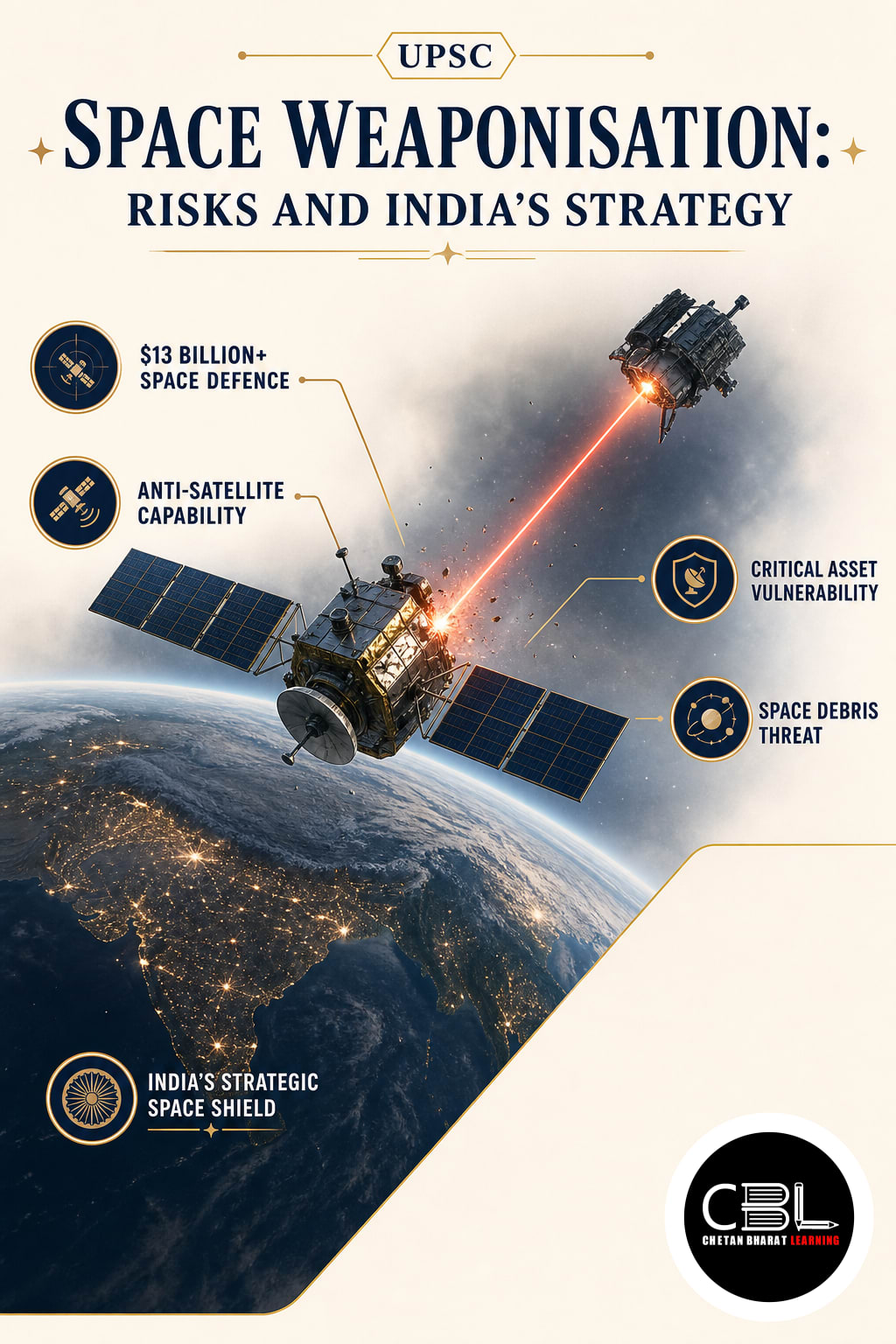
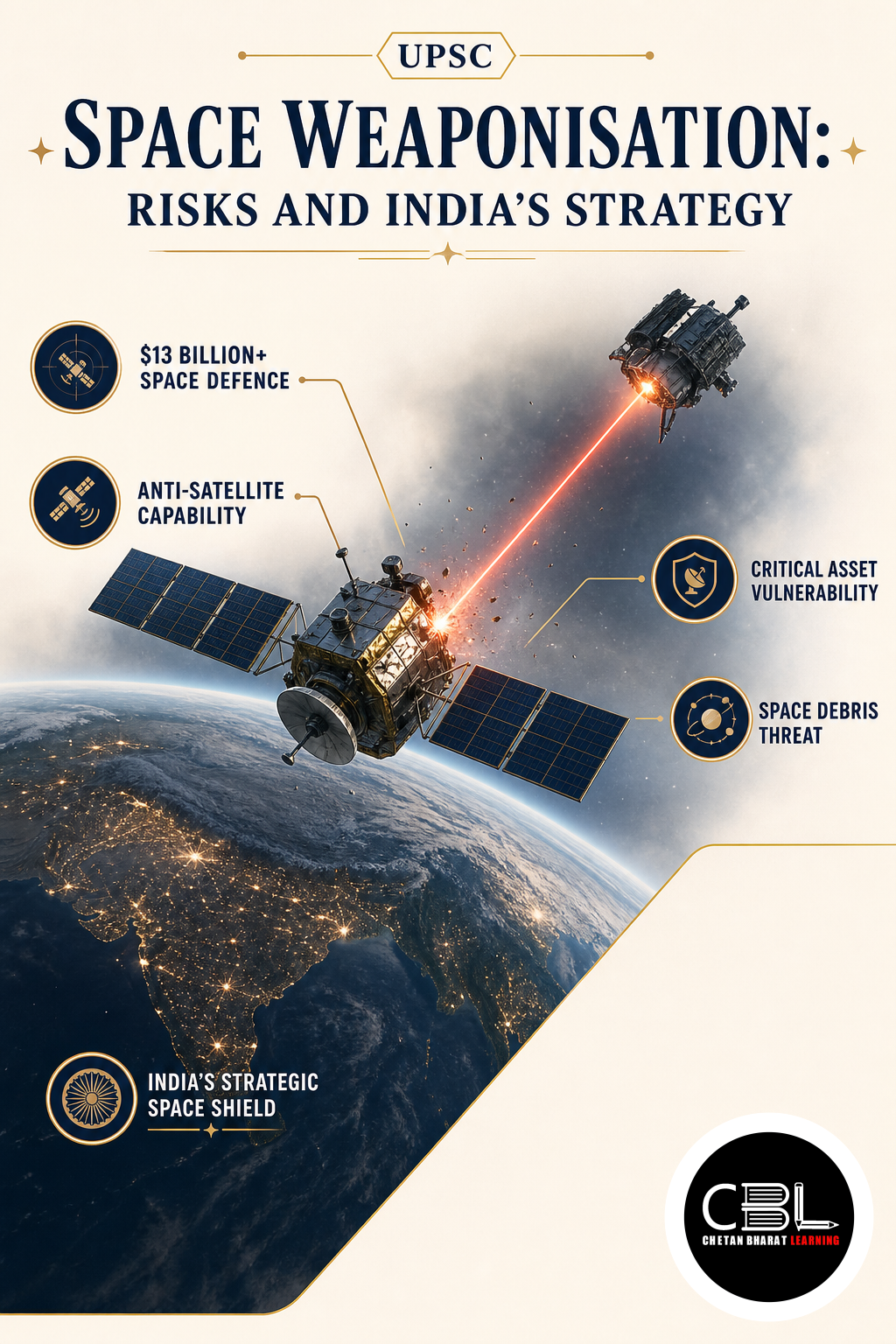
Space Weaponisation refers to developing, deploying or using systems capable of damaging assets in outer space or attacking terrestrial targets from space. Such systems include anti-satellite weapons, co-orbital interceptors, directed-energy systems and electronic or cyber capabilities. Some weapons operate from Earth, while others may approach or interfere with objects already in orbit.
The concept differs from the militarisation of space. Militarisation includes using satellites for communication, navigation, surveillance and early warning without necessarily placing offensive weapons in orbit. The distinction remains difficult because many technologies are dual-use and can perform both peaceful and military functions.
Why is Space Weaponisation in News?
Space Weaponisation has gained attention as major powers expand military space commands, satellite constellations and counterspace capabilities. Recent debates have focused on systems capable of jamming communications, disrupting navigation, dazzling sensors or physically attacking satellites. The United Nations disarmament framework continues to examine measures for preventing an arms race in outer space.
Satellites now support military operations as well as civilian critical infrastructure. This dependence makes orbital assets strategically valuable and potentially vulnerable during crises. Destructive testing also generates orbital debris, which can threaten satellites, crewed missions and scientific programmes belonging to countries uninvolved in the original confrontation.
Key Features
- Direct-ascent weapons: Ground-launched missiles can intercept satellites in orbit, but destructive impacts may create numerous fragments travelling at extremely high speeds.
- Co-orbital systems: Spacecraft can manoeuvre close to another satellite for inspection, servicing or interference, making hostile intent difficult to establish beforehand.
- Non-kinetic attacks: Jamming, spoofing, cyber intrusions and directed energy can disrupt satellite services without producing visible physical destruction or permanent debris.
- Dual-use technology: Robotic arms, rendezvous systems and orbital-servicing spacecraft can repair satellites but may also manipulate or disable another state’s asset.
- Integrated warfare: Military forces increasingly combine space-based intelligence, navigation and communication with operations across land, sea, air and cyberspace.
Challenges
- Gaps in international law: The Outer Space Treaty prohibits nuclear weapons and other weapons of mass destruction in orbit but does not comprehensively prohibit conventional space weapons.
- Attribution problems: Governments may struggle to determine whether a satellite malfunction resulted from technical failure, cyber intrusion, electronic interference or deliberate hostile action.
- Orbital debris: Destructive anti-satellite operations can produce long-lasting fragments that endanger spacecraft and potentially make valuable orbital regions harder to use.
- Arms-race dynamics: Defensive preparations by one state may appear offensive to another, encouraging competitive deployments and reducing opportunities for mutual restraint.
- Civilian vulnerability: Disruption of navigation, communications or weather satellites can affect aviation, banking, agriculture and disaster response.
Way Forward
India should address Space Weaponisation through credible deterrence, resilient satellite architecture and sustained diplomacy. Distributed constellations, protected communication, backup navigation, rapid satellite replacement and improved space situational awareness can reduce vulnerability. India must also strengthen coordination among civilian agencies, defence institutions, private operators and research organisations.
Internationally, states need transparency measures, advance notifications, crisis-communication channels and responsible rules for close orbital approaches. Negotiations should prioritise restrictions on debris-producing tests and interference with essential civilian services. India can use forums supported by the UN Committee on the Peaceful Uses of Outer Space to promote peaceful and sustainable access while protecting legitimate national-security interests.
Prelims Practice Corner
Q1. Which treaty prohibits placing nuclear weapons or other weapons of mass destruction in Earth’s orbit?
- (a) Moon Agreement
- (b) Outer Space Treaty
- (c) Liability Convention
- (d) Registration Convention
Answer: Article IV of the Outer Space Treaty restricts weapons of mass destruction in orbit.
Q2. What was the primary objective of India’s Mission Shakti?
- (a) Testing an anti-satellite capability
- (b) Landing a rover on Mars
- (c) Establishing a permanent space station
- (d) Launching a regional navigation system
Answer: Mission Shakti demonstrated India’s direct-ascent anti-satellite capability in 2019.
Q3. Which of the following is a non-kinetic counterspace capability?
- (a) Missile interception
- (b) Satellite jamming
- (c) Physical collision
- (d) Orbital bombardment
Answer: Jamming interferes with satellite signals without requiring a physical impact.
Q4. Consider the following statements:
1. The Outer Space Treaty completely prohibits every conventional weapon in Earth’s orbit.
2. The treaty prohibits national appropriation of outer space and celestial bodies.
3. States bear international responsibility for national space activities.
Which statements are correct?
- (a) 1 and 2 only
- (b) 2 and 3 only
- (c) 1 and 3 only
- (d) 1, 2 and 3
Answer: The treaty does not impose a comprehensive prohibition on all conventional weapons in orbit; it prohibits WMDs and national appropriation, and states bear responsibility.
Q5. Why are destructive anti-satellite tests considered hazardous?
- (a) They permanently stop solar radiation
- (b) They alter Earth’s gravitational field
- (c) They can create high-speed orbital debris
- (d) They prevent every future rocket launch
Answer: Collision fragments can remain in orbit and threaten other spacecraft.
Mains Practice Questions
Q1. Distinguish between the militarisation and weaponisation of outer space. Examine their implications for India’s national security. (15 marks)
Answer Structure
Intro: Define both concepts and explain the growing dependence on orbital infrastructure.
Body: Cover military support functions, counterspace systems, civilian dependence, debris, deterrence, attribution and India’s Mission Shakti experience.
Conclusion: Recommend resilient capabilities combined with rules-based international engagement.
Q2. Existing international space law remains inadequate for contemporary security challenges. Critically examine and suggest reforms. (15 marks)
Answer Structure
Intro: Introduce the Outer Space Treaty as the foundation of international space law.
Body: Discuss legal gaps involving conventional weapons, dual-use systems, verification, attribution and debris-producing activities.
Conclusion: Propose transparency, notification, verification and restrictions on harmful conduct.
FAQs on Space Weaponisation
Does Space Weaponisation mean every military use of satellites?
No. Military satellites may provide navigation, communication or early warning without functioning as offensive weapons. Weaponisation involves capabilities intended to damage targets or interfere with their operation.
What was Mission Shakti?
Mission Shakti was India’s anti-satellite test conducted in March 2019. It demonstrated the ability to intercept an Indian satellite in low Earth orbit.
Why is orbital debris a security concern?
Debris travels at high velocity and can damage operational satellites or crewed spacecraft. A collision can generate further fragments and increase risks across heavily used orbital regions.
Related Current Affairs
Preparing for UPSC, PCS or HCS?
Talk to a mentor at Chetan Bharat Learning, Chandigarh. Free guidance on choosing the right exam and building a study plan.
Chat on WhatsAppCall 97793 53345UPSC / IAS / PCS coaching in Chandigarh · Trusted by aspirants across Punjab & Haryana
Leave a Reply
You must be logged in to post a comment.