
Voyager 1 light-day milestone marks a calculated first for a spacecraft travelling from Earth. For related topics, explore CBL’s science and technology coverage.
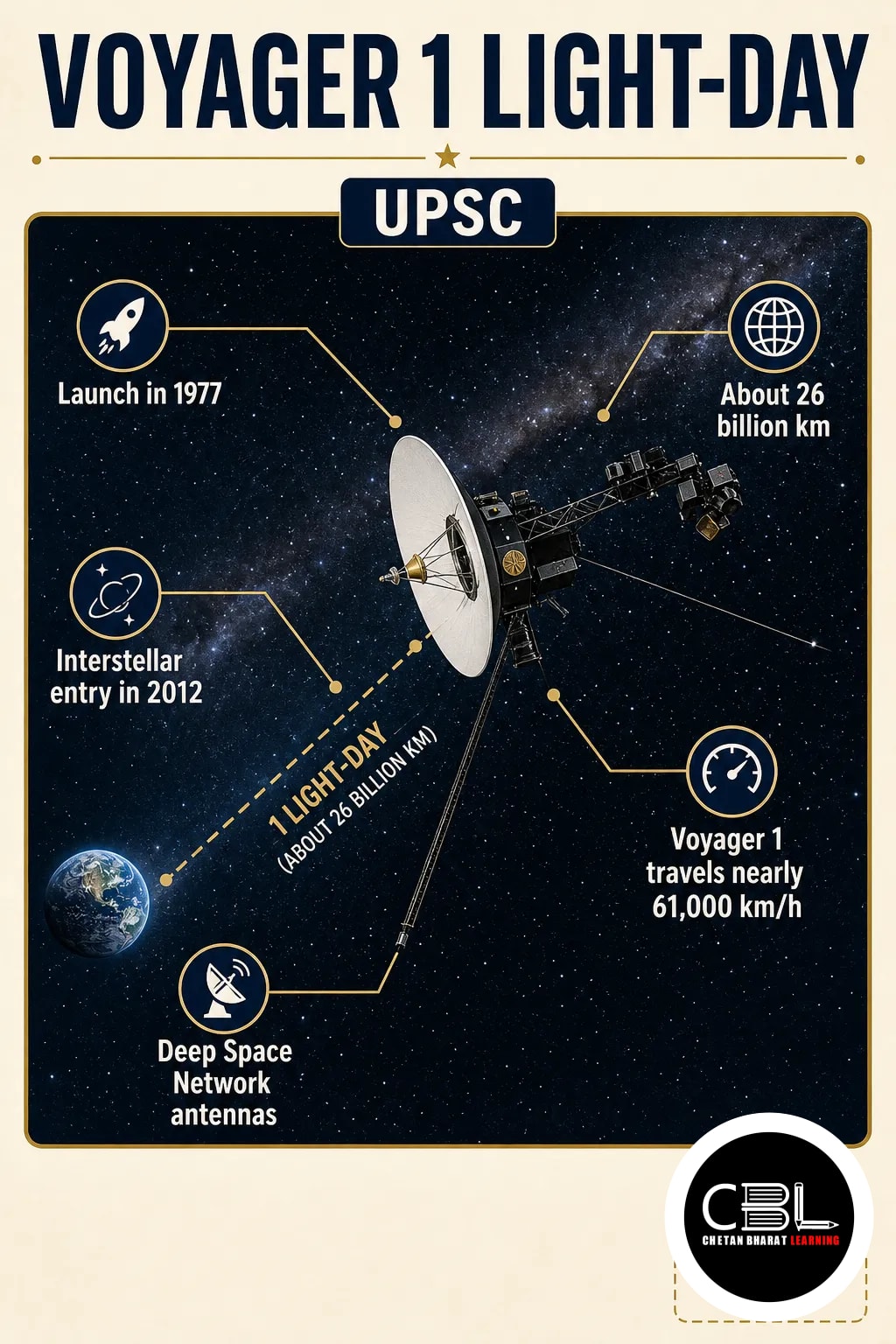
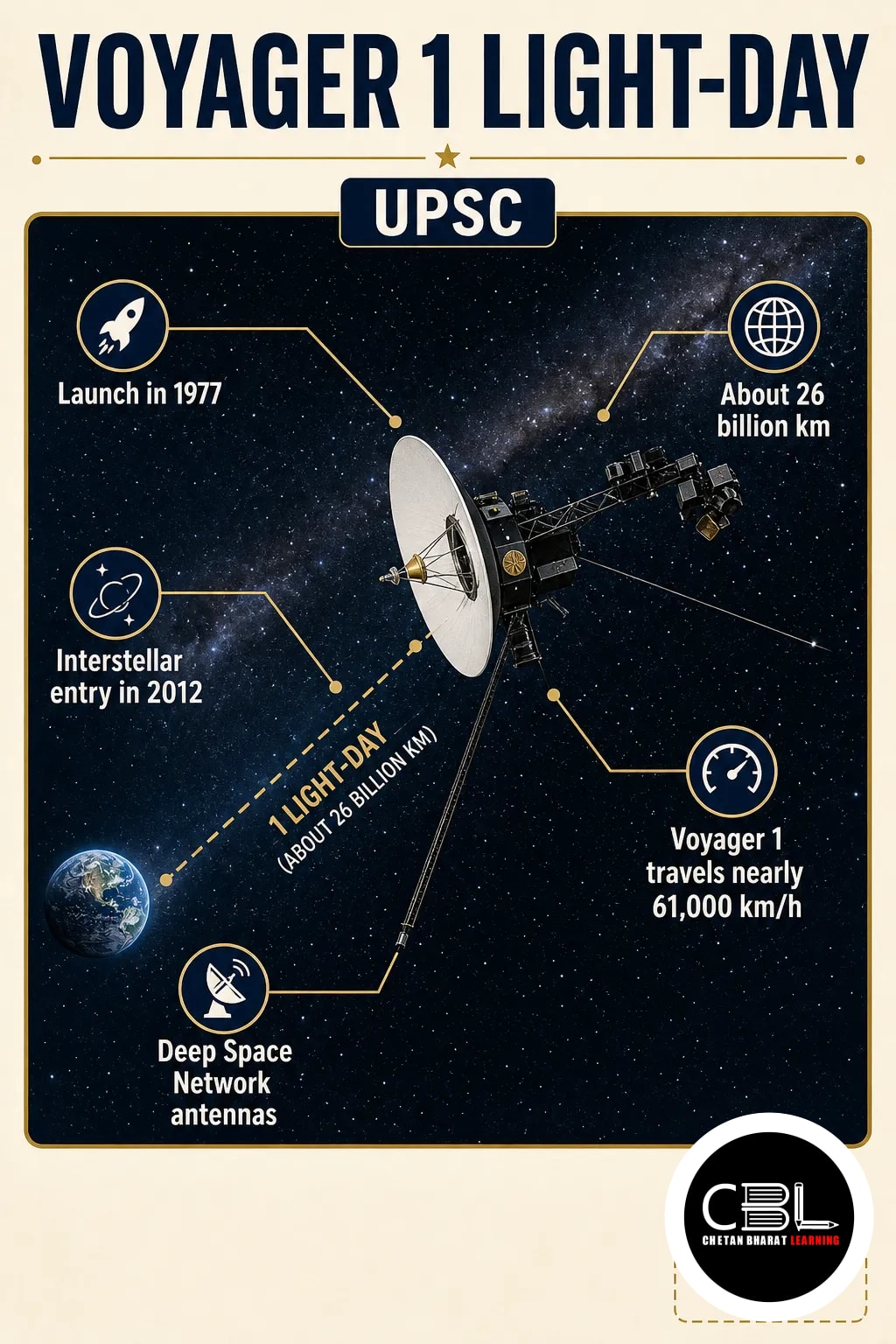
Quick answer: The National Aeronautics and Space Administration (NASA) calculated that Voyager 1 reached one light-day from Earth on 18 November 2026. That distance is about 26 billion km. However, confirmation depended on a signal taking roughly a day to reach Earth from the spacecraft, which entered interstellar space in 2012.
What does the Voyager 1 light-day milestone mean?
It means the probe was calculated to be as far from Earth as light travels in 24 hours. A light-day measures distance, not time; it equals approximately 26 billion km.
NASA calculated the crossing at 10:16 GMT on 18 November 2026. However, the Jet Propulsion Laboratory in California needed to wait about a day for a confirming signal. The milestone therefore remained a calculation rather than a confirmed observation in the source report.
At this distance, a signal travelling one way takes roughly 24 hours. Consequently, an exchange involving a command and a response takes approximately two days, excluding processing time.
Voyager mission: key facts
Voyager 1 is NASA’s most distant human-made object and continues to collect scientific data.
| Fact | Detail |
|---|---|
| Launch | Voyager 1 and its twin, Voyager 2, launched in 1977. |
| Planetary encounters | Voyager 1 travelled past Jupiter and Saturn. |
| Interstellar entry | Voyager 1 crossed the heliosphere’s outer edge in 2012; Voyager 2 followed in 2018. |
| Speed | Voyager 1 travels at nearly 61,000 km per hour. |
Power-saving measures could sustain communications with both probes for another three to four years, according to a laboratory representative. For background, see CBL’s coverage of Voyager mission power management.
What are the heliosphere and interstellar space?
The heliosphere is a bubble of particles and magnetic fields produced by the Sun. Its outer boundary is called the heliopause.
Voyager 1 crossed this boundary in 2012. However, solar effects do not stop abruptly there: the probe still observes shocks and pressure fronts associated with solar storms.
Its instruments measure magnetic fields, cosmic rays and plasma waves. In addition, they have detected vibrations in the sparse gas of interstellar space.
Why does the milestone matter?
The milestone highlights both the scale of deep-space travel and the difficulty of communicating across it.
NASA receives Voyager’s measurements through the Deep Space Network, an international array of large radio antennas. Moreover, the continuing data help scientists study how far the Sun’s influence extends beyond the heliopause.
Source: The Hindu Sci-Tech, 19 November 2026
Punjab PCS and Haryana HCS General Studies may test the Voyager missions alongside basic space-science concepts. Therefore, revise the light-day, heliopause and the roles of space probes.
Prelims Practice Corner
Mains Practice Questions
Frequently Asked Questions
How far is Voyager 1 at one light-day?
About 26 billion km from Earth. NASA calculated that it reached this distance on 18 November 2026, although confirmation required a signal from the probe.
When did Voyager 1 enter interstellar space?
In 2012. Voyager 2 followed in 2018, after crossing the outer edge of the heliosphere.
How does NASA receive data from Voyager 1?
Through the Deep Space Network’s radio antennas. At one light-day, a signal takes roughly 24 hours to travel one way.
Related Current Affairs
Preparing for UPSC, PCS or HCS?
Talk to a mentor at Chetan Bharat Learning, Chandigarh. Free guidance on choosing the right exam and building a study plan.
Chat on WhatsAppCall 97793 53345UPSC / IAS / PCS coaching in Chandigarh · Trusted by aspirants across Punjab & Haryana









Leave a Reply
You must be logged in to post a comment.