

UPSC Mapping
| Prelims | Mains |
|---|---|
| Governance & Polity | GS Paper 2 |
Quick Facts
| Item | Value |
|---|---|
| Bihar Allocation | 5.75 MAF |
| Jharkhand Allocation | 2.0 MAF |
| Dispute Duration | 25 Years |
| Resolution Method | Negotiated MoU |
Article
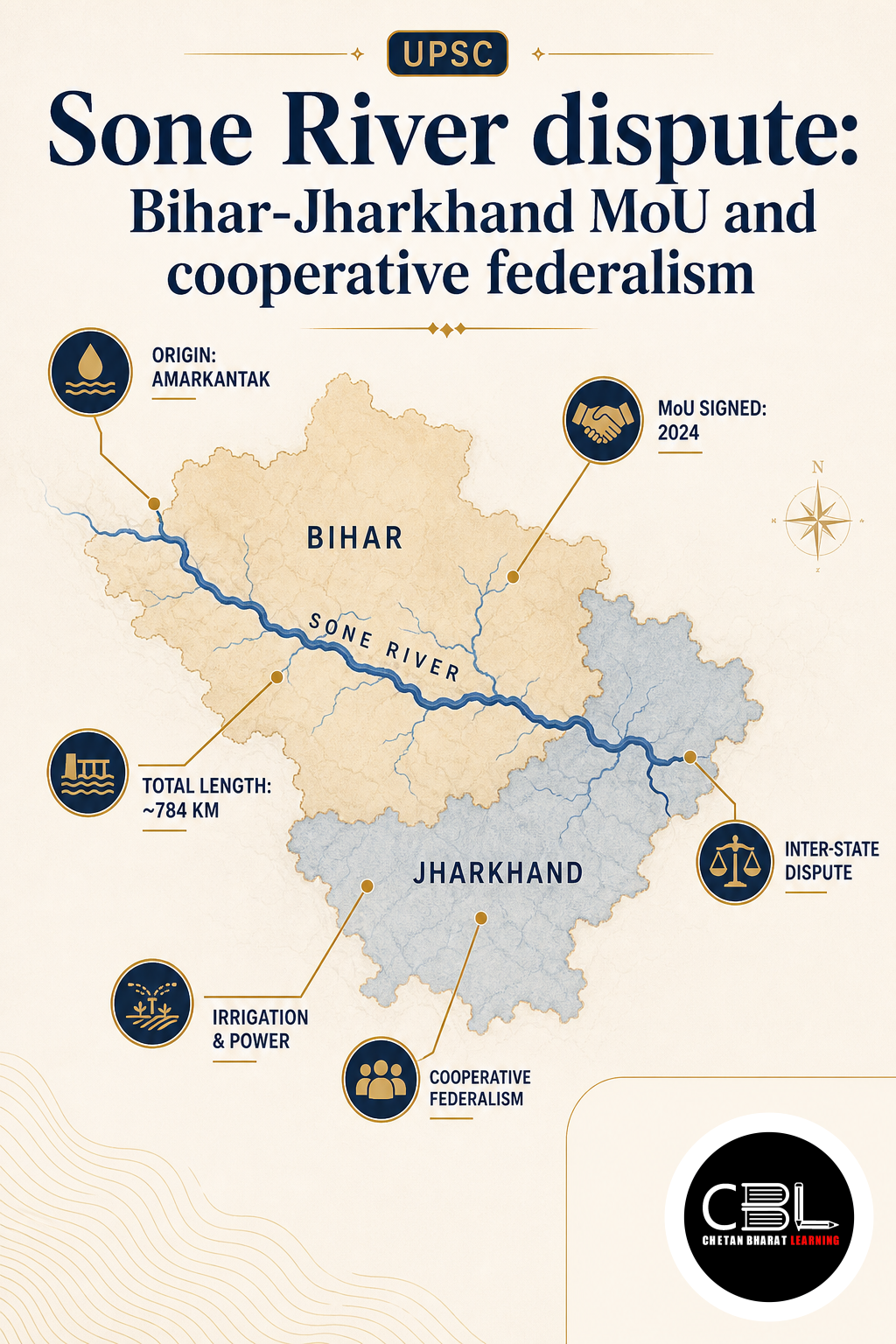
The 25-year Sone River dispute between Bihar and Jharkhand has been resolved through a negotiated memorandum of understanding (MoU), allocating 5.75 million acre-feet (MAF) of water to Bihar and 2.0 MAF to Jharkhand. This historic settlement stands in sharp contrast to the protracted litigation and political posturing that characterizes most inter-state water conflicts in India. Policymakers view this as a replicable model for cooperative federalism and basin-level governance. The administration actively promotes negotiated settlements over adversarial tribunal processes.
What is Sone River dispute?
The Sone River, a major tributary of the Ganga, flows through Madhya Pradesh, Jharkhand, and Bihar before joining the Ganga near Patna. For over two decades, Bihar and Jharkhand contested the equitable sharing of its waters, primarily for irrigation purposes. The dispute centred on the allocation of water from the Indrapuri Barrage and the regeneration of critical canal systems that had fallen into disrepair.
Unlike the litigious trajectory of the Cauvery or Krishna-Godavari disputes, the Sone River dispute was resolved through direct bilateral negotiation rather than a constitutionally mandated inter-state water tribunal under Article 262. The negotiated MoU represents a pragmatic approach where both states agreed to a fixed quantum allocation, prioritizing the revival of dormant irrigation infrastructure over prolonged legal battles.
Why is Sone River dispute in News?
The signing of the MoU marks the culmination of years of back-channel negotiations between the two neighbouring states. The agreement specifically aims to revive critical irrigation infrastructure in Bihar’s Shahabad and Magadh regions, which have suffered from chronic water scarcity and declining agricultural productivity.
The resolution also highlights the broader challenge of climate variability on river systems. Experts emphasize that static water-sharing agreements must evolve into dynamic, basin-level governance models that account for erratic monsoons, changing rainfall patterns, and growing urban demand. The Sone settlement offers a template for moving from litigation to cooperation in India’s federal water architecture.
Key Features
- Fixed Quantum Allocation: Bihar receives 5.75 MAF and Jharkhand receives 2.0 MAF, providing clear, legally binding entitlements for irrigation and drinking water purposes.
- Infrastructure Revival: The MoU prioritizes the restoration of defunct canal networks and the modernization of the Indrapuri Barrage to maximize water-use efficiency.
- Bilateral Negotiation: Unlike tribunal-imposed awards, the settlement was reached through direct state-to-state dialogue, reducing implementation friction and political resistance.
- Irrigation Focus: The primary objective is reviving agricultural productivity in drought-prone districts of Bihar’s Shahabad region and Jharkhand’s Palamu-Garhwa belt.
Challenges
- Climate Variability: A fixed allocation model does not account for drought years or deficient monsoons, potentially reigniting tensions during periods of acute water scarcity.
- Infrastructure Deficit: Decades of neglect have left the canal systems severely silted and dysfunctional, requiring massive capital investment before water can actually reach farmers’ fields.
- Upstream-Downstream Tensions: Madhya Pradesh, the uppermost riparian state, was not a primary party to this bilateral MoU, raising questions about basin-wide comprehensive planning.
- Enforcement Mechanism: Unlike tribunal awards backed by constitutional authority, MoUs rely on political goodwill and may lack robust enforcement during electoral cycles or regime changes.
- Groundwater Depletion: Over-extraction of groundwater in both states has lowered water tables dramatically, reducing the effective benefit of surface water allocations.
Way Forward
The administration must evolve the static allocation model into a comprehensive distress-sharing formula that defines scarcity thresholds and burden-sharing mechanisms in advance. Establishing real-time data sharing on rainfall, reservoir levels, and river flows will build trust and prevent future disputes. Mandating basin-level planning that integrates science, institutions, and inter-state cooperation is essential for long-term sustainability.
India must move from claiming water to collectively managing shared river basins, and from dividing water in normal years to sharing scarcity fairly during distress years. This unified approach, anchored in cooperative federalism, will significantly accelerate the national transition toward climate-resilient water governance.
Prelims Practice Corner
Q1. How much water has been allocated to Bihar under the Sone River MoU?
(a) 2.0 MAF (b) 3.5 MAF (c) 5.75 MAF (d) 7.75 MAF
Answer: (c) Bihar has been allocated 5.75 million acre-feet of water under the negotiated settlement.
Q2. Which constitutional article empowers Parliament to provide for the adjudication of inter-state river water disputes?
(a) Article 131 (b) Article 262 (c) Article 280 (d) Article 356
Answer: (b) Article 262 empowers Parliament to legislate on inter-state river water disputes and bar court jurisdiction.
Q3. The Sone River is a major tributary of which river system?
(a) Brahmaputra (b) Yamuna (c) Ganga (d) Godavari
Answer: (c) The Sone River joins the Ganga near Patna, Bihar.
Q4. What distinguishes the Sone dispute resolution from the Cauvery or Krishna-Godavari disputes?
(a) It was decided by the Supreme Court (b) It was resolved through bilateral negotiation rather than a tribunal (c) It was arbitrated by the World Bank (d) It remains unresolved
Answer: (b) The Sone dispute was settled through a negotiated MoU between Bihar and Jharkhand, not through a water tribunal.
Q5. Which barrage is central to the Sone River water allocation between Bihar and Jharkhand?
(a) Farakka Barrage (b) Indrapuri Barrage (c) Tehri Dam (d) Bansagar Dam
Answer: (b) The Indrapuri Barrage on the Sone River is the key infrastructure for water diversion and allocation.
Mains Practice Questions
Q1. Discuss the significance of the Bihar-Jharkhand Sone River MoU as a model for resolving inter-state water disputes through cooperative federalism. (10 marks)
Intro: Introduce the 25-year Sone River dispute and its resolution through a negotiated MoU allocating 5.75 MAF to Bihar and 2.0 MAF to Jharkhand.
Body: Contrast this bilateral approach with the adversarial tribunal model used in Cauvery and Krishna disputes. Highlight the benefits of negotiated settlements: faster implementation, reduced political friction, and greater flexibility for future modifications.
Conclusion: Conclude that cooperative federalism and basin-level thinking offer a more sustainable path than litigation-centric water governance.
Q2. “India must move from claiming water rights to collectively managing shared river basins through science, institutions, and cooperation.” Analyze this statement with reference to the challenges of climate variability and inter-state water governance. (15 marks)
Intro: Highlight the structural limitations of India’s inter-state water dispute mechanism under Article 262 and the need for a paradigm shift.
Body: Analyze the five pillars of river-basin governance: distress-sharing formulas, real-time data sharing, basin-level planning, climate-resilient governance, and demand-side reforms. Discuss the vulnerability of fixed allocations to erratic monsoons and the necessity of upstream-downstream cooperation.
Conclusion: Suggest that the Sone MoU, while a positive step, must evolve into a dynamic, climate-adaptive framework incorporating all riparian states including Madhya Pradesh for true basin-level management.
FAQs on Sone River dispute
Why is the Sone dispute resolution considered unique in India’s water governance history?
Most inter-state water disputes in India, such as the Cauvery and Krishna-Godavari, are resolved through constitutionally mandated tribunals or Supreme Court litigation. The Sone dispute was settled through direct bilateral negotiation and an MoU, demonstrating that cooperative federalism can deliver faster, more implementable outcomes than adversarial legal processes.
What are the limitations of a fixed quantum water allocation?
A fixed allocation does not account for hydrological variability. During drought years or deficient monsoons, the total available water may fall short of the combined allocations, potentially reigniting tensions. Experts recommend incorporating a pre-agreed distress-sharing formula that automatically triggers proportional cuts during scarcity years.
Why was Madhya Pradesh not a primary party to this bilateral MoU?
The dispute primarily concerned the utilization of water downstream of the Indrapuri Barrage, which falls within the Bihar-Jharkhand stretch. However, comprehensive basin-level governance ideally requires the participation of all riparian states, including Madhya Pradesh as the uppermost state, to ensure holistic planning and prevent future upstream-downstream conflicts.
Related Current Affairs
Preparing for UPSC, PCS or HCS?
Talk to a mentor at Chetan Bharat Learning, Chandigarh. Free guidance on choosing the right exam and building a study plan.
Chat on WhatsAppCall 97793 53345UPSC / IAS / PCS coaching in Chandigarh · Trusted by aspirants across Punjab & Haryana
Leave a Reply
You must be logged in to post a comment.