
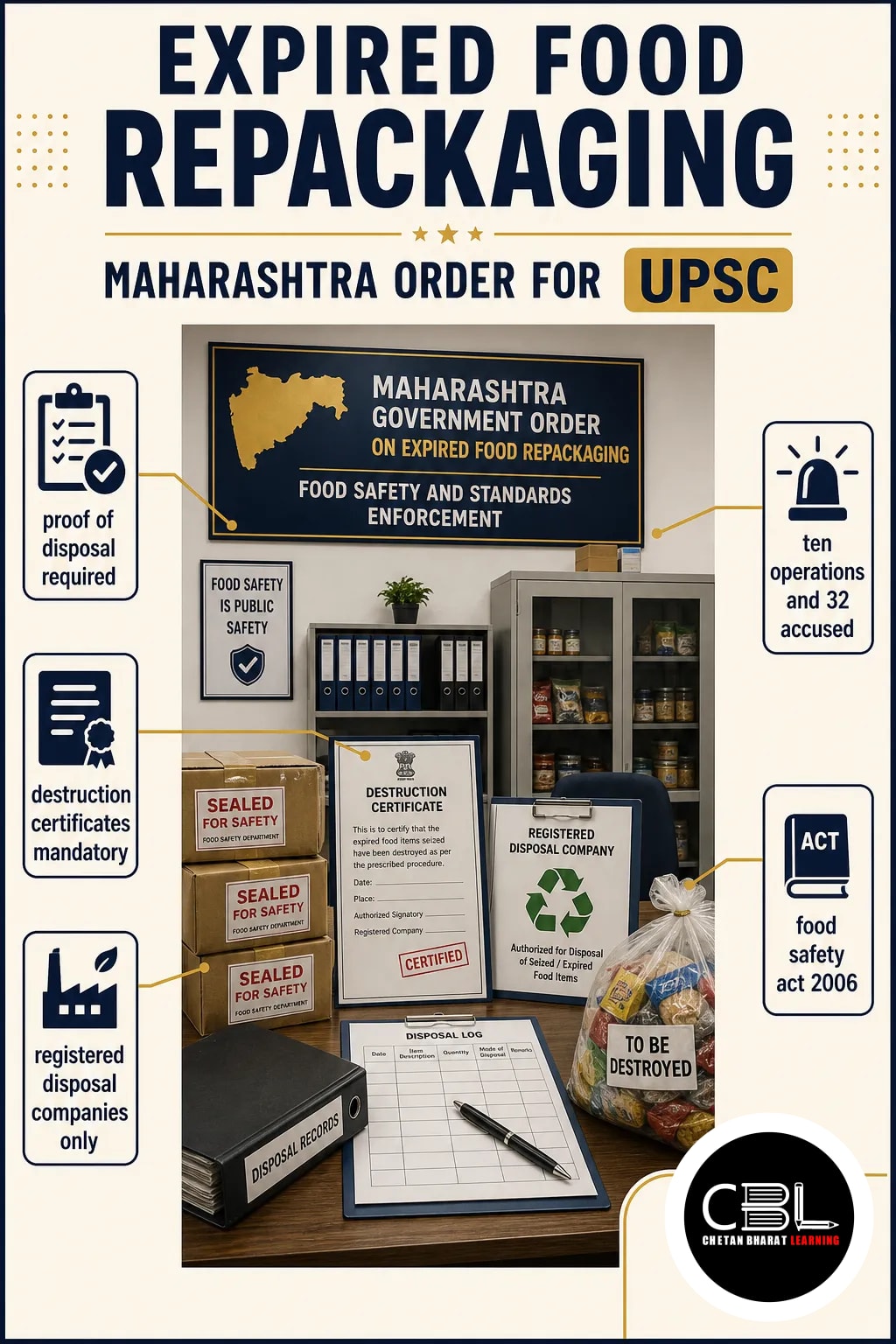

Expired food repackaging has prompted Maharashtra’s Food and Drug Administration (FDA) to tighten disposal requirements. The order connects state enforcement and public health with accountability across food supply chains.
Quick answer: Maharashtra’s FDA has ordered companies to provide proof of disposal for expired, spoiled or returned food. They must also obtain destruction certificates from disposal companies registered with the Maharashtra Pollution Control Board. Commissioner Tukaram Mundhe explained the move on 30 October 2026, citing expired food repackaging and manipulation of production dates.
What does the Maharashtra order require?
The order requires companies to substantiate the disposal of expired, spoiled or returned food. Businesses must also obtain a certificate of destruction from disposal companies registered with the Maharashtra Pollution Control Board.
The requirement addresses a gap between a disposal entry and actual destruction. According to Mundhe, some agents repack food recorded as destroyed and return it to sale. In some cases, they also manipulate production dates.
However, the source does not specify an implementation deadline or a detailed verification procedure. The certificate requirement should therefore not be confused with a complete description of the order’s implementation.
Why is expired food repackaging in the news?
The FDA announced the order alongside statewide enforcement against illegal food activities. At the 30 October briefing, Mundhe described both disposal concerns and recent seizures.
| Indicator | Reported detail |
|---|---|
| Statewide cases | Two cases registered; adulterated food worth ₹5 crore seized. |
| Gulzar Nagar, Bhiwandi | Stocks worth ₹80,000 and ₹26 lakh seized. |
| Other locations | Action also took place in Vadpe, Padgha and Ambarnath. |
| Overall operations | Ten operations; 32 people, including company owners, accused. |
| Compliance guidance | Twenty-two orders covering sectors including hotels, dairy, edible oils and school nutrition. |
The FDA also suspended licences of people involved in the illegal activities. The source reports the seizure values separately; it does not establish whether they overlap.
How does food safety regulation work in India?
The Food Safety and Standards Act, 2006 provides India’s principal statutory framework for food safety. It replaced the Prevention of Food Adulteration Act, 1954 and consolidated several earlier food laws.
The Food Safety and Standards Authority of India (FSSAI) sets standards and regulates food safety under the 2006 Act. State authorities also have enforcement responsibilities; Maharashtra’s FDA action illustrates the state-level role.
For exam purposes, distinguish the national statutory framework from this state administrative order. The source identifies the latter’s disposal requirements but does not cite a specific section of the Act as their basis.
Why does the disposal order matter?
The order targets a point where unsafe or returned stock can move back into the market. Its significance extends beyond a single seizure.
- Consumer protection: Reliable disposal can reduce opportunities to sell spoiled or expired goods as usable food.
- Information integrity: Manipulated production dates prevent consumers from judging products using accurate labels.
- Business accountability: Disposal proof connects a company’s records with action by a registered disposal provider.
- Regulatory coordination: The certificate requirement links food enforcement with the pollution control registration system.
Moreover, the inclusion of returned food recognises that stock may leave normal sales channels before reaching a disposal decision. Its return alone, however, does not establish that every item is unsafe.
What are the enforcement challenges?
The central challenge is to verify that records correspond to the food actually destroyed. A certificate improves documentation, but its value depends on checks across the disposal chain.
- Traceability: Inspectors need to connect quantities leaving businesses with quantities received for destruction.
- Document reliability: Paper compliance alone cannot prevent diversion if records or certificates are inaccurate.
- Inspection capacity: Multiple sectors and locations require enforcement resources and prioritisation.
- Compliance costs: Businesses must organise documented disposal; smaller operators may need clear guidance on the procedure.
- Evidence and fairness: Seizures and accusations require proper investigation; they do not by themselves establish guilt.
Furthermore, seizure values measure the stated value of goods, not the number of consumers harmed. The reported figures should not be treated as an estimate of the full scale of the problem.
What can strengthen implementation?
Effective implementation requires verifiable records, targeted inspections and clear guidance for businesses. The following measures are policy options, not additional requirements attributed to the announced order.
- Match records: Authorities could compare company disposal records with receipts and certificates from disposal providers.
- Use risk-based checks: Inspections could prioritise complaints, suspicious date changes and inconsistencies in returned stock.
- Coordinate agencies: Food and pollution control authorities could share registration and compliance information.
- Guide businesses: Clear instructions on documentation and available registered providers could support compliance.
- Enable consumer reporting: Accessible complaint channels could help officials identify suspicious labels and products for inspection.
Finally, regulators should evaluate compliance through verified disposal as well as enforcement action. This would make the record of destruction more useful than a paper declaration alone.
Source: The Hindu, 1 November 2026
Asked in UPSC: Previous Year Questions
- UPSC CSE Prelims 2018 (GS Paper I): Did the Food Safety and Standards Act, 2006 replace the 1954 Act, and is FSSAI under the Director General of Health Services?
UPSC links food safety legislation with institutional arrangements, so revise both the Act and the authority.
Punjab PCS and Haryana HCS General Studies may test the 2006 Act and the respective roles of national and state authorities. Moreover, the Maharashtra example illustrates how states can connect food inspections with documented disposal.
Prelims Practice Corner
Mains Practice Questions
Frequently Asked Questions
What does Maharashtra’s food disposal order require?
It requires disposal proof and a destruction certificate for the specified food items. The certificate must come from a disposal company registered with the Maharashtra Pollution Control Board.
Why did the FDA issue the order?
It acted because food recorded as destroyed was being repacked and sold. Moreover, the commissioner said production dates were manipulated in some cases.
How many operations and accused did the FDA report?
The FDA reported 10 operations and 32 accused persons. The accused included company owners; an accusation, however, is not a finding of guilt.
Which law provides India’s main food safety framework?
The Food Safety and Standards Act, 2006 provides the framework. It also replaced the Prevention of Food Adulteration Act, 1954.
Related Current Affairs
Preparing for UPSC, PCS or HCS?
Talk to a mentor at Chetan Bharat Learning, Chandigarh. Free guidance on choosing the right exam and building a study plan.
Chat on WhatsAppCall 97793 53345UPSC / IAS / PCS coaching in Chandigarh · Trusted by aspirants across Punjab & Haryana

 Ananya RanaIAS · AIR 60
 Aditya SharmaIAS · AIR 70
 Ria Kaur SethiIPS · AIR 89
 Aman AloonIRS · AIR 295
 Sumer Singh VirkIRS · AIR 335
 Shivani PanchalIAS

Leave a Reply
You must be logged in to post a comment.