
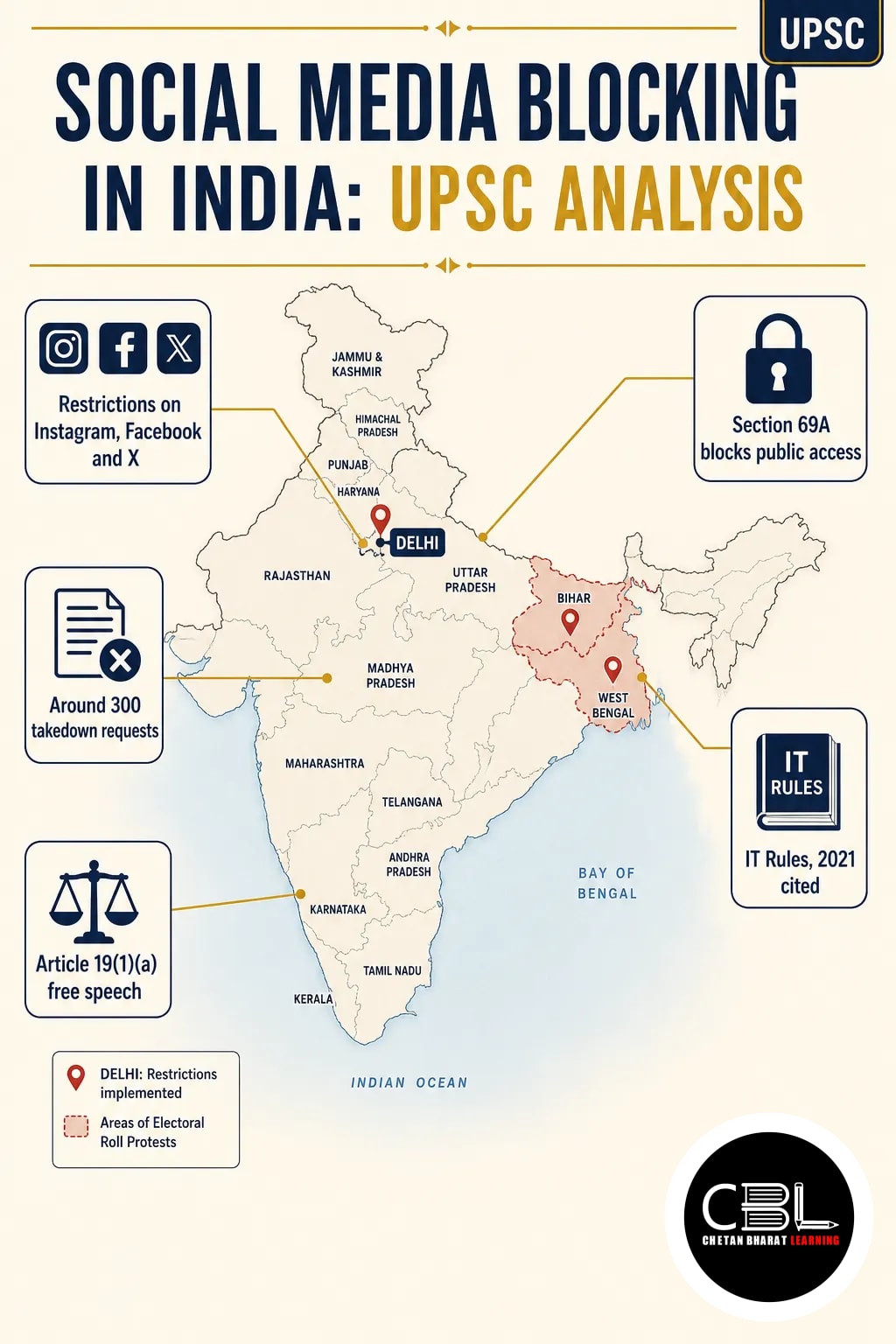
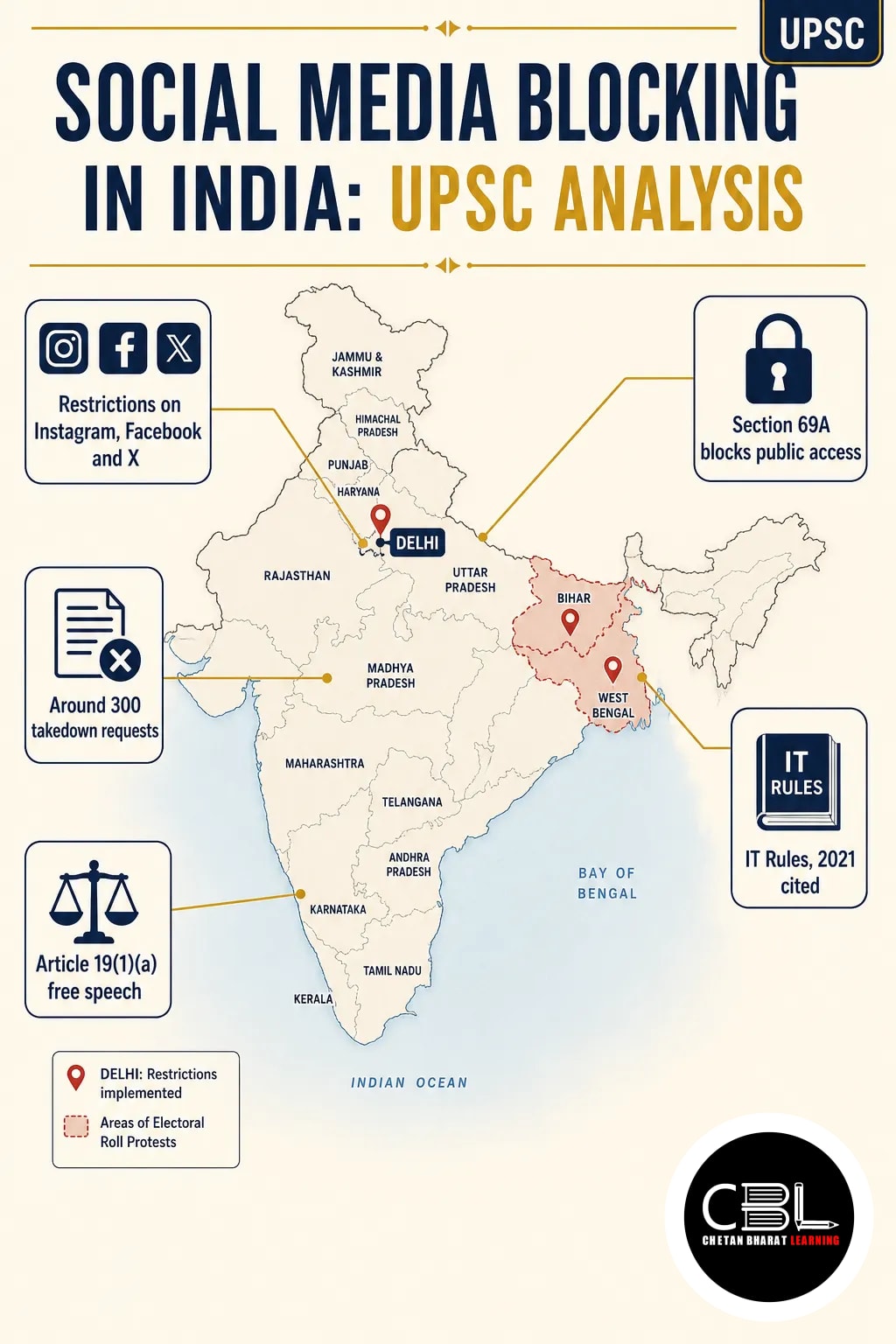
Social media blocking has drawn attention amid protests over electoral roll revision. The issue connects digital governance with constitutional rights and public accountability.
Quick answer: Social media blocking in India has come under scrutiny after users reported restrictions on Instagram, Facebook and X during protests over electoral roll revision. According to sources cited by The Hindu, Delhi Police issued around 300 takedown requests in three months, most of which platforms acted upon. The reasons for individual restrictions require separate examination.
Why is social media blocking in the news?
Users have reported restrictions on posts, reels and accounts across major platforms in recent weeks. These reports emerged during protests against the Special Intensive Revision (SIR) of electoral rolls and demands for Chief Election Commissioner Gyanesh Kumar’s resignation.
Some screenshots say a post is unavailable in India. Others refer to an automated system under the Information Technology (Intermediary Guidelines and Digital Media Ethics Code) Rules, 2021. However, a notice alone does not establish who initiated a particular restriction or why.
The Hindu also cites sources saying Delhi Police issued around 300 takedown requests over three months. Platforms acted on most, according to those sources; the report does not say that all requests concerned the protests. For the electoral context, read about voter roll revision and appeals.
How can online content be restricted?
Restrictions can follow government action or a platform’s own content policies. Therefore, an assessment must distinguish a legal direction from a platform moderation decision.
| Mechanism | What to examine |
|---|---|
| Government direction | The legal authority, stated grounds and scope of the direction. |
| Platform enforcement | The applicable platform rule, explanation and review option. |
| Automated action | The notice and whether a person can seek review of an error. |
The source notes mention an advisory by the Ministry of Electronics and Information Technology (MeitY) to Meta and shorter takedown deadlines under amended rules. However, the supplied text does not specify the advisory’s terms or the revised deadlines. It also does not establish which mechanism applied to each reported restriction.
A restriction may concern access within India, as some notices indicate, or the removal of content or an account. Consequently, its scope matters when assessing its impact. Related digital access questions arose in the coverage of BitChat repository restrictions.
Which constitutional and legal provisions matter?
Free expression is protected, but the Constitution also permits restrictions on specified grounds. The Information Technology (IT) Act provides a separate statutory framework for blocking and intermediary liability.
| Provision | Relevance |
|---|---|
| Article 19(1)(a) | Protects citizens’ freedom of speech and expression. |
| Article 19(2) | Permits reasonable restrictions by law on specified grounds, including public order. |
| IT Act, Section 69A | Provides for directions to block public access on specified grounds, subject to prescribed safeguards. |
| IT Act, Section 79 | Provides conditional protection to intermediaries for third-party information, subject to statutory requirements. |
| Articles 32 and 226 | Provide constitutional routes to approach the Supreme Court and High Courts, respectively. |
Article 19(2) does not authorise every restriction merely because an authority invokes public order. Rather, a restriction must have a legal basis and satisfy constitutional requirements. Equally, Section 79 protection is conditional; it is not an unrestricted exemption from liability.
What are the governance concerns?
The central concern is how to address unlawful content without unnecessarily suppressing legitimate expression. Several issues require attention:
- Accountability: Without a clear notice, users may not know whether a public authority or the platform initiated action.
- Political expression: Restrictions during protests can affect access to debate; however, their legality depends on the facts and grounds of each case.
- Speed and accuracy: Shorter deadlines may encourage prompt action, but they can also leave less time to assess context.
- Automated errors: An automated system may misread context; therefore, meaningful human review is important.
- Transparency: Aggregate request numbers alone do not explain the content, legal basis or outcomes of individual cases.
These concerns also intersect with the wider debate on privacy and press freedom, although that debate concerns a different legal framework.
What recourse and safeguards can help?
Users can first check the platform’s notice and available review process; constitutional remedies may also be relevant where public action is challenged. The appropriate route depends on the action and the facts.
For effective review, users need an understandable explanation, the scope of the restriction and an accessible way to contest errors. Moreover, authorities and platforms can improve accountability through aggregate disclosures that distinguish requests from actions taken.
Finally, a proportionate response should target the identified unlawful material rather than restrict more speech than necessary. Independent scrutiny and reasoned decisions can help reconcile enforcement with free expression.
Source: The Hindu, 1 November 2026
Punjab PCS and Haryana HCS General Studies can test free speech, public order and digital governance through this issue. In addition, revise the distinction between a police request and a legally authorised blocking direction.
Prelims Practice Corner
Mains Practice Questions
Frequently Asked Questions
Why are social media posts being restricted in India?
Restrictions can follow government action or platform policy enforcement. However, the available report does not establish the reason for every individual restriction.
Which IT Act provision concerns blocking public access?
Section 69A concerns directions to block public access to information. It operates on specified grounds and is subject to prescribed safeguards.
Can a user challenge a content restriction?
Yes, users can check the platform’s available review process and consider legal remedies where appropriate. However, the suitable route depends on who took the action and the facts of the case.
Related Current Affairs
Preparing for UPSC, PCS or HCS?
Talk to a mentor at Chetan Bharat Learning, Chandigarh. Free guidance on choosing the right exam and building a study plan.
Chat on WhatsAppCall 97793 53345UPSC / IAS / PCS coaching in Chandigarh · Trusted by aspirants across Punjab & Haryana

 Ananya RanaIAS · AIR 60
 Aditya SharmaIAS · AIR 70
 Ria Kaur SethiIPS · AIR 89
 Aman AloonIRS · AIR 295
 Sumer Singh VirkIRS · AIR 335
 Shivani PanchalIAS

Leave a Reply
You must be logged in to post a comment.