
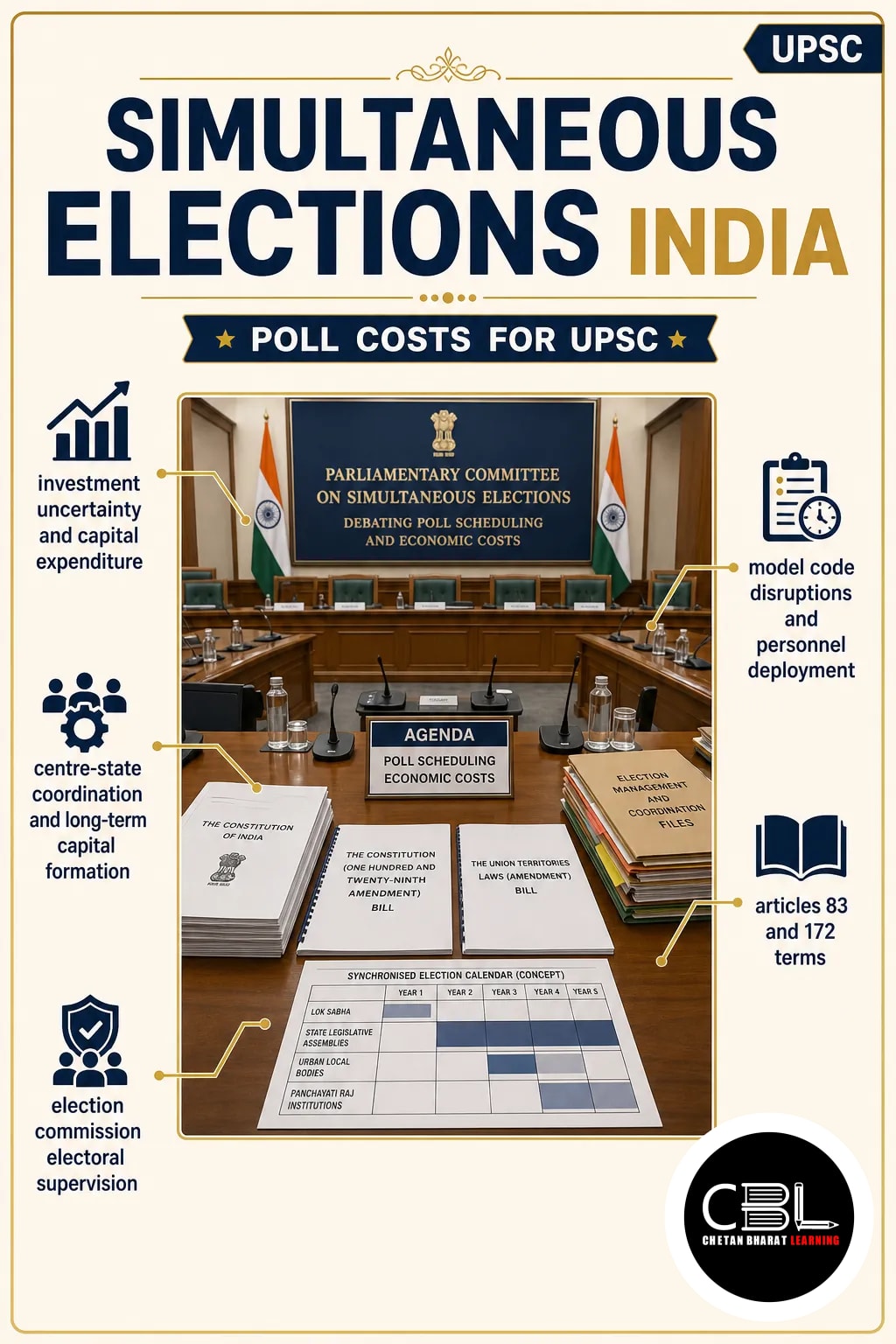

Simultaneous elections India discussions have sharpened after economists flagged costs beyond poll expenditure before a parliamentary panel. The issue links electoral scheduling with investment and constitutional governance.
Quick answer: The simultaneous elections India debate concerns holding Lok Sabha and state Assembly polls together. In October 2026, Economic Advisory Council to the Prime Minister members told a parliamentary panel that staggered polls can affect investment, Centre-state coordination and personnel deployment, in addition to direct election spending.
What are simultaneous elections?
Simultaneous elections broadly mean aligning Lok Sabha and state Assembly election cycles. Unlike the present staggered schedule, voters would choose representatives for both levels within a common electoral cycle.
However, a common cycle need not mean voting everywhere on one day. Scheduling, early dissolution and the treatment of an incomplete term would require clear rules. The polity and governance analysis of one nation, one election provides further context.
Why are staggered poll costs in the news?
The Indian Express reported that Economic Advisory Council to the Prime Minister (EAC-PM) members discussed the economic costs of staggered polls with a Joint Parliamentary Committee. Bharatiya Janata Party Member of Parliament P P Chaudhary chairs the committee examining the simultaneous elections Bills.
The committee met EAC-PM chairperson S Mahendra Dev, member Shamika Ravi and part-time member Pami Dua. It also met S Gurumurthy, chairperson of the Vivekananda International Foundation. The earlier coverage of the council’s cost concerns outlines the same debate.
| Participant | Reported concern |
|---|---|
| S Mahendra Dev | General-election uncertainty and contraction in corporate capital expenditure |
| Shamika Ravi | Low-income families, Centre-state coordination and long-term capital formation |
| Pami Dua | Model Code disruptions, government revenue expenditure and personnel deployment |
These are concerns conveyed to the committee, not a published estimate of total national losses. Moreover, the source supplies no cost figure or details of the underlying studies.
How can frequent elections affect the economy?
Frequent elections can create indirect costs when uncertainty and administrative demands affect decisions beyond the polling process.
Investment and public spending
Direct costs include expenses associated with conducting elections. By contrast, economic costs can include investment decisions postponed because firms face uncertainty about future policy.
Mahendra Dev raised a finding linking general-election uncertainty with lower corporate capital expenditure. However, an observed association alone does not establish that every delayed project results from elections. The size and duration of any effect require separate evidence.
Ravi also highlighted interruptions to Centre-state coordination and their effect on long-term capital formation. For example, projects requiring decisions by both levels of government may depend on predictable administrative coordination. Her concern about low-income families likewise calls for assessment of who bears disruption, rather than treating aggregate savings as sufficient.
Administration and the Model Code
The Model Code of Conduct sets standards for parties and governments during elections. Dua flagged disruptions associated with the code, increased government revenue expenditure and personnel deployment.
However, the code is not a blanket prohibition on all government activity. Its purpose is to protect a level electoral playing field; therefore, any assessment must distinguish essential administration from actions that could confer electoral advantage.
Which constitutional provisions matter?
The Constitution establishes legislative terms, electoral supervision and amendment procedures relevant to any change in election cycles.
| Provision | Relevance |
|---|---|
| Article 83 | Provides for the duration of Parliament; the Lok Sabha normally has a five-year term unless dissolved sooner. |
| Article 172 | Provides for the duration of state legislatures; an Assembly normally has a five-year term unless dissolved sooner. |
| Article 324 | Vests superintendence, direction and control of specified elections in the Election Commission of India. |
| Article 368 | Sets out the constitutional amendment procedure; specified amendments also require ratification by at least half the states. |
Thus, synchronisation must address existing terms and the possibility of early dissolution. Article 368 does not mean that every amendment automatically requires state ratification; the requirement depends on the provision affected.
What are the main trade-offs and the way forward?
The central trade-off is between potential administrative savings and the constitutional and representative costs of changing electoral cycles.
- Federal representation: State elections concern distinct issues; therefore, a common campaign should not weaken attention to state priorities.
- Legislative accountability: Governments must retain the confidence of their legislatures, so a durable schedule needs a response to an early loss of majority.
- Operational capacity: Combined polls may reduce repeated deployment, but simultaneous demand for personnel and equipment also needs assessment.
- Evidence: Direct spending, investment effects and household impacts should be measured separately; moreover, estimates should disclose assumptions and uncertainty.
A credible reform process should compare alternative schedules and their transition costs. It should also consult states and election administrators, while protecting the Election Commission’s independence and representative accountability. Finally, safeguards for premature dissolution should be settled before assuming recurring savings.
Source: Indian Express, 31 October 2026
- Simultaneous Elections: EAC-PM Cost Concerns for UPSC (31 Oct 2026)
- One Nation One Election: Polity & Governance Analysis (7 Sep 2026)
Asked in State PCS: Previous Year Questions
- Punjab PCS Mains 2018 (GS Paper 2): Discuss the benefits and challenges of simultaneous elections to the Lok Sabha and state Assemblies.
State PCS examinations can test both the advantages and constitutional challenges of election synchronisation.
Punjab PCS and Haryana HCS candidates should examine how a common cycle could affect state Assembly terms and administrative deployment. In addition, compare possible savings with state-level representation and accountability.
Prelims Practice Corner
Mains Practice Questions
Frequently Asked Questions
What are simultaneous elections?
They are elections held on an aligned cycle for the Lok Sabha and state Assemblies. However, alignment does not necessarily require voting everywhere on a single day.
What costs of staggered elections did the economists flag?
They flagged investment uncertainty, coordination disruptions and personnel deployment, among other costs. In addition, the report noted concerns about low-income families and government revenue expenditure.
Does the Model Code of Conduct stop all government work?
No, it does not impose a blanket halt on government activity. Instead, it sets election-period standards intended to protect a level playing field.
Which Articles govern Lok Sabha and state Assembly terms?
Articles 83 and 172 respectively address the duration of Parliament and state legislatures. Both provide for a normal five-year term for the relevant elected house, unless it is dissolved sooner.
Related Current Affairs
Preparing for UPSC, PCS or HCS?
Talk to a mentor at Chetan Bharat Learning, Chandigarh. Free guidance on choosing the right exam and building a study plan.
Chat on WhatsAppCall 97793 53345UPSC / IAS / PCS coaching in Chandigarh · Trusted by aspirants across Punjab & Haryana

 Ananya RanaIAS · AIR 60
 Aditya SharmaIAS · AIR 70
 Ria Kaur SethiIPS · AIR 89
 Aman AloonIRS · AIR 295
 Sumer Singh VirkIRS · AIR 335
 Shivani PanchalIAS

Leave a Reply
You must be logged in to post a comment.