

UPSC Syllabus Mapping
GS Paper: GS-II and GS-III
Subject: India-Russia Relations, International Trade, External Sector and Energy Security
Article
What is Rupee Settlement Mechanism?
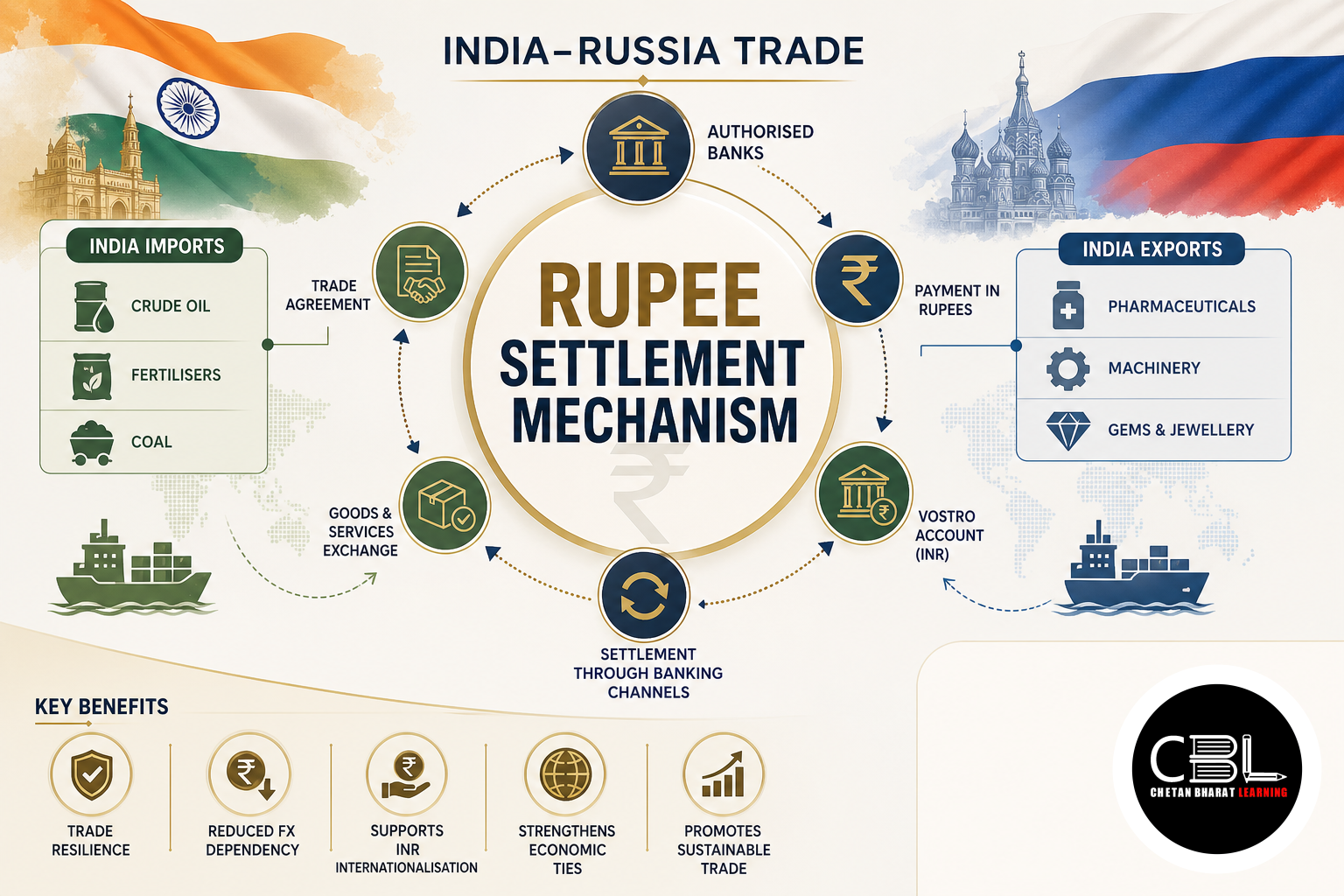
International trade traditionally requires exporters and importers to agree on an invoicing and settlement currency. The US dollar dominates a large share of global cross-border transactions. However, two countries can establish arrangements that allow eligible trade to settle in their domestic currencies.
India has created a framework for international trade settlement in Indian rupees through banking channels authorised by the Reserve Bank of India. Under such arrangements, banks can use Special Rupee Vostro Accounts for settlement. Consequently, eligible import and export payments can move through rupee-denominated accounts rather than requiring dollar settlement for every transaction.
A vostro account is an account that a domestic bank maintains on behalf of a foreign bank. From the domestic bank’s perspective, it represents the foreign bank’s money held with it. Therefore, vostro arrangements provide banking infrastructure for processing cross-border payments and maintaining balances.
The mechanism does not eliminate the economic importance of exchange rates. Importers, exporters and banks still need an agreed method for determining currency values. Moreover, adequate liquidity and confidence remain necessary for a settlement system to function efficiently at scale.
Why is Rupee Settlement Mechanism in News?
Renewed India-Russia discussions on trade settlement in national currencies have gained prominence after India sharply increased purchases of Russian crude. Western financial sanctions affecting Russia also prompted exploration of alternative payment channels that reduce reliance on conventional dollar-based pathways. India continues to pursue its economic and strategic interests, balancing energy security and de-dollarisation debates.
Energy security explains much of India’s interest in stable payment channels. Crude oil supports transportation, industry, petrochemicals, aviation and several other sectors. Disruptions in oil supply or payment systems can affect inflation, the current account and broader macroeconomic stability.
The policy also forms part of India’s wider effort to facilitate the international use of the rupee where commercially viable. Internationalisation is a gradual process that requires deep financial markets and sustained confidence.
Key Features
1. Domestic currency settlement: Importers make rupee payments through designated banking arrangements; exporters receive corresponding value via the settlement structure.
2. Special Rupee Vostro Accounts: Foreign banks maintain rupee-denominated accounts with authorised Indian banks under the RBI framework.
3. Reduced dollar dependency: May lower intermediary-currency costs and payment disruptions when exchange-rate terms and liquidity are attractive.
4. Trade balance influence: Sustained bilateral settlement requires reasonably complementary trade flows to prevent imbalanced rupee accumulations.
5. Diversification, not replacement: Arrangements represent options within a still largely dollar-centred system.
Challenges
Limited global convertibility of the rupee and its shallow market depth reduce its attractiveness to foreign exporters. India-Russia trade imbalances can lead to large rupee balances on the Russian side that are difficult to deploy. Exchange-rate management and liquidity concerns affect participants’ willingness to hold rupees. Geopolitical factors, sanctions and correspondent-bank relationships add complexity. Excessive expectations about de-dollarisation can obscure the need for trust, usability and deep markets.
Way Forward
Gradually expand local-currency settlement where it yields genuine commercial benefits. Strengthen payment infrastructure, clear regulatory frameworks and workable exchange-rate arrangements. Encourage export diversification to reduce bilateral imbalances. Deepen financial markets, maintain macroeconomic stability and build confidence in the rupee. Continue energy diversification and pragmatic bilateral engagement to secure strategic flexibility.
Prelims Practice Corner
-
1. A Vostro account is best described as:
- A. An account maintained by a central bank only
- B. An account a domestic bank maintains on behalf of a foreign bank
- C. An account exclusively for foreign tourists
- D. A government budget account
Answer: B. A vostro account represents funds of a foreign bank maintained with a domestic bank.
-
2. Special Rupee Vostro Accounts are associated primarily with:
- A. Agricultural subsidies
- B. International trade settlement in rupees
- C. Fiscal transfers to states
- D. Gold imports by households
Answer: B. They facilitate eligible international trade settlement using Indian rupees.
-
3. Which institution regulates India’s banking and foreign-exchange framework?
- A. SEBI
- B. RBI
- C. CCI
- D. NITI Aayog
Answer: B. The Reserve Bank of India is the central regulatory authority.
-
4. De-dollarisation broadly refers to:
- A. Abolition of all currencies except the dollar
- B. Reduced dependence on the US dollar in trade, finance or reserves
- C. Fixing every currency to the dollar
- D. Removal of foreign-exchange markets
Answer: B. It refers to reducing reliance on the US dollar in international transactions or reserves.
-
5. Consider the following statements: 1. Local-currency settlement necessarily eliminates exchange-rate risk. 2. A large bilateral trade imbalance can complicate local-currency settlement. Which is correct?
- A. 1 only
- B. 2 only
- C. Both 1 and 2
- D. Neither 1 nor 2
Answer: B. Currency risk can remain, and persistent imbalances complicate settlement.
Mains Practice Questions
-
Examine the significance of local-currency trade settlement for India’s external economic strategy. (10 marks)
- Define local-currency settlement
- Explain Special Rupee Vostro Accounts
- Discuss transaction costs, resilience and rupee internationalisation
- Examine convertibility and trade-imbalance constraints
- Conclude with gradual diversification
-
India’s energy relationship with Russia illustrates the interaction between economics and strategic autonomy. Discuss. (15 marks)
- Explain India’s energy dependence
- Discuss affordable crude and supply diversification
- Examine geopolitical pressures and payment challenges
- Connect with strategic autonomy
- Recommend diversified energy sources and pragmatic financial arrangements
FAQs on Rupee Settlement Mechanism
What is a Special Rupee Vostro Account?
It is a rupee-denominated account maintained by an authorised Indian bank for a foreign bank under the regulatory framework. These accounts facilitate eligible international trade settlement in Indian rupees.
Does rupee settlement mean India is replacing the US dollar?
No. Local-currency settlement provides an alternative for selected transactions. The US dollar continues to play a dominant role in international finance, reserves and commodity trade.
Why can a trade imbalance create problems for rupee settlement?
If one partner consistently exports much more than it imports, it may accumulate large rupee balances. The arrangement works best when those balances can finance imports, investments or other permitted transactions.
Related Current Affairs
Preparing for UPSC, PCS or HCS?
Talk to a mentor at Chetan Bharat Learning, Chandigarh. Free guidance on choosing the right exam and building a study plan.
Chat on WhatsAppCall 97793 53345UPSC / IAS / PCS coaching in Chandigarh · Trusted by aspirants across Punjab & Haryana
Leave a Reply
You must be logged in to post a comment.