
UPSC Mapping
| Exam | Focus Area |
|---|---|
| Prelims | Polity & Education |
| Mains | GS Paper 2 (Polity & Social Justice) |
| Key Provision | Regulation 3(1)(c) |
|---|---|
| Legal Authority | Sections 12 & 26, UGC Act, 1956 |
What are UGC Equity Regulations?
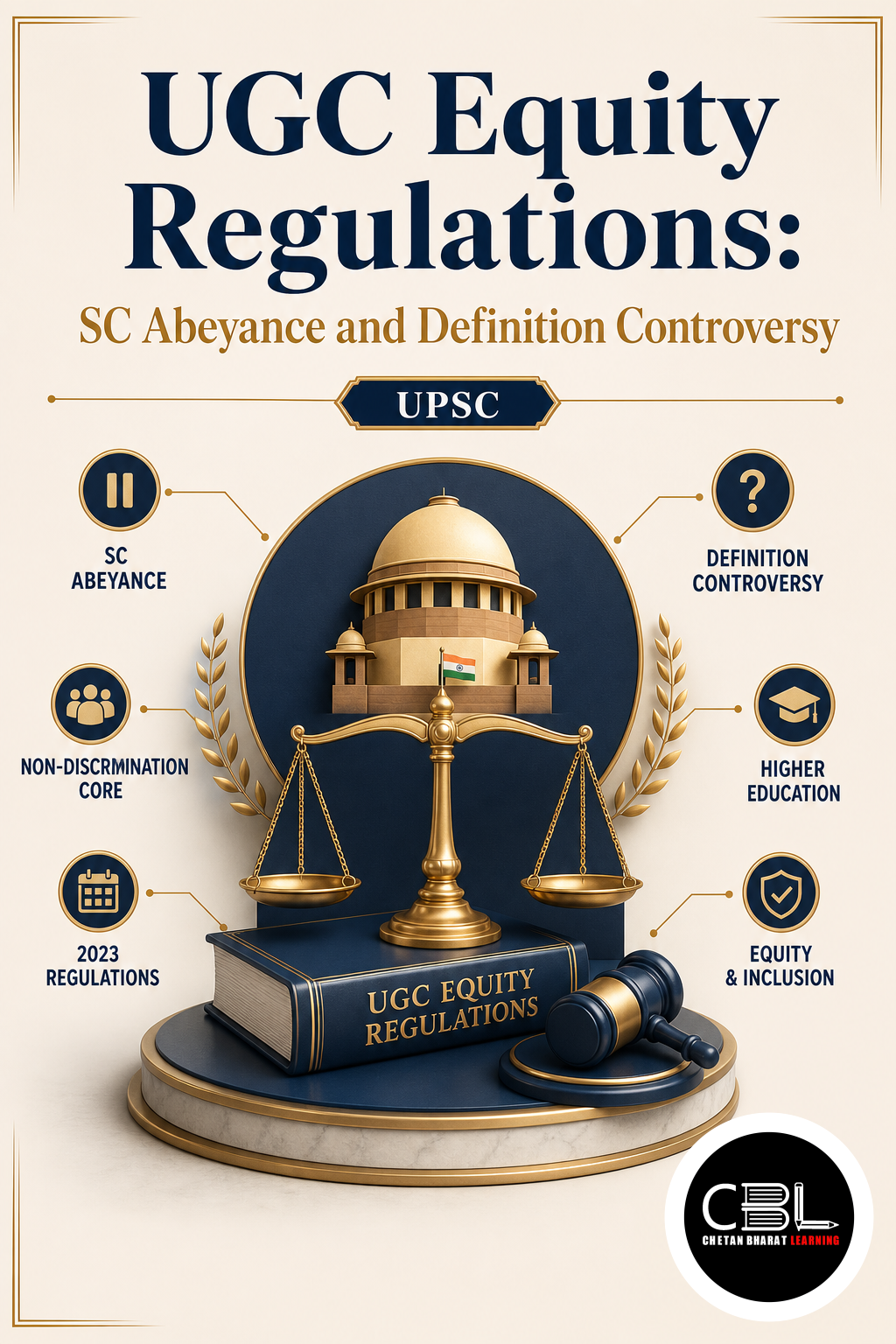
The UGC Equity Regulations, 2026, were notified to replace the 2012 framework on promoting equity and preventing discrimination in higher education institutions. The regulations were framed under Section 12 read with Section 26 of the UGC Act, 1956, which empowers the UGC to make regulations for promoting equity and inclusion in HEIs.
The core controversy centres on Regulation 3(1)(c), which defines caste-based discrimination broadly, potentially bringing within its ambit academic critique, research, and classroom discussions. The Supreme Court kept the regulations in abeyance after the Centre stated it was reconsidering the provisions. The 2012 framework continues to operate in the interim.
Why are UGC Equity Regulations in News?
The UGC Equity Regulations are in the news because the Supreme Court has kept them in abeyance following petitions challenging their constitutionality. The Centre has told the Court it is reconsidering the regulations, particularly the definition of caste-based discrimination. The Court has deferred framing legal questions pending the government’s decision.
The controversy highlights the tension between preventing discrimination and protecting academic freedom. Critics argue that the broad definition could chill legitimate academic discourse, while proponents contend that robust safeguards are needed to protect marginalised students from discrimination.
Key Features of UGC Equity Regulations
- Anti-Discrimination Framework: Aims to prevent discrimination based on caste, gender, religion, disability, and other grounds.
- Complaint Mechanism: Establishes a mechanism for reporting and addressing grievances.
- Institutional Responsibility: Mandates HEIs to create equitable and inclusive environments.
- Regulation 3(1)(c): The controversial provision defining caste-based discrimination, including subtle and indirect forms.
- Legal Authority: Framed under the UGC Act, 1956.
Challenges in UGC Equity Regulations
- Definition Ambiguity: Regulation 3(1)(c) may be too broad, potentially chilling academic freedom and legitimate discourse.
- Constitutional Concerns: The provisions may infringe upon freedom of speech and expression under Article 19.
- Institutional Capacity: HEIs may lack the infrastructure and training to effectively implement the regulations.
- Enforcement: Ensuring compliance across diverse HEIs is a significant challenge.
- Balancing Rights: Protecting marginalised students without undermining academic freedom requires careful calibration.
Way Forward for UGC Equity Regulations
To address the UGC Equity Regulations concerns, the government should consult with all stakeholders—including academics, students, and constitutional experts—to refine the definition of discrimination. Clearer guidelines on what constitutes discrimination versus legitimate academic inquiry are essential.
Providing training and capacity-building for HEI staff and grievance redressal bodies can improve implementation. The Supreme Court’s final ruling will set the constitutional boundaries for such regulations.
Prelims Practice Corner
- Under which Act do the UGC Equity Regulations derive authority?
Answer: (a) UGC Act, 1956 - Which provision of the regulations is at the centre of the controversy?
Answer: (b) Regulation 3(1)(c) - What has the Supreme Court done with the 2026 regulations?
Answer: (b) Kept them in abeyance - Which framework continues to operate in the interim?
Answer: (b) 2012 regulations - What is the primary concern with Regulation 3(1)(c)?
Answer: (b) It may chill academic freedom
Mains Practice Questions
- Critically analyse the constitutional and policy dimensions of the UGC Equity Regulations, 2026, in the context of balancing social justice and academic freedom. (250 words, 15 marks)
Answer Structure: Intro, objectives and key provisions, constitutional analysis (Articles 14, 15, 19, 29, 30), balanced approach, conclusion.
- What is the role of the University Grants Commission in promoting equity in higher education? (150 words, 10 marks)
Answer Structure: Define UGC’s mandate, explain its regulatory role and standards setting under the UGC Act, mention 2026 regulations and need for balance, conclude on equity and academic freedom.
FAQs on UGC Equity Regulations
What are the UGC Equity Regulations, 2026?
They are regulations to prevent discrimination and promote equity in higher education institutions, currently under Supreme Court scrutiny.
Why are they controversial?
Regulation 3(1)(c) defines caste-based discrimination broadly, raising concerns about chilling academic freedom.
What is the current status of the regulations?
The Supreme Court has kept them in abeyance while the Centre reconsiders the provisions.
Related Current Affairs
Preparing for UPSC, PCS or HCS?
Talk to a mentor at Chetan Bharat Learning, Chandigarh. Free guidance on choosing the right exam and building a study plan.
Chat on WhatsAppCall 97793 53345UPSC / IAS / PCS coaching in Chandigarh · Trusted by aspirants across Punjab & Haryana
Leave a Reply
You must be logged in to post a comment.