

UPSC Mapping
| Prelims | Environment & Ecology |
|---|---|
| Mains | GS Paper 3 (Environment & Biodiversity) |
| IUCN Status | Least Concern (LC) |
| CITES | Appendix II |
Article
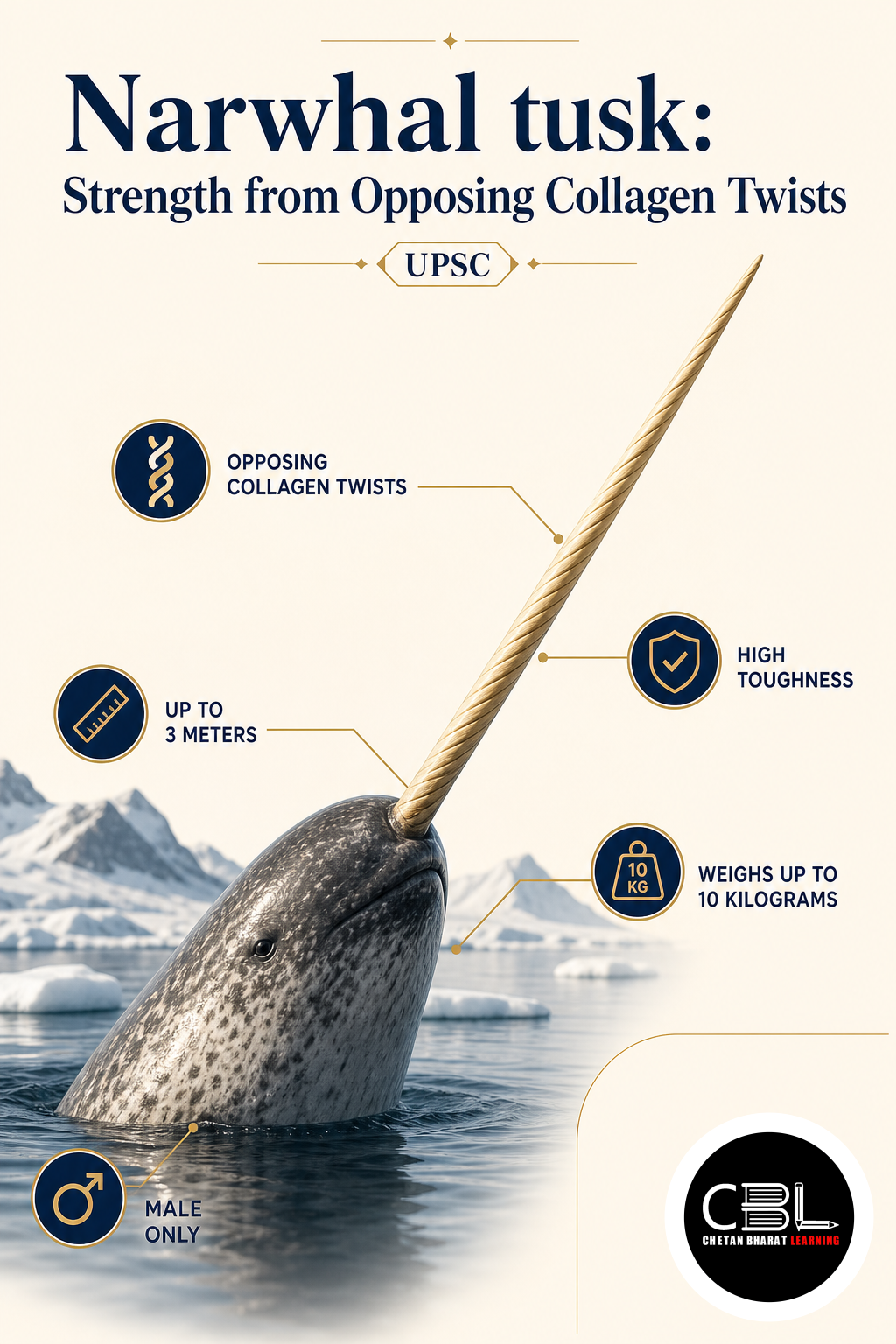
A recent study has revealed that the narwhal tusk derives its remarkable strength from opposing twists in its outer and inner collagen fibril layers. This discovery sheds new light on the unique adaptation of the narwhal, often called the ‘Unicorn of the Sea’. The narwhal is a medium-sized toothed whale found in the Arctic, and its tusk is actually a sensory organ that detects chemical and temperature changes in the ocean. This topic is relevant for environment current affairs.
What is a Narwhal?
The narwhal (Monodon monoceros) is a medium-sized toothed whale known for its long, spiraled tusk, which is actually an elongated upper left canine tooth. Males typically have the tusk, which can grow up to 3 meters long, while females rarely develop one. The narwhal is closely related to the beluga whale and is found in the frigid, deep-water coastal environments and seasonal ice-pack waters of Canada, Greenland, Svalbard, and Russia.
Narwhals have mottled black-and-white skin that lightens with age and lack a dorsal fin, an adaptation for swimming under thick ice. They are suction feeders that hunt benthic prey, including Greenland halibut, Arctic cod, and squid. The narwhal serves as a biological indicator of Arctic marine ecosystem stability.
Why is the Narwhal Tusk in News?
The narwhal tusk is in the news following a study that uncovered the secret behind its strength. Researchers found that the tusk’s outer and inner collagen fibril layers have opposing twists, which enhance its mechanical properties. This discovery not only helps understand the narwhal’s unique adaptation but also has potential implications for biomimetic material design.
The narwhal’s tusk is also a sensory organ with millions of nerve endings that detect chemical and temperature changes in the ocean, helping the whale navigate and find food. This remarkable adaptation makes the narwhal a fascinating subject for scientific study. For more on marine biodiversity, explore the marine biodiversity archive.
Key Features of the Narwhal
- Unique Tusk: The spiraled tusk is an elongated tooth with sensory functions, not a horn.
- Arctic Habitat: Lives in cold, deep waters and seasonal pack ice of the Arctic.
- Suction Feeder: Hunts benthic prey like halibut, cod, and squid.
- No Dorsal Fin: Lacks a dorsal fin to facilitate swimming under ice.
- Conservation Status: Listed as Least Concern by IUCN and Appendix II by CITES. For more on biodiversity, visit the biodiversity archive.
Challenges to Narwhal Conservation
- Climate Change: Melting sea ice reduces habitat and affects prey availability.
- Pollution: Contaminants like heavy metals and persistent organic pollutants accumulate in narwhal tissues.
- Shipping and Noise: Increased Arctic shipping causes noise pollution that disrupts communication and feeding.
- Hunting: Indigenous subsistence hunting is regulated but remains a pressure.
Way Forward for Arctic Conservation
Protecting the narwhal and its habitat requires global cooperation to mitigate climate change, regulate shipping, and reduce pollution. The Arctic ecosystem is fragile, and the narwhal serves as an important indicator of its health. As per IUCN guidelines, conservation efforts must focus on habitat protection, pollution control, and sustainable hunting practices.
Scientific research on the narwhal’s tusk and its sensory functions can also inform biomimetic innovations, highlighting the importance of preserving biodiversity for its intrinsic and utilitarian value.
Prelims Practice Corner
-
Q1. What is the scientific name of the narwhal?
- (a) Delphinapterus leucas
- (b) Monodon monoceros
- (c) Physeter macrocephalus
- (d) Orcinus orca
Answer: (b) Monodon monoceros.
-
Q2. What is the conservation status of the narwhal according to IUCN?
- (a) Endangered
- (b) Vulnerable
- (c) Least Concern
- (d) Near Threatened
Answer: (c) Least Concern.
-
Q3. What is the primary function of the narwhal tusk?
- (a) Fighting
- (b) Sensory organ
- (c) Digging
- (d) Defense
Answer: (b) Sensory organ.
-
Q4. In which regions are narwhals found?
- (a) Antarctic
- (b) Arctic
- (c) Tropical
- (d) Temperate
Answer: (b) Arctic.
-
Q5. What is the closest relative of the narwhal?
- (a) Dolphin
- (b) Beluga whale
- (c) Blue whale
- (d) Sperm whale
Answer: (b) Beluga whale.
Mains Practice Questions
Q1. “The narwhal serves as a biological indicator of Arctic marine ecosystem stability.” Discuss the threats to narwhal populations and the implications of their decline. (250 words, 15 marks)
Answer Structure:
Intro: Introduce the narwhal and its ecological role.
Body: Discuss threats (climate change, pollution, shipping), the significance of its tusk, and conservation measures.
Conclusion: Highlight the need for Arctic conservation and global cooperation.
Q2. “Biomimicry can provide sustainable solutions by learning from nature’s adaptations.” Analyse the potential applications of the narwhal tusk’s structure. (250 words, 15 marks)
Answer Structure:
Intro: Explain the concept of biomimicry and the narwhal tusk’s unique properties.
Body: Discuss the collagen twist structure and its potential in material science, engineering, and medicine.
Conclusion: Emphasise the need for biodiversity conservation for its utilitarian value.
FAQs on Narwhal
What is the function of the narwhal tusk?
The tusk is a sensory organ that detects chemical and temperature changes in the ocean, helping the narwhal navigate and find food.
Where are narwhals found?
Narwhals are found in the Arctic waters of Canada, Greenland, Svalbard, and Russia, in deep-water coastal environments and seasonal ice packs.
What is the closest relative of the narwhal?
The beluga whale is the narwhal’s only living close relative.
Related Current Affairs
Preparing for UPSC, PCS or HCS?
Talk to a mentor at Chetan Bharat Learning, Chandigarh. Free guidance on choosing the right exam and building a study plan.
Chat on WhatsAppCall 97793 53345UPSC / IAS / PCS coaching in Chandigarh · Trusted by aspirants across Punjab & Haryana
Leave a Reply
You must be logged in to post a comment.