

UPSC Mapping
- GS Paper III: Inclusive development, mining, governance, sustainable development, environmental governance, federalism and regional development.
Quick Facts
| State | Jharkhand |
|---|---|
| Major Region | Chota Nagpur Plateau |
| Issue | High mineral wealth but persistent poverty |
| UPSC Themes | Inclusive development, mining, governance, sustainable development |
Article
What is the Resource Curse?
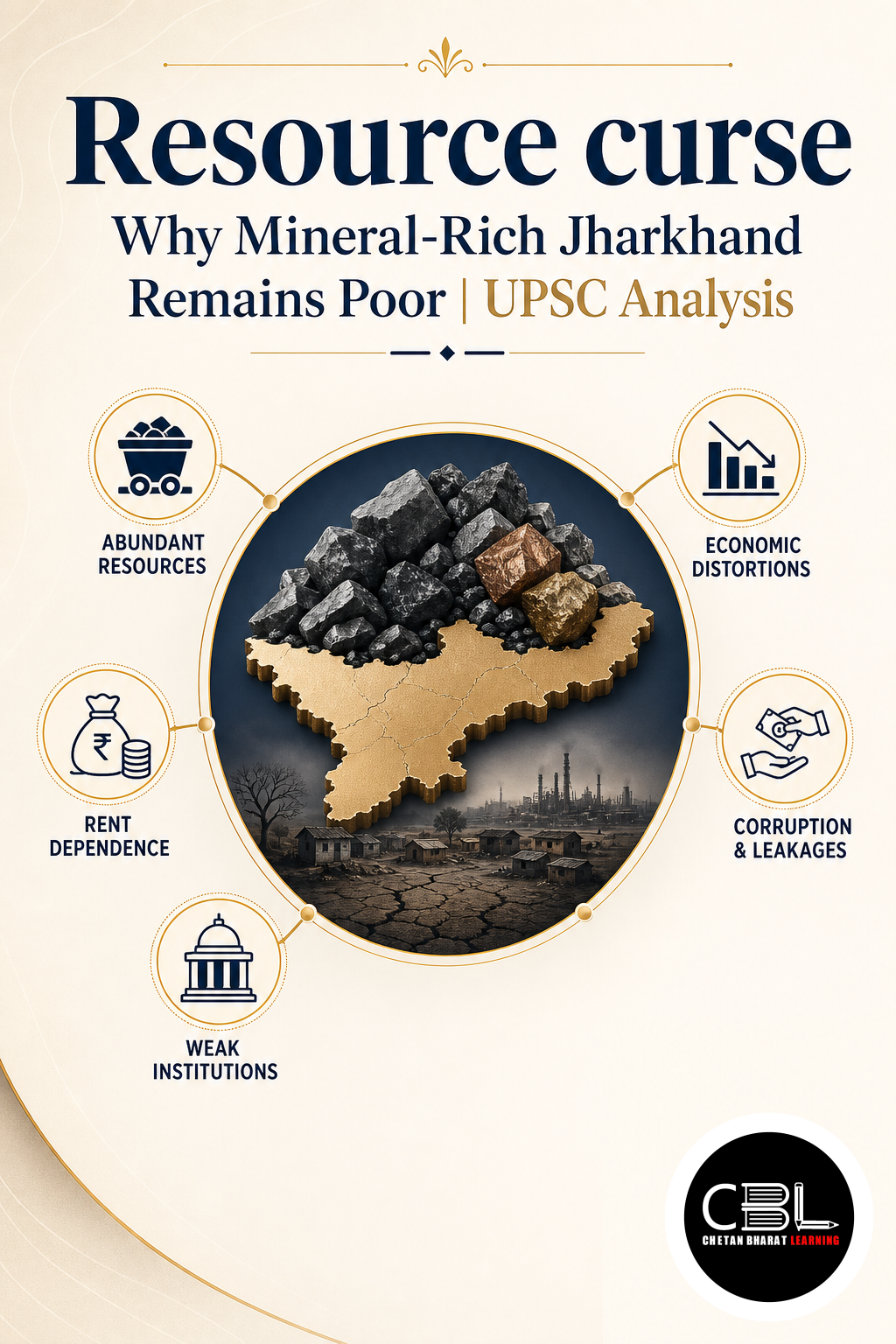
The Resource Curse, also known as the paradox of plenty, describes a situation where regions with abundant natural resources experience slower economic growth and weaker human development compared to less resource-endowed areas.
Features of the Resource Curse
- Persistent Poverty
- Corruption
- Weak Governance
- Environmental Degradation
- Social Conflicts
Global Examples
- Nigeria (Oil)
- Venezuela (Oil)
- Democratic Republic of the Congo (Minerals)
- Sierra Leone (Diamonds)
Why is Jharkhand Mineral Rich?
Jharkhand, located on the Chota Nagpur Plateau, is one of India’s most important mineral belts, contributing significantly to the country’s mining output with coal, iron ore, copper, uranium, bauxite, limestone and mica.
The Central Question
Despite enormous mineral wealth, development gains from mining have not translated into broad-based improvements in living standards for local communities.
Reason 1: Mining Benefits Do Not Reach Local People
- Poor schools
- Weak healthcare facilities
- Limited access to safe drinking water
- High levels of poverty
- Limited employment opportunities
Reason 2: Governance Deficit
- Delays in development projects
- Inefficient utilisation of public funds
- Poor transparency
- Weak public confidence in institutions
Reason 3: Delayed Mineral Auctions
Delays in conducting timely auctions for mining leases have affected production and reduced revenue generation.
Reason 4: Employment Decline
- Loss of jobs
- Reduced transport activity
- Lower business for local shops
- Migration from mining areas
Reason 5: Environmental Costs
- Air pollution
- Water contamination
- Land degradation
- Loss of agricultural land
What is the District Mineral Foundation (DMF)?
The DMF, established under the Mines and Minerals (Development and Regulation) Amendment Act, 2015, ensures that communities affected by mining receive a share of benefits through contributions from mining companies.
Uses of DMF Funds
- Healthcare
- Education
- Drinking water
- Road infrastructure
- Livelihood generation
- Skill development
- Environmental restoration
Concerns Regarding DMF
Despite substantial funds, benefits have not adequately reached affected communities due to transparency, utilisation and accountability challenges.
Mineral Auctions
Mineral auctions aim to ensure transparency, fair competition, higher government revenue and efficient resource allocation. Delays in auctions can reduce production and revenue.
Prelims Practice Questions
- Q1. The ‘Resource Curse’ refers to: (a) Declining agricultural production (b) Regions with abundant natural resources experiencing poor development outcomes (c) High population growth (d) Low mineral production.
Answer: (b) - Q2. According to the passage, Jharkhand is located on the: (a) Deccan Plateau (b) Chota Nagpur Plateau (c) Malwa Plateau (d) Meghalaya Plateau.
Answer: (b) - Q3. The District Mineral Foundation was established under which legislation? (a) Environment Protection Act, 1986 (b) Mines and Minerals (Development and Regulation) Amendment Act, 2015 (c) Forest Rights Act, 2006 (d) National Green Tribunal Act, 2010.
Answer: (b) - Q4. According to the passage, DMF funds are primarily intended for: (a) Defence expenditure (b) Welfare of mining-affected communities (c) Foreign investment promotion (d) Urban metro projects.
Answer: (b) - Q5. Which of the following is identified as a feature of the Resource Curse in the passage? (a) Weak governance (b) Environmental degradation (c) Poverty (d) All of the above.
Answer: (d)
Mains Practice Questions
- Q1 (10 Marks): Explain the concept of the Resource Curse. Why do mineral-rich regions often experience lower levels of development?
- Q2 (15 Marks): Evaluate the role of the District Mineral Foundation in ensuring inclusive and sustainable development of mining-affected regions in India.
FAQs
What is the Resource Curse?
According to the passage, it is the paradox where regions rich in natural resources experience weaker development outcomes because of governance and institutional challenges.
What is the purpose of the District Mineral Foundation?
It aims to ensure that communities affected by mining receive developmental benefits funded through contributions from mining companies.
Why does the passage identify Jharkhand as an example?
Despite possessing abundant mineral resources, the state continues to face poverty, governance challenges and uneven distribution of mining benefits.
Related Current Affairs
Preparing for UPSC, PCS or HCS?
Talk to a mentor at Chetan Bharat Learning, Chandigarh. Free guidance on choosing the right exam and building a study plan.
Chat on WhatsAppCall 97793 53345UPSC / IAS / PCS coaching in Chandigarh · Trusted by aspirants across Punjab & Haryana
Leave a Reply
You must be logged in to post a comment.