
UPSC Mapping
| Prelims | Economy & Banking |
|---|---|
| Mains | GS Paper 3 (Economic Development & Banking) |
Quick Facts
| Current Stance | Neutral |
|---|---|
| Key Dilemma | Growth vs Inflation |
What is RBI Policy Dilemma?
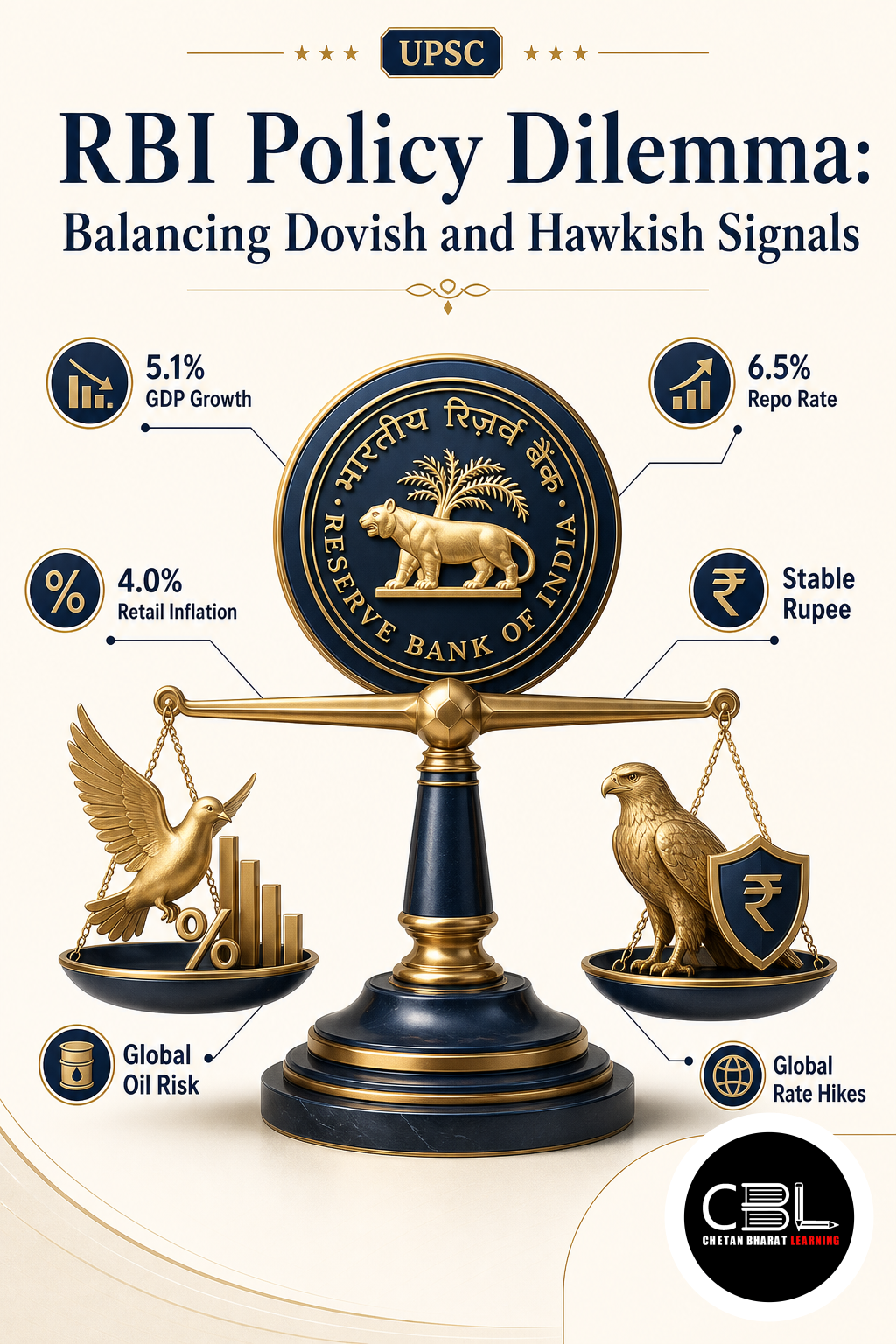
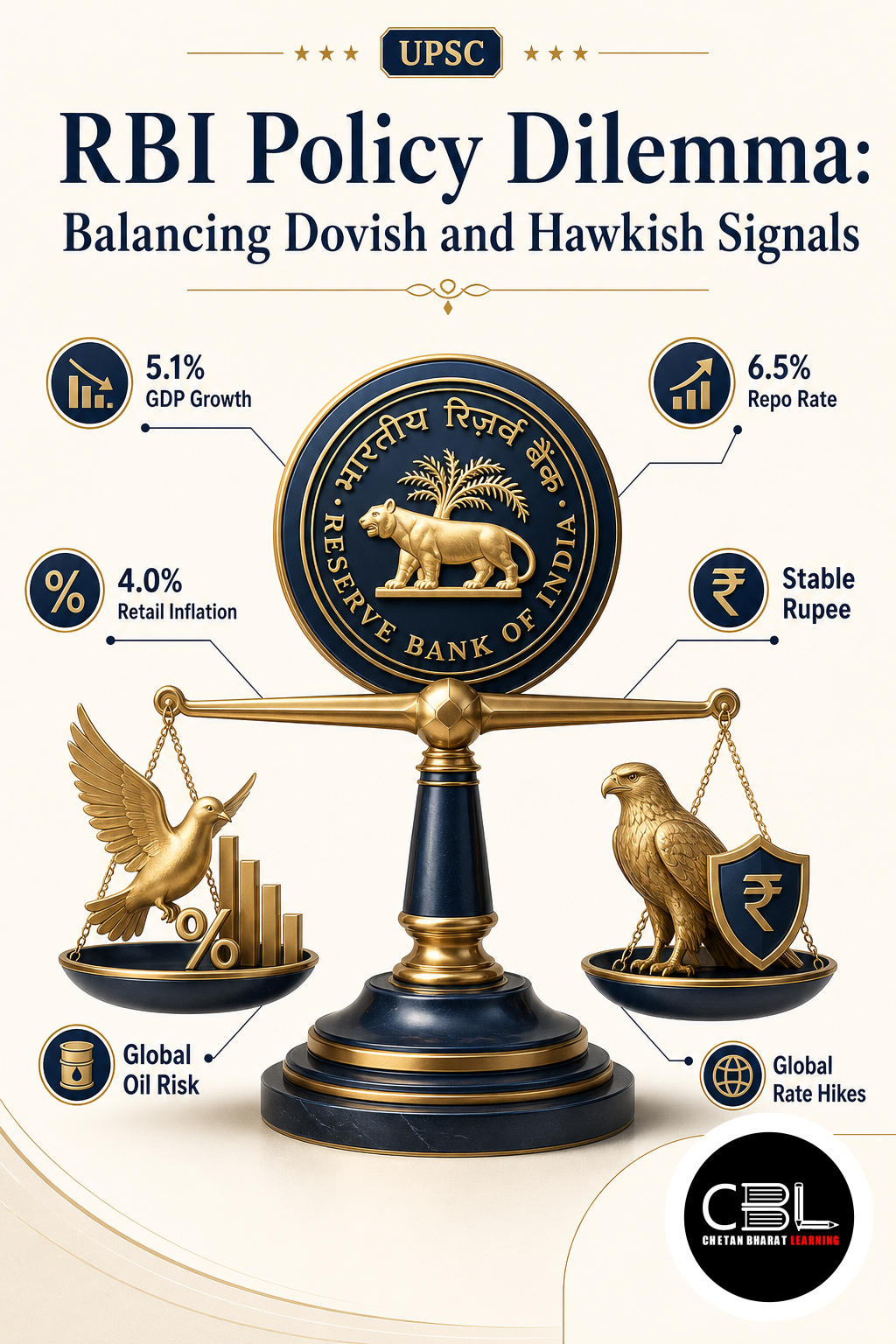
RBI Policy Dilemma refers to the challenge faced by the Monetary Policy Committee in balancing the dual objectives of supporting economic growth and controlling inflation. A dovish stance (lower rates) supports growth but risks fuelling inflation, while a hawkish stance (higher rates) curbs inflation but can stifle growth. The MPC’s current neutral stance reflects this dilemma.
The dilemma is particularly acute given the uncertainties in the global economy, including geopolitical tensions, supply chain disruptions, and volatile commodity prices. The RBI must also consider the impact of its policy on the exchange rate and external sector. The central bank’s communication is critical to manage market expectations.
Why is RBI Policy Dilemma in News?
RBI Policy Dilemma is in the news because the MPC has indicated that it cannot be both dovish and hawkish, emphasising the need for a clear policy stance. The minutes of the recent MPC meeting revealed divergent views among members, with some leaning towards a rate hike and others favouring a pause. The governor’s remarks have highlighted the complexity of the current economic environment.
The inflation outlook remains uncertain, with food and fuel prices posing upside risks, while growth has shown signs of recovery. For more details, refer to this PIB release.
Key Features of RBI Policy Dilemma
The RBI Policy Dilemma has several distinctive features:
- Dual Mandate: Balancing inflation control (hawkish) with growth support (dovish).
- Neutral Stance: The MPC’s current stance reflects uncertainty and data dependence.
- Global Headwinds: External factors complicate domestic policy decisions.
- Communication Challenge: Managing market expectations through clear guidance.
- Data Dependence: Policy decisions are based on evolving economic data.
Challenges in RBI Policy Dilemma
The RBI Policy Dilemma faces several challenges:
- Uncertain Inflation: Food and fuel price shocks are difficult to predict.
- Growth Concerns: Premature rate hikes could derail the recovery.
- Global Spillovers: US Fed policy and geopolitical tensions affect India’s policy space.
- Exchange Rate: Rate differentials with the US can impact the rupee.
- Fiscal Deficit: Government borrowing can crowd out private investment. For more on monetary policy, visit the economy section.
Way Forward for RBI Policy Dilemma
To navigate the RBI Policy Dilemma, the MPC should maintain its data-dependent and calibrated approach. Clear communication about the policy trajectory can reduce uncertainty. The RBI should focus on core inflation, which reflects demand-side pressures, while using targeted measures to address supply-side shocks.
Coordination with the government on fiscal policy can support growth while ensuring fiscal discipline. A flexible inflation targeting framework with a medium-term focus can provide stability. For international best practices, refer to the IMF.
Prelims Practice Corner
Q1. What is the current stance of the RBI’s Monetary Policy Committee?
(a) Dovish (b) Hawkish (c) Neutral (d) Accommodative
Answer: (c) The stance is neutral.
Q2. What is a dovish monetary policy?
(a) Raising interest rates (b) Lowering interest rates to support growth (c) Stable interest rates (d) Focus on inflation only
Answer: (b) A dovish policy lowers rates to support growth.
Q3. What is a hawkish monetary policy?
(a) Lowering interest rates (b) Raising interest rates to control inflation (c) Unchanged rates (d) Focus on growth only
Answer: (b) A hawkish policy raises rates to control inflation.
Q4. What is the RBI’s inflation target?
(a) 2% (b) 4% (c) 6% (d) 8%
Answer: (b) The RBI targets 4% inflation with a +/-2% band.
Q5. What is the Monetary Policy Committee’s main role?
(a) Setting tax rates (b) Setting interest rates (c) Managing government debt (d) Regulating banks
Answer: (b) The MPC sets the policy rate to achieve inflation targets.
Mains Practice Questions
Q1. Analyse the challenges faced by the RBI in balancing inflation and growth objectives in the current economic environment. (250 words, 15 marks)
- Intro: Introduce the RBI’s policy dilemma.
- Body: Discuss the drivers of inflation (food, fuel) and the need to support growth. Analyse the MPC’s neutral stance and the challenges of global spillovers. Suggest a data-dependent approach.
- Conclusion: Emphasise the need for clear communication and fiscal coordination.
Q2. What is the difference between dovish and hawkish monetary policy? (150 words, 10 marks)
- Intro: Define dovish and hawkish stances.
- Body: Explain that dovish policy lowers rates to boost growth, while hawkish policy raises rates to curb inflation. The choice depends on the economic trade-off.
- Conclusion: Conclude that the RBI’s stance reflects its assessment of this trade-off.
FAQs on RBI Policy Dilemma
What is the RBI’s current policy stance?
The stance is neutral, meaning the MPC is data-dependent and ready to act in either direction.
Why can’t the RBI be both dovish and hawkish?
A clear policy stance is needed to anchor expectations; mixed signals create uncertainty.
What factors influence the RBI’s policy decision?
Inflation outlook, growth prospects, global conditions, and exchange rate dynamics.
Related Current Affairs
Preparing for UPSC, PCS or HCS?
Talk to a mentor at Chetan Bharat Learning, Chandigarh. Free guidance on choosing the right exam and building a study plan.
Chat on WhatsAppCall 97793 53345UPSC / IAS / PCS coaching in Chandigarh · Trusted by aspirants across Punjab & Haryana
Leave a Reply
You must be logged in to post a comment.