

UPSC Mapping
| Exam | Topics |
|---|---|
| Prelims | Red Sea, Bab-el-Mandeb Strait, Gulf of Aden, Suez Canal |
| Mains | GS Paper I – World Geography; GS Paper II – International Relations |
Key Facts
| Feature | Detail |
|---|---|
| Ocean | Indian Ocean |
| Southern Link | Bab-el-Mandeb Strait |
| Northern Arms | Gulf of Aqaba & Gulf of Suez |
| Separating Landmass | Sinai Peninsula |
What is the Red Sea?
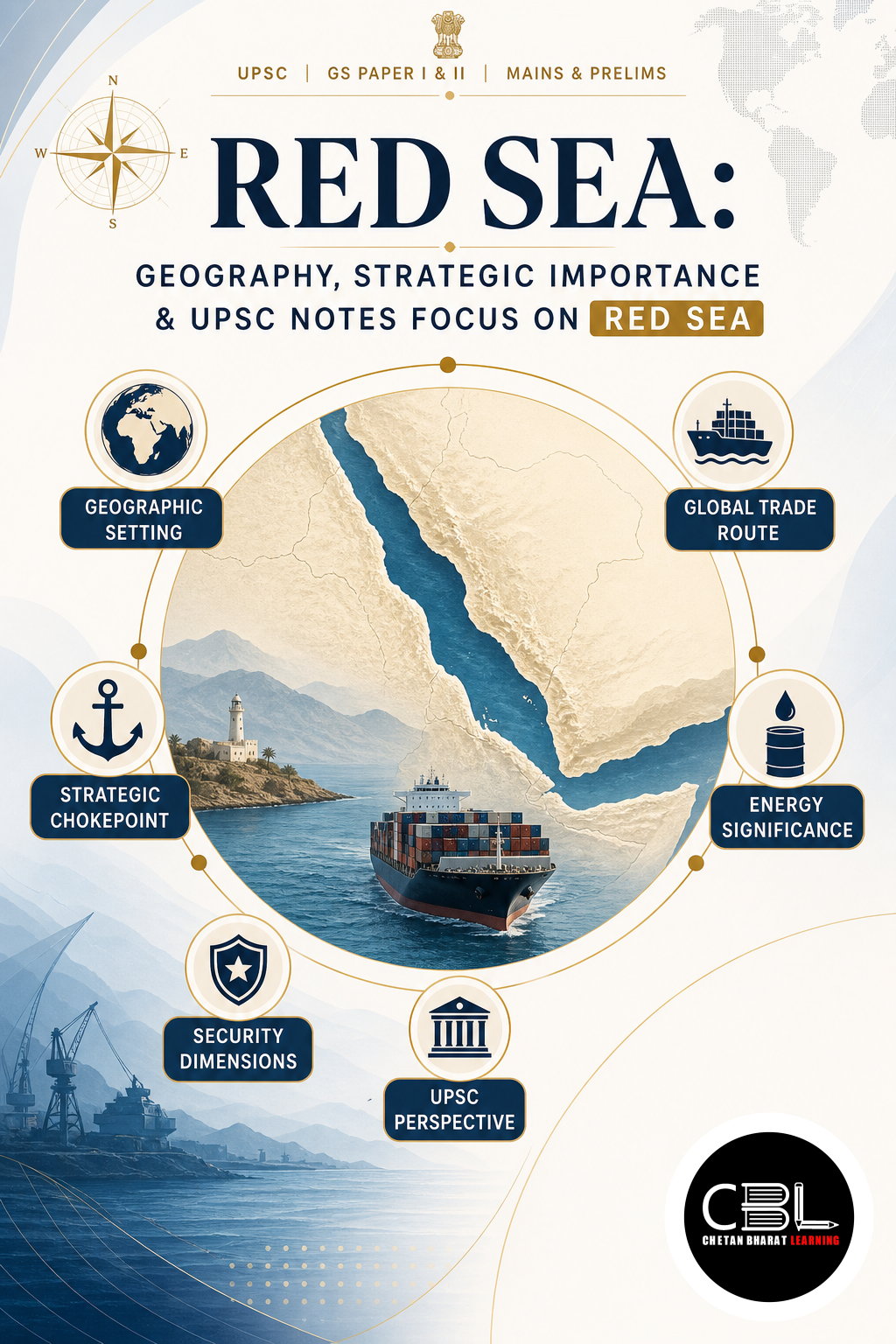
Red Sea is a narrow sea inlet of the Indian Ocean located between Africa and the Arabian Peninsula in Asia. It is one of the world’s busiest maritime routes, connecting Europe, Asia and Africa through the Suez Canal.
The sea is renowned for its strategic location, rich marine biodiversity and importance in international shipping. It serves as a major route for container traffic, crude oil and liquefied natural gas shipments.
Why is the Red Sea in News?
The Red Sea is in the news after Yemen’s Houthi movement, officially known as Ansar Allah, announced a maritime blockade in the region. Their actions have raised concerns over the safety of commercial shipping and global supply chains because the Red Sea is a critical international trade corridor. Maritime information can be accessed through the International Maritime Organization.
Geographical Features of the Red Sea
The Red Sea occupies a strategically important position between Africa and West Asia.
- Southern connection: Linked to the Gulf of Aden and the Indian Ocean through the Bab-el-Mandeb Strait.
- Northern division: Splits into the Gulf of Aqaba and the Gulf of Suez.
- Sinai Peninsula: Separates the Gulf of Aqaba from the Gulf of Suez.
- Marine ecosystem: Known for extensive coral reefs and exceptional biodiversity.
- International shipping route: Connects the Mediterranean Sea with the Indian Ocean through the Suez Canal.
Countries Bordering the Red Sea
The Red Sea is bordered by countries in both Africa and Asia.
- African coast: Egypt, Sudan, Eritrea and Djibouti.
- Asian coast: Saudi Arabia, Yemen, Jordan and Israel.
- Strategic location: The sea forms an important maritime interface between Africa and the Middle East.
- Global connectivity: It provides access to major international shipping lanes.
Important Water Bodies Connected to the Red Sea
The Red Sea is connected with several strategically important gulfs and straits.
- Gulf of Aden: A deep-water gulf of the Arabian Sea situated between Yemen and Somalia that links the Red Sea with the Indian Ocean.
- Bab-el-Mandeb Strait: A narrow maritime chokepoint connecting the Red Sea and the Gulf of Aden.
- Gulf of Aqaba: The northeastern arm of the Red Sea providing maritime access to Jordan and Israel.
- Gulf of Suez: Connects directly with the Suez Canal and the Mediterranean Sea.
- Suez Canal: Provides one of the shortest sea routes between Europe and Asia.
Strategic Importance of the Red Sea
The Red Sea is among the world’s most strategically significant maritime corridors.
- Global trade: Carries a substantial share of international container shipping.
- Energy security: Facilitates transportation of crude oil and petroleum products.
- Naval operations: Hosts significant naval deployments due to its geopolitical importance.
- Maritime chokepoints: Control of Bab-el-Mandeb and the Suez Canal affects global commerce.
- Regional stability: Developments in the Red Sea influence security across West Asia, Africa and Europe.
Way Forward
Strengthening international maritime cooperation, ensuring freedom of navigation and enhancing regional dialogue remain essential for maintaining security in the Red Sea. Multilateral coordination can reduce risks to commercial shipping and global supply chains.
Continued diplomatic engagement and adherence to international maritime law will support stability in this strategically important region. Aspirants should also revise world geography through the world geography section and consult the United Nations for developments relating to regional peace and security.
Prelims Practice Corner
Q1. The Red Sea is connected to the Indian Ocean through:
(a) Strait of Hormuz (b) Bab-el-Mandeb Strait (c) Bosporus Strait (d) Strait of Malacca
Answer: (b) Bab-el-Mandeb Strait.
Q2. Which peninsula separates the Gulf of Aqaba from the Gulf of Suez?
(a) Arabian Peninsula (b) Sinai Peninsula (c) Anatolian Peninsula (d) Qatar Peninsula
Answer: (b) Sinai Peninsula.
Q3. Which gulf connects the Red Sea with the Suez Canal?
(a) Gulf of Aden (b) Gulf of Aqaba (c) Gulf of Suez (d) Gulf of Oman
Answer: (c) Gulf of Suez.
Q4. The Gulf of Aden lies between:
(a) Oman and Iran (b) Yemen and Somalia (c) Egypt and Sudan (d) Saudi Arabia and Jordan
Answer: (b) Yemen and Somalia.
Q5. The Red Sea lies between:
(a) Europe and Africa (b) Africa and the Arabian Peninsula (c) Asia and Australia (d) North America and South America
Answer: (b) Africa and the Arabian Peninsula.
Mains Practice Questions
Q1. Explain the strategic significance of the Red Sea in global trade and maritime security. (10 marks)
Answer Structure
Intro: Introduce the geographical location of the Red Sea.
Body: Discuss maritime chokepoints, trade routes, energy security, regional conflicts and geopolitical importance.
Conclusion: Emphasise the need for secure and open sea lanes for global commerce.
Q2. Discuss how developments in the Red Sea region affect India’s strategic and economic interests. (15 marks)
Answer Structure
Intro: Explain India’s dependence on maritime trade.
Body: Cover shipping routes, energy imports, security challenges, diplomatic engagement and international cooperation.
Conclusion: Highlight the importance of maritime stability for India’s growth.
FAQs on Red Sea
Where is the Red Sea located?
The Red Sea is a sea inlet of the Indian Ocean situated between Africa and the Arabian Peninsula.
Why is the Red Sea strategically important?
It connects the Mediterranean Sea and the Indian Ocean through the Suez Canal and Bab-el-Mandeb Strait, making it a vital route for global trade and energy transportation.
Why is the Red Sea important for UPSC?
The Red Sea is frequently asked in UPSC because of its geography, maritime chokepoints, international trade routes, regional conflicts and geopolitical significance.
Related Current Affairs
Preparing for UPSC, PCS or HCS?
Talk to a mentor at Chetan Bharat Learning, Chandigarh. Free guidance on choosing the right exam and building a study plan.
Chat on WhatsAppCall 97793 53345UPSC / IAS / PCS coaching in Chandigarh · Trusted by aspirants across Punjab & Haryana
Leave a Reply
You must be logged in to post a comment.