
UPSC Mapping
| Prelims | Kanwar Yatra, Jyotirlingas, Shravan Month, Indian Culture |
|---|---|
| Mains | GS Paper I – Indian Culture and Heritage |
Quick Facts
| Festival Month | Shravan (July–August) |
|---|---|
| Main Deity | Lord Shiva |
| Pilgrims | Kanwariyas |
| Sacred Offering | Ganga Water |
What is Kanwar Yatra?
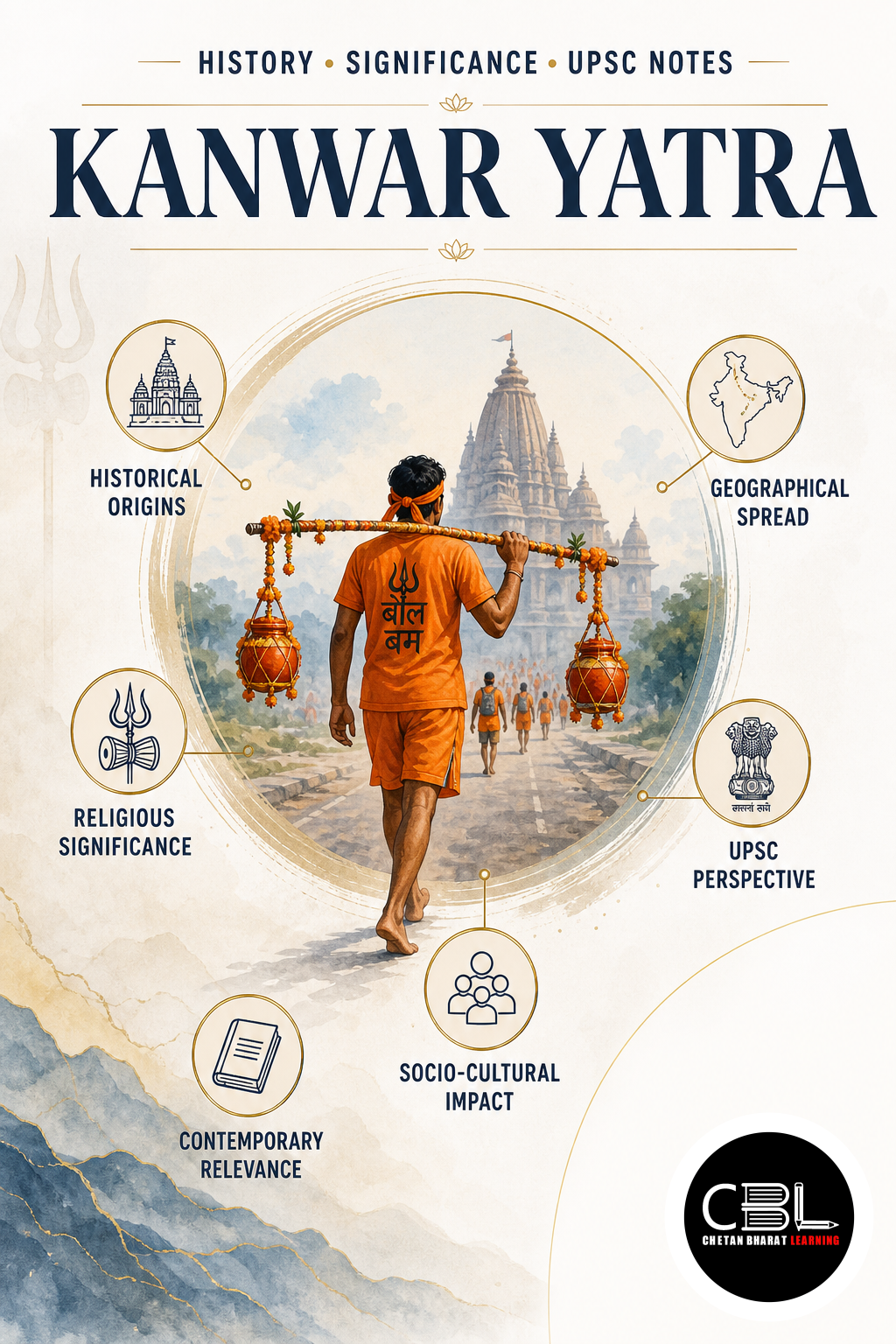
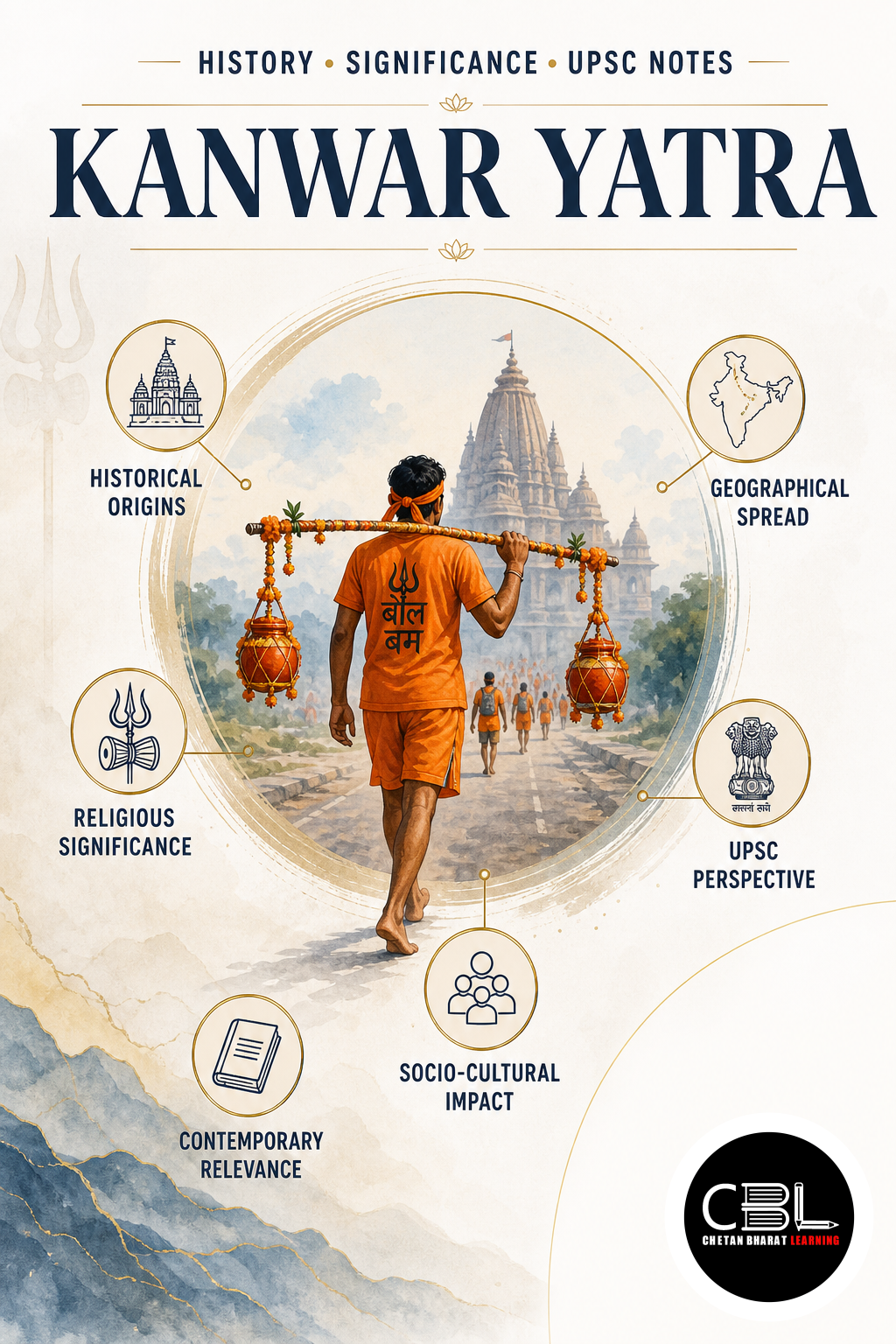
Kanwar Yatra is an annual Hindu pilgrimage undertaken by devotees of Lord Shiva, known as Kanwariyas, during the holy month of Shravan (July–August). Devotees collect sacred water from the River Ganga and carry it over long distances to offer it at Shiva temples and Jyotirlingas.
The pilgrimage symbolises devotion, penance and spiritual discipline. Participants usually travel barefoot while carrying the sacred water in decorated containers suspended from a bamboo pole called the Kanwar.
Why is Kanwar Yatra in News?
Kanwar Yatra has begun across several northern states with extensive traffic management and security arrangements owing to the participation of millions of pilgrims. The annual pilgrimage is one of India’s largest religious gatherings.
Official advisories regarding pilgrim management are issued by the respective state governments, while information on cultural heritage is available through the Ministry of Culture.
Rituals and Symbolism
The pilgrimage is deeply rooted in Hindu symbolism and ritual practice. Devotees collect holy water from sacred locations such as Haridwar, Gangotri, Sultanganj, Prayagraj and Varanasi. The water is offered at Jyotirlingas and Shiva temples as an act of devotion.
- Kanwar: The decorated bamboo pole represents Lord Shiva.
- Water pots: The two suspended pitchers symbolise Brahma and Vishnu.
- Trimurti symbolism: Together, the bamboo pole and water pots signify the Hindu Trimurti.
- Sacred offering: Ganga water is poured over the Shiva Linga during worship.
- Spiritual discipline: Many pilgrims observe fasting, celibacy and barefoot walking during the journey.
Historical Evidence
Kanwar Yatra has a long historical tradition. Archaeological evidence includes a sculpture dating to the 7th or 8th century CE at Kalinjar Fort in present-day Uttar Pradesh depicting a figure carrying a Kanwar.
The evidence suggests that the practice has been associated with Shaivite traditions for many centuries, highlighting the continuity of India’s cultural heritage.
The Twelve Jyotirlingas
The sacred water collected during the pilgrimage is often offered at the twelve revered Jyotirlingas, which represent manifestations of Lord Shiva.
- Gujarat: Somnath and Nageshwar.
- Andhra Pradesh: Mallikarjuna.
- Madhya Pradesh: Mahakaleshwar and Omkareshwar.
- Uttarakhand: Kedarnath.
- Maharashtra: Bhimashankar, Trimbakeshwar and Grishneshwar.
- Uttar Pradesh: Kashi Vishwanath.
- Jharkhand: Baidyanath.
- Tamil Nadu: Ramanathaswamy Temple and Rameswaram.
Cultural Significance
The pilgrimage strengthens India’s living cultural traditions and promotes community participation across regions. It also supports local economies through religious tourism, hospitality and transport services.
- Religious devotion: Expresses faith in Lord Shiva.
- Cultural continuity: Preserves ancient pilgrimage traditions.
- Social participation: Encourages collective worship and volunteer service.
- Economic impact: Generates livelihood opportunities along pilgrimage routes.
- National heritage: Reflects India’s rich diversity of religious practices.
Way Forward
Improved pilgrim facilities, effective traffic management, environmental conservation and coordinated disaster preparedness can make the Kanwar Yatra safer and more sustainable. Public awareness regarding responsible waste disposal and river conservation should complement administrative efforts.
Digital route management, emergency medical services and better inter-state coordination will further strengthen pilgrimage management while preserving its cultural significance. Aspirants should also revise Indian culture topics through the art and culture section and refer to the Archaeological Survey of India for heritage-related information.
Prelims Practice Corner
Q1. Kanwar Yatra is primarily associated with the worship of:
(a) Lord Vishnu (b) Lord Shiva (c) Goddess Durga (d) Lord Ganesha
Answer: (b) Lord Shiva.
Q2. Kanwar Yatra is undertaken during which Hindu month?
(a) Chaitra (b) Kartik (c) Shravan (d) Magha
Answer: (c) Shravan.
Q3. The Kanwar traditionally carries:
(a) Holy fire (b) Ganga water (c) Sandalwood (d) Tulsi leaves
Answer: (b) Ganga water.
Q4. Historical evidence of Kanwar Yatra is found at:
(a) Chittorgarh Fort (b) Kalinjar Fort (c) Gwalior Fort (d) Golconda Fort
Answer: (b) Kalinjar Fort.
Q5. Which of the following is a Jyotirlinga located in Gujarat?
(a) Kedarnath (b) Somnath (c) Mahakaleshwar (d) Baidyanath
Answer: (b) Somnath.
Mains Practice Questions
Q1. Discuss the cultural significance of the Kanwar Yatra in preserving India’s religious traditions. (10 marks)
Answer Structure:
- Intro: Introduce Kanwar Yatra.
- Body: Rituals, symbolism, historical evidence, cultural importance and socio-economic impact.
- Conclusion: Highlight the importance of preserving India’s living cultural heritage.
Q2. Examine the role of pilgrimage traditions in strengthening India’s cultural unity and heritage. (15 marks)
Answer Structure:
- Intro: Define pilgrimage traditions.
- Body: Religious significance, heritage conservation, tourism, community participation and challenges.
- Conclusion: Emphasise sustainable preservation of India’s cultural traditions.
FAQs on Kanwar Yatra
What is Kanwar Yatra?
Kanwar Yatra is an annual pilgrimage undertaken by devotees of Lord Shiva during the month of Shravan, carrying Ganga water to offer at Shiva temples and Jyotirlingas.
Why do devotees carry the Kanwar?
The bamboo Kanwar symbolises Lord Shiva, while the two water pots represent Brahma and Vishnu, together signifying the Trimurti.
Why is Kanwar Yatra important for UPSC?
It is important for UPSC Prelims under Indian Art and Culture, pilgrimage traditions, Jyotirlingas and religious heritage.
Related Current Affairs
Preparing for UPSC, PCS or HCS?
Talk to a mentor at Chetan Bharat Learning, Chandigarh. Free guidance on choosing the right exam and building a study plan.
Chat on WhatsAppCall 97793 53345UPSC / IAS / PCS coaching in Chandigarh · Trusted by aspirants across Punjab & Haryana
Leave a Reply
You must be logged in to post a comment.