

UPSC Mapping
Prelims
- National Parks, Assam, Golden Langur, Rivers, Biodiversity
Mains
- GS Paper III – Biodiversity Conservation, Protected Areas & Wildlife
Quick Facts
| State | Assam |
|---|---|
| District | Kokrajhar |
| Region | Bodoland Territorial Region |
| Border | India–Bhutan |
What is Raimona National Park?
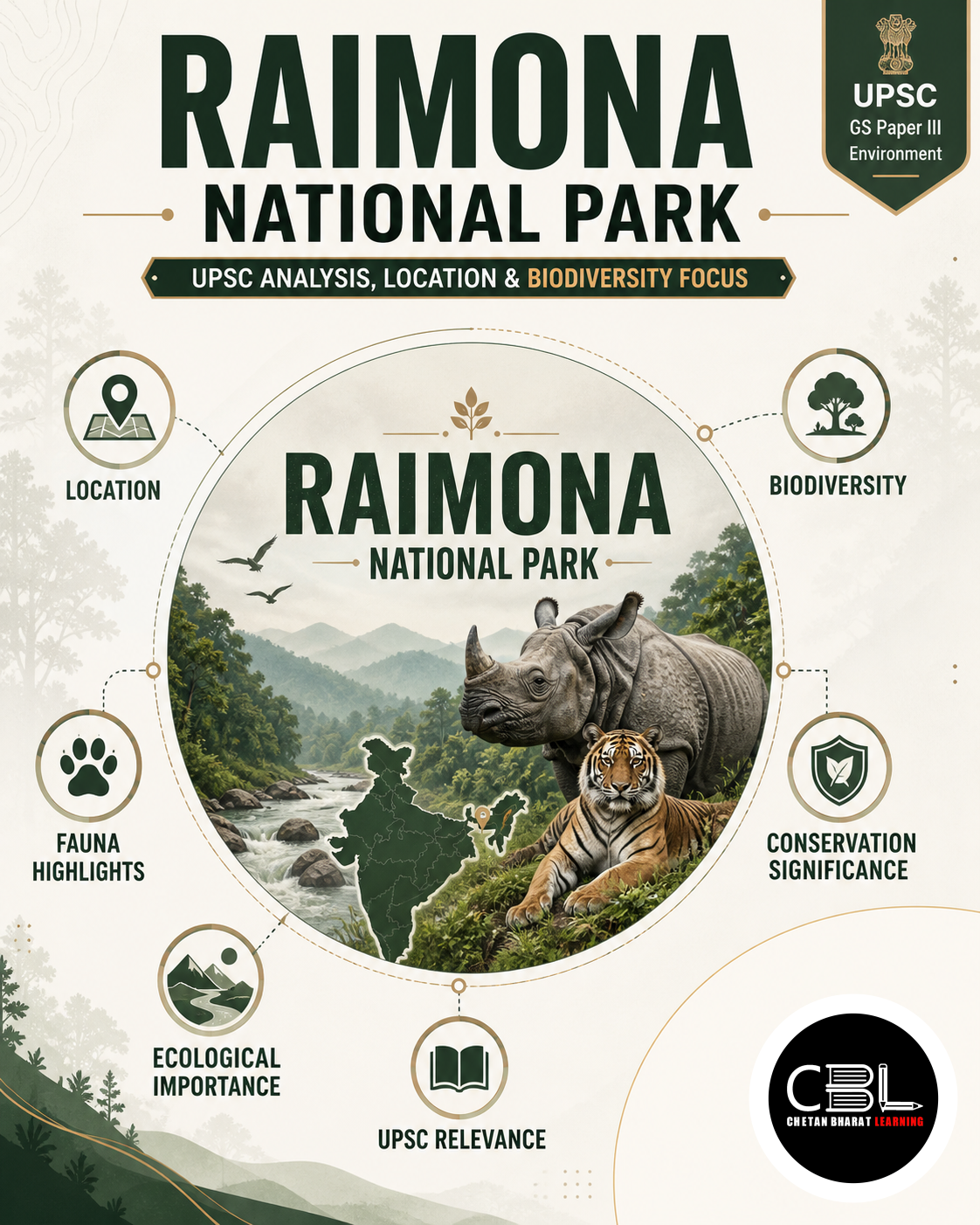
Raimona National Park is located in the Kokrajhar district of Assam within the Bodoland Territorial Region. Situated along the India–Bhutan border at the foothills of the Eastern Himalayas, it is one of the newest national parks in India and an important biodiversity hotspot in Northeast India.
The park forms part of a vast transboundary conservation landscape by connecting with Bhutan’s Phibsoo Wildlife Sanctuary and Jigme Singye Wangchuck National Park. Together, these protected areas create a contiguous forest ecosystem covering more than 2,400 sq km, enabling free movement of wildlife across international boundaries.
Why is Raimona National Park in News?
Raimona National Park recently attracted attention after a firing incident was reported in the Athiabari Range during an operation against suspected illegal deforestation. The incident has renewed focus on forest protection, anti-encroachment measures and conservation of ecologically sensitive habitats in Assam.
The park is also significant because it safeguards several endangered species and strengthens cross-border wildlife conservation between India and Bhutan. Official information on protected areas is available through the Ministry of Environment, Forest and Climate Change.
Key Features of Raimona National Park
- Strategic location: Lies along the India–Bhutan border contributing to an internationally connected forest ecosystem.
- Major rivers: Sankosh (western boundary), Saralbhanga (eastern side) and Pekua (southern boundary).
- Rich vegetation: Tropical forests, riverine grasslands, orchids, bamboo and wetlands.
- Flagship species: One of the most important habitats of the endangered Golden Langur.
- High biodiversity: Bengal tiger, Asian elephant, gaur, wild buffalo, clouded leopard, hornbills, 170+ bird species and 150+ butterfly species.
Conservation Significance
- Golden Langur conservation: Crucial habitat for this endangered primate.
- Transboundary cooperation: Connectivity with Bhutan enhances wildlife movement and genetic diversity.
- Climate resilience: Forests contribute to carbon sequestration and watershed protection.
- Biodiversity hotspot: Conserves unique floral and faunal diversity of Northeast India.
- Eco-tourism potential: Sustainable tourism can support local livelihoods and conservation.
Challenges
- Illegal deforestation: Encroachment and illicit tree felling.
- Human–wildlife conflict: Rising interactions with nearby communities.
- Habitat fragmentation: Infrastructure development affecting connectivity.
- Poaching: Continuous monitoring and enforcement needed.
- Cross-border coordination: Sustained cooperation between India and Bhutan.
Way Forward
Strengthening anti-poaching infrastructure, enhancing community participation and improving scientific wildlife monitoring will help protect Raimona National Park’s unique biodiversity. Greater investment in habitat restoration and eco-development programmes can further reduce conservation pressures.
India and Bhutan should continue to strengthen transboundary conservation initiatives to protect shared ecosystems and migratory wildlife while promoting sustainable development in border regions. Additional information is available through the National Tiger Conservation Authority.
Prelims Practice Corner
Q1. Raimona National Park is located in which state?
(a) Arunachal Pradesh
(b) Assam
(c) Meghalaya
(d) Nagaland
Answer: (b) Raimona National Park is located in Assam’s Kokrajhar district.
Q2. Which river forms the western boundary of Raimona National Park?
(a) Manas
(b) Sankosh
(c) Subansiri
(d) Jia Bharali
Answer: (b) The Sankosh River forms the western boundary.
Q3. Which endangered species is regarded as the mascot of the Bodoland region?
(a) Hoolock Gibbon
(b) Golden Langur
(c) Red Panda
(d) Lion-tailed Macaque
Answer: (b) The Golden Langur is the mascot of the Bodoland region.
Q4. Raimona National Park forms a transboundary conservation landscape with protected areas in:
(a) Nepal
(b) Bangladesh
(c) Bhutan
(d) Myanmar
Answer: (c) It connects with Phibsoo Wildlife Sanctuary and Jigme Singye Wangchuck National Park in Bhutan.
Q5. Raimona National Park is situated at the foothills of the:
(a) Aravalli Range
(b) Vindhya Range
(c) Eastern Himalayas
(d) Satpura Range
Answer: (c) The park lies at the foothills of the Eastern Himalayas.
Mains Practice Questions
Q1. Discuss the ecological significance of Raimona National Park in conserving biodiversity in Northeast India. (10 marks)
- Intro: Introduce the park and its location.
- Body: Explain biodiversity, transboundary conservation, flagship species and ecological importance.
- Conclusion: Highlight integrated landscape conservation.
Q2. Evaluate the importance of transboundary protected areas in wildlife conservation with reference to Raimona National Park. (15 marks)
- Intro: Explain transboundary conservation.
- Body: Discuss ecological connectivity, wildlife movement, conservation challenges and international cooperation.
- Conclusion: Emphasise collaborative biodiversity management.
FAQs on Raimona National Park
Where is Raimona National Park located?
Raimona National Park is located in Kokrajhar district of Assam within the Bodoland Territorial Region, along the India–Bhutan border.
Which is the flagship species of Raimona National Park?
The endangered Golden Langur is the flagship species of the park and the mascot of the Bodoland region.
Why is Raimona National Park important for UPSC?
It is important because of its biodiversity, transboundary conservation landscape, protected area status, unique species and relevance to environment and geography in both Prelims and Mains.
Related Current Affairs
Preparing for UPSC, PCS or HCS?
Talk to a mentor at Chetan Bharat Learning, Chandigarh. Free guidance on choosing the right exam and building a study plan.
Chat on WhatsAppCall 97793 53345UPSC / IAS / PCS coaching in Chandigarh · Trusted by aspirants across Punjab & Haryana
Leave a Reply
You must be logged in to post a comment.