
UPSC Mapping
| Prelims | Science & Tech |
|---|---|
| Mains | GS Paper 3 |
| Launch Year | 2023 |
|---|---|
| Ministry | DST |
| Type | Mission Mode |
| Authority | DST and TIFR |
What is Quantum Mission?
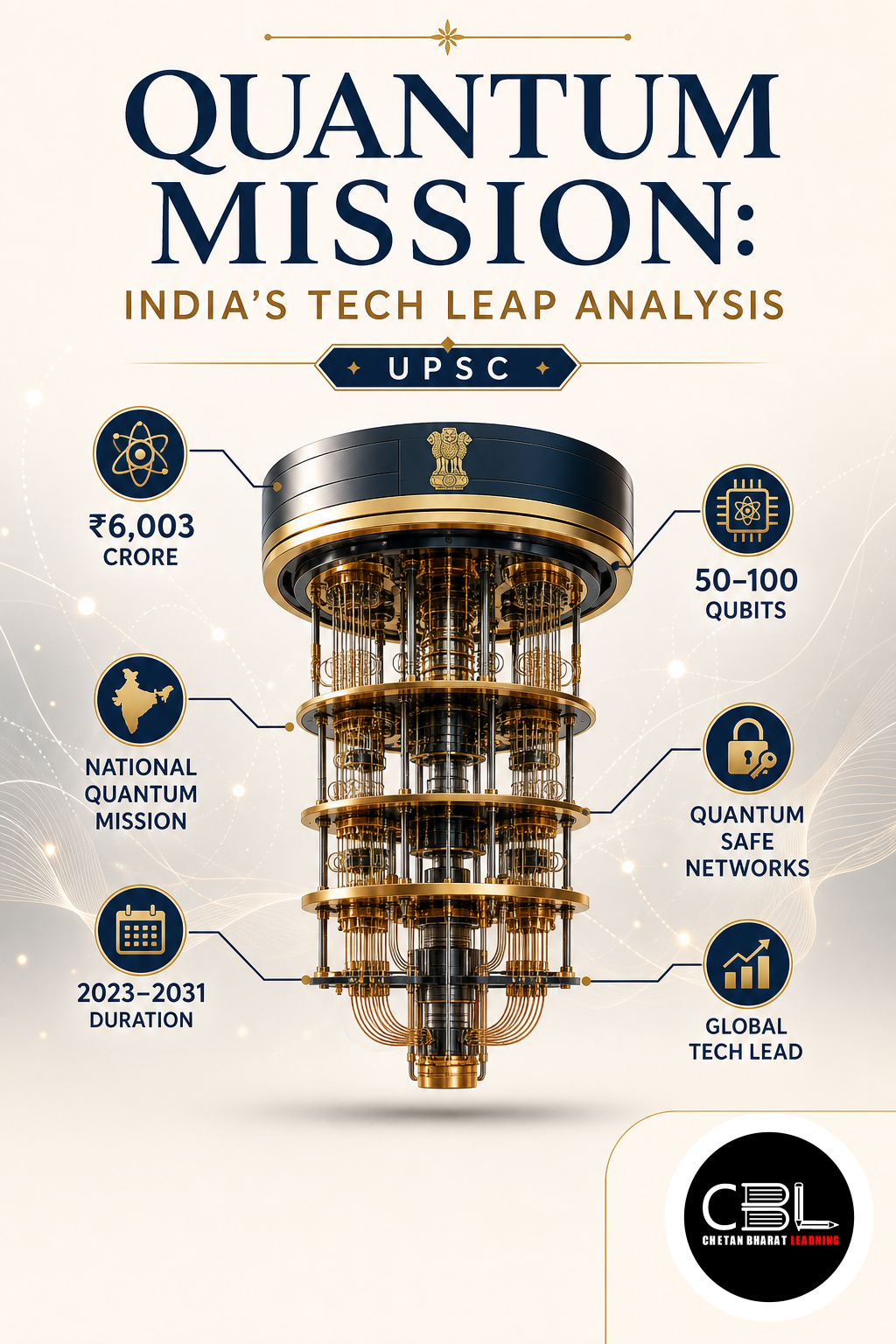
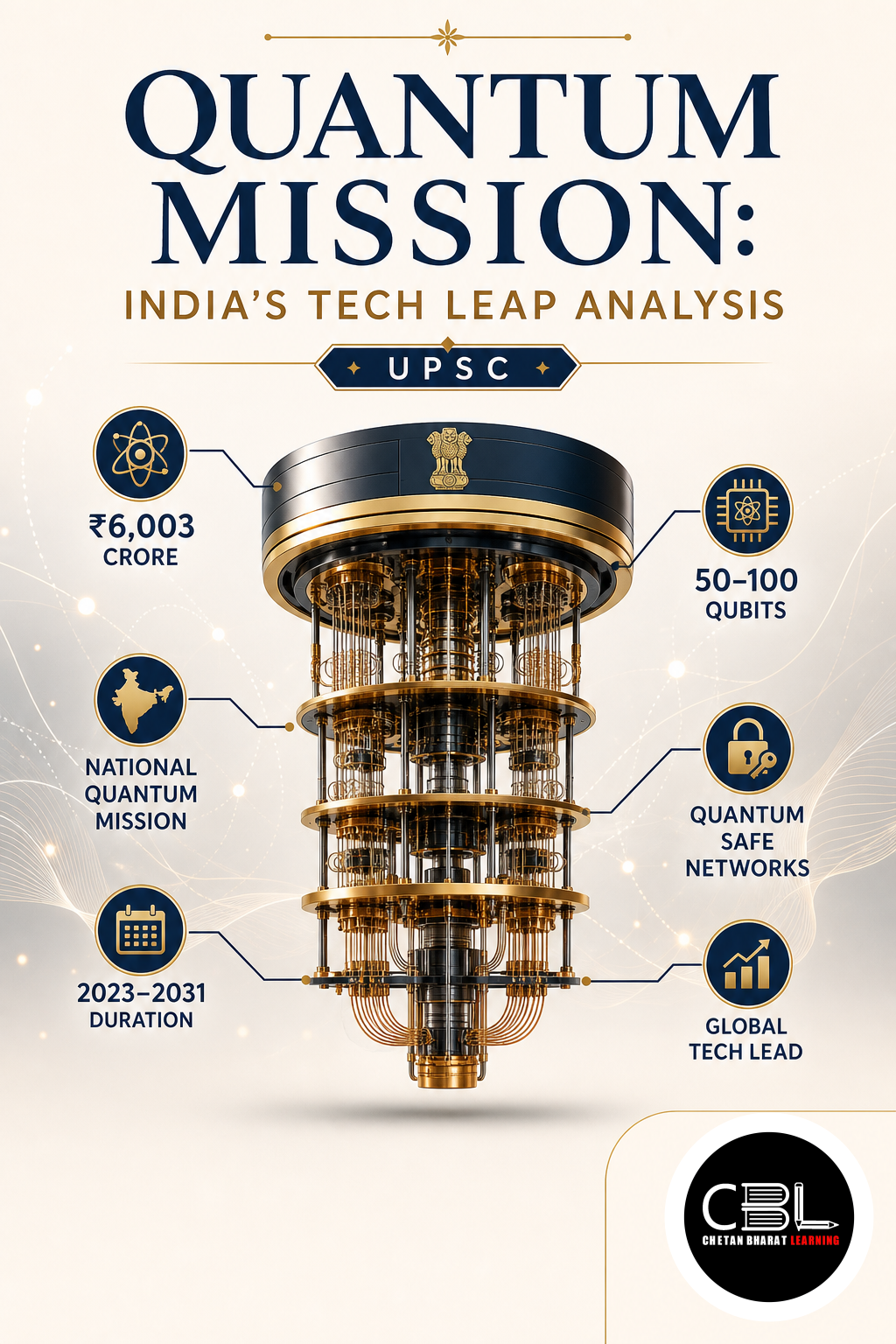
The Quantum Mission represents a strategic push to develop intermediate-scale quantum computers with 50-1000 physical qubits. These advanced machines leverage quantum mechanics principles like superposition and entanglement to solve complex computational problems. This capability completely outpaces traditional supercomputers when handling specific cryptographic and optimization tasks.
The initiative primarily operates through the establishment of four specialized Thematic Hubs across premier academic institutions. These hubs focus on quantum computing, communication, sensing, and materials science. The government aims to create a complete ecosystem covering fundamental research, device fabrication, and commercial application development.
Industry experts consider this deep technology the cornerstone of future national security and economic competitiveness globally. Heavy sectors like pharmaceutical manufacturing and financial modeling cannot easily process massive datasets using classical silicon-based architectures. Replacing classical algorithms with quantum alternatives provides the only viable pathway to eliminate stubborn computational bottlenecks entirely.
The government also envisions creating specialized export hubs for quantum-safe cryptographic software to serve international markets. Secure digital channels equipped with quantum key distribution will eventually transmit sensitive financial data to energy-hungry nations across Europe and East Asia. This digital logistics network will firmly establish the country as a dominant global supplier of secure communication protocols.
Why is Quantum Mission in News?
The Department of Science and Technology recently approved substantial financial outlays to accelerate the Quantum Mission. Several state governments have also announced complementary policies to attract massive private investments into the sector. A recent PIB release highlighted the successful allocation of funds under the thematic hub schemes.
International partnerships are simultaneously expanding research access for Indian scientists entering the global deep-tech markets. Global demand for secure communication networks continues to rise sharply as developed nations enforce stricter data protection protocols. These regulatory shifts create highly lucrative opportunities for domestic startups scaling up their quantum cryptography operations rapidly.
Recent diplomatic engagements have secured multiple bilateral agreements to jointly develop advanced production technologies and safety standards. These international collaborations significantly reduce the financial risks associated with pioneering such complex and capital-intensive research projects. Foreign direct investment is expected to surge as global conglomerates seek reliable long-term technology supply contracts.
Domestic research institutions are simultaneously working on reducing the heavy reliance on expensive imported cryogenic cooling systems. Innovations in alternative high-temperature superconducting materials could dramatically lower the overall capital expenditure required for setting up new laboratory facilities. Such technological breakthroughs remain absolutely essential for making the hardware commercially competitive against established global alternatives.
Key Features
- Thematic Hubs: Establishes four dedicated research centers in top IITs and scientific institutes to drive specialized innovation.
- Quantum Computers: Targets the development of machines with 50-1000 physical qubits for complex problem-solving applications.
- Secure Networks: Dedicated funding supports the creation of a 2000-kilometer quantum communication network across the country.
- Sensing Applications: Researchers will develop highly sensitive magnetometers and atomic clocks for precise navigation and disaster warning systems.
- Material Science: Focuses on discovering novel superconducting materials required to build stable quantum hardware components.
Challenges
- High Infrastructure Costs: Maintaining near-absolute zero temperatures for quantum processors requires extremely expensive cryogenic dilution refrigerators.
- Talent Deficit: The country currently faces a severe shortage of specialized physicists and quantum engineers capable of designing complex algorithms.
- Decoherence Issues: Quantum states are highly fragile and easily disrupted by minor environmental noise, leading to high computational error rates.
- Hardware Reliance: Domestic researchers still heavily depend on imported components for advanced microwave control systems and specialized lasers.
- Commercial Viability: Translating fundamental laboratory breakthroughs into scalable commercial products requires massive long-term patient capital investments.
Way Forward
The government must aggressively pursue international technology transfer agreements to localize advanced cryogenic manufacturing capabilities. Establishing joint ventures with global leaders will rapidly bridge existing technological gaps in domestic supply chains. A comprehensive DST strategy should also prioritize skilling programs to create a specialized workforce capable of managing these complex facilities.
Developing robust domestic demand mandates for the Quantum Mission in banking and defense will provide crucial initial market certainty. Simultaneously, policymakers must streamline intellectual property rights for academic spin-offs to encourage rapid commercialization. Long-term success ultimately depends on creating a self-sustaining commercial ecosystem independent of perpetual state subsidies.
Policymakers must also introduce standardized safety protocols and certification mechanisms to build confidence among international partners and domestic consumers. Harmonizing these regulatory frameworks with established global standards will eliminate unnecessary trade barriers and facilitate smoother cross-border technology transactions. A unified national certification authority could oversee quality control across all regional research hubs.
Furthermore, integrating massive classical computing grids with quantum processors requires advanced hybrid algorithms and high-capacity error correction protocols. Upgrading the existing national supercomputing infrastructure will prevent data bottlenecks and ensure maximum utilization of generated quantum insights. These complementary investments will ultimately determine the true scientific integrity and economic feasibility of the entire value chain.
Prelims Practice Corner
-
Q1. Which ministry acts as the primary nodal agency for the Quantum Mission?
(a) Ministry of Electronics and IT (b) Department of Science and Technology (c) Ministry of Education (d) NITI Aayog
Answer: (b) The Department of Science and Technology oversees the implementation and funding of the mission.
-
Q2. The mission primarily operates through the establishment of which specialized centers?
(a) Centres of Excellence in AI (b) Thematic Hubs in premier institutes (c) National Supercomputing Grids (d) Space Research Labs
Answer: (b) It establishes four Thematic Hubs focusing on computing, communication, sensing, and materials science.
-
Q3. Quantum computers leverage which specific principles to solve complex computational problems?
(a) Classical mechanics and thermodynamics (b) Superposition and entanglement (c) Nuclear fission and fusion (d) Relativity and gravity
Answer: (b) They utilize quantum mechanics principles like superposition and entanglement to process massive datasets simultaneously.
-
Q4. What is a major technical challenge associated with maintaining quantum processors?
(a) High electricity consumption (b) Requirement of near-absolute zero temperatures (c) Excessive heat generation (d) Large physical footprint
Answer: (b) Maintaining stable quantum states requires extremely expensive cryogenic dilution refrigerators to reach near-absolute zero temperatures.
-
Q5. What is the targeted scale of quantum computers under this mission?
(a) 10-50 physical qubits (b) 50-1000 physical qubits (c) 10,000-50,000 physical qubits (d) 1 million physical qubits
Answer: (b) The mission targets the development of intermediate-scale machines with 50-1000 physical qubits.
Mains Practice Questions
-
Q1. Discuss the potential of the Quantum Mission in securing India’s digital infrastructure and advancing scientific research. What are the key infrastructure bottlenecks hindering its immediate success? (250 words)
Answer Structure:
- Intro: Define the mission and its core objective to achieve technological sovereignty in deep-tech sectors.
- Body: Discuss potential in quantum-safe cryptography, drug discovery, and financial modeling. Highlight bottlenecks like cryogenic infrastructure deficits, decoherence issues, and talent shortages.
- Conclusion: Emphasize the need for international technology partnerships and specialized skilling programs to ensure commercial viability.
-
Q2. Establishing domestic demand mandates is crucial for the commercial viability of quantum technologies. Analyze this statement in the context of global deep-tech transitions and India’s export ambitions. (150 words)
Answer Structure:
- Intro: Explain the concept of demand mandates in defense and banking, and their role in de-risking private investments.
- Body: Link domestic consumption to economies of scale. Discuss how scale reduces costs, making quantum-safe software exports competitive against global players.
- Conclusion: Conclude that a strong domestic market acts as the foundational launchpad for becoming a global deep-tech hub.
FAQs on Quantum Mission
- What is the main difference between classical and quantum computing?
- Classical computers process information in binary bits (0s and 1s) sequentially. Quantum computers use qubits that leverage superposition to process multiple states simultaneously, solving specific complex problems exponentially faster.
- How will the mission benefit the Indian economy?
- The initiative will create thousands of high-value engineering jobs while securing the country’s critical digital infrastructure against future cyber threats. It also positions India as a major global exporter of advanced cryptographic software.
- Why is decoherence a major concern for quantum hardware development?
- Quantum states are extremely fragile and easily disrupted by minor environmental noise or temperature fluctuations. This decoherence leads to high computational error rates, requiring complex and expensive error correction protocols.
Related Current Affairs
Preparing for UPSC, PCS or HCS?
Talk to a mentor at Chetan Bharat Learning, Chandigarh. Free guidance on choosing the right exam and building a study plan.
Chat on WhatsAppCall 97793 53345UPSC / IAS / PCS coaching in Chandigarh · Trusted by aspirants across Punjab & Haryana
Leave a Reply
You must be logged in to post a comment.