

UPSC Mapping
- Prelims: Food Security, NFSA, PDS Reforms and Government Schemes
- Mains: GS Paper III – Agriculture, Food Security and Technology in Governance
Quick Facts
| Key Law | National Food Security Act |
|---|---|
| ePoS Coverage | 99.6% Fair Price Shops |
| Aadhaar Authentication | Over 97% |
| ONORC Launch | 2019 |
What is the Public Distribution System?
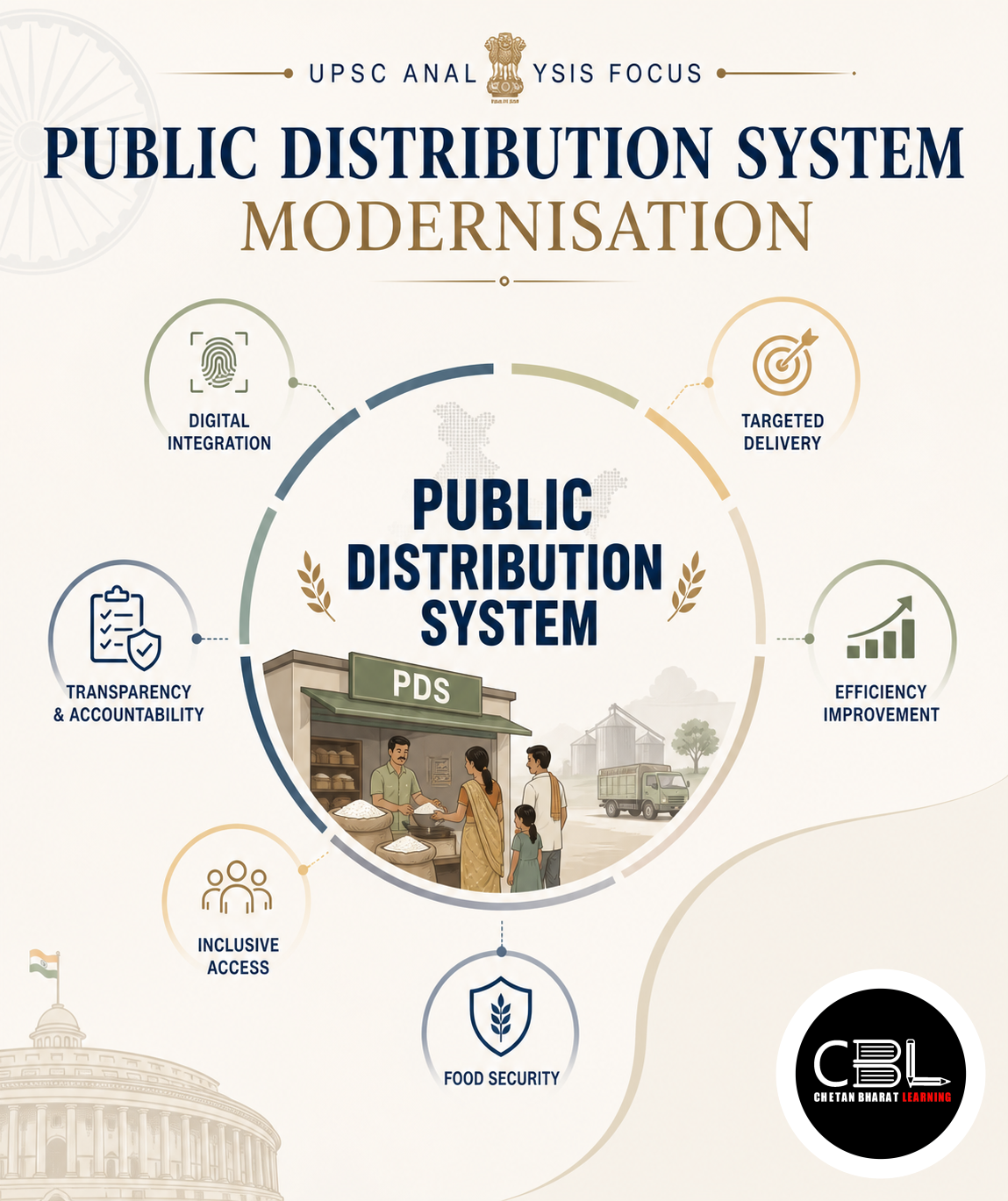
The Public Distribution System is India’s primary food security mechanism that distributes subsidised foodgrains to eligible households through a nationwide network of Fair Price Shops (FPSs). It operates under the National Food Security Act, 2013, ensuring affordable access to essential food commodities.
In recent years, the government has increasingly adopted digital technologies to improve transparency, eliminate leakages, strengthen beneficiary authentication and enhance supply-chain efficiency across the PDS ecosystem.
Why is the Public Distribution System in News?
The Public Distribution System is in the news after a Parliamentary Standing Committee on Consumer Affairs, Food and Public Distribution identified approximately 2.91 crore suspect or ineligible beneficiaries, including silent and deceased beneficiaries. The report recommended strengthening beneficiary verification and accelerating digital reforms.
The Committee also emphasised improving connectivity, ensuring inclusion and enhancing the financial sustainability of Fair Price Shops. Official information is available through the Department of Food and Public Distribution (dfpd.gov.in).
Government Initiatives for Public Distribution System Modernisation
- ePoS Automation (2014): Automates Fair Price Shop transactions through biometric authentication. It covers 99.6% of FPSs, with over 97% of transactions Aadhaar-authenticated.
- SARTHAK-PDS (2026): Integrates technology-based reforms under a unified framework to automate grievance redressal and strengthen end-to-end supply-chain logistics.
- SMART-PDS (2023): Creates a unified digital platform integrating procurement, allocation, logistics, ration cards and biometric distribution across states.
- Anna Chakra Platform (2024): Optimises foodgrain transportation using demand, stock and logistics data, reducing transit time, diversion risks and transportation costs.
- One Nation One Ration Card (ONORC) (2019): Enables eligible beneficiaries, particularly migrant workers, to access foodgrain entitlements from any Fair Price Shop across India.
Significance of Public Distribution System Modernisation
- Greater transparency: Digital beneficiary authentication reduces duplication and fraudulent claims.
- Efficient supply chain: Real-time monitoring improves procurement, storage and foodgrain distribution.
- Portability: ONORC strengthens food security for migrant workers through nationwide access.
- Reduced leakages: Digital tracking limits diversion of subsidised foodgrains.
- Improved accountability: Integrated databases support evidence-based policy implementation.
Challenges in Public Distribution System Modernisation
- Connectivity gaps: Weak internet connectivity disrupts biometric authentication in remote regions.
- Biometric failures: Worn fingerprints among elderly persons and manual workers may lead to authentication failures.
- Financial viability of FPSs: Inter-state portability can reduce dealer commissions and affect business sustainability.
- Outdated beneficiary database: NFSA coverage remains linked to the 2011 Census, excluding many newly vulnerable households.
- Regional disparities: Aadhaar seeding and digital infrastructure vary considerably across states, creating uneven service delivery.
Recommendations of the Standing Committee
- Mission-mode verification: Conduct time-bound field verification of flagged beneficiaries while preventing wrongful exclusion.
- Solutions for no-network areas: Introduce offline synchronisation, alternative authentication methods and dedicated connectivity for remote FPSs.
- Strengthen FPS viability: Increase dealer margins, integrate electronic weighing scales with ePoS devices and allow additional citizen-centric services.
- Periodic DBT assessment: Compare direct benefit transfers with physical foodgrain distribution before expanding the DBT model.
- Integrated databases: Link PDS databases with FCI, CWC and UIDAI to improve beneficiary verification and supply-chain monitoring.
Way Forward
The future of the Public Distribution System depends on balancing technological innovation with social inclusion. Reliable offline authentication, updated beneficiary databases and stronger digital infrastructure can ensure that reforms improve efficiency without excluding deserving households.
Regular database verification, interoperability across government agencies and investments in digital infrastructure will enhance food security and strengthen public trust in welfare delivery. Additional information is available through the National Food Security Portal.
Prelims Practice Corner
Q1. The One Nation One Ration Card (ONORC) scheme was launched in:
- 2017
- 2018
- 2019
- 2020
Answer: (c) 2019.
Q2. The Public Distribution System primarily operates under which Act?
- Essential Commodities Act
- National Food Security Act
- Food Safety Act
- Consumer Protection Act
Answer: (b) National Food Security Act.
Q3. SARTHAK-PDS primarily focuses on:
- Agricultural exports
- Technology-based PDS integration
- Crop insurance
- Fertiliser subsidy
Answer: (b) Technology-based PDS integration.
Q4. Anna Chakra Platform is designed to:
- Procure MSP crops
- Optimise foodgrain transport
- Register farmers
- Monitor rainfall
Answer: (b) Optimise foodgrain transport.
Q5. Which agency is recommended for integration with PDS databases for beneficiary verification?
- UIDAI
- RBI
- SEBI
- TRAI
Answer: (a) UIDAI.
Mains Practice Questions
Q1. Discuss the role of digital technologies in modernising India’s Public Distribution System while ensuring inclusion of vulnerable households. (10 marks)
- Intro: Introduce PDS and its significance.
- Body: Digital initiatives, benefits, implementation challenges and reforms.
- Conclusion: Highlight inclusive and technology-enabled food security.
Q2. Evaluate the effectiveness of the One Nation One Ration Card initiative in strengthening food security and migrant welfare in India. (15 marks)
- Intro: Explain the rationale behind ONORC.
- Body: Portability, digital reforms, implementation issues and policy recommendations.
- Conclusion: Link portability with inclusive welfare delivery.
FAQs on Public Distribution System
What is the Public Distribution System?
The Public Distribution System is India’s food security mechanism that distributes subsidised foodgrains to eligible households through Fair Price Shops under the National Food Security Act.
What is One Nation One Ration Card?
The One Nation One Ration Card scheme enables eligible beneficiaries to access subsidised foodgrains from any Fair Price Shop across India, supporting migrant workers and portability.
Why is Public Distribution System modernisation important for UPSC?
It is relevant for GS Paper III under agriculture, food security, welfare schemes, digital governance and technology-driven public service delivery.
Related Current Affairs
Preparing for UPSC, PCS or HCS?
Talk to a mentor at Chetan Bharat Learning, Chandigarh. Free guidance on choosing the right exam and building a study plan.
Chat on WhatsAppCall 97793 53345UPSC / IAS / PCS coaching in Chandigarh · Trusted by aspirants across Punjab & Haryana
Leave a Reply
You must be logged in to post a comment.