
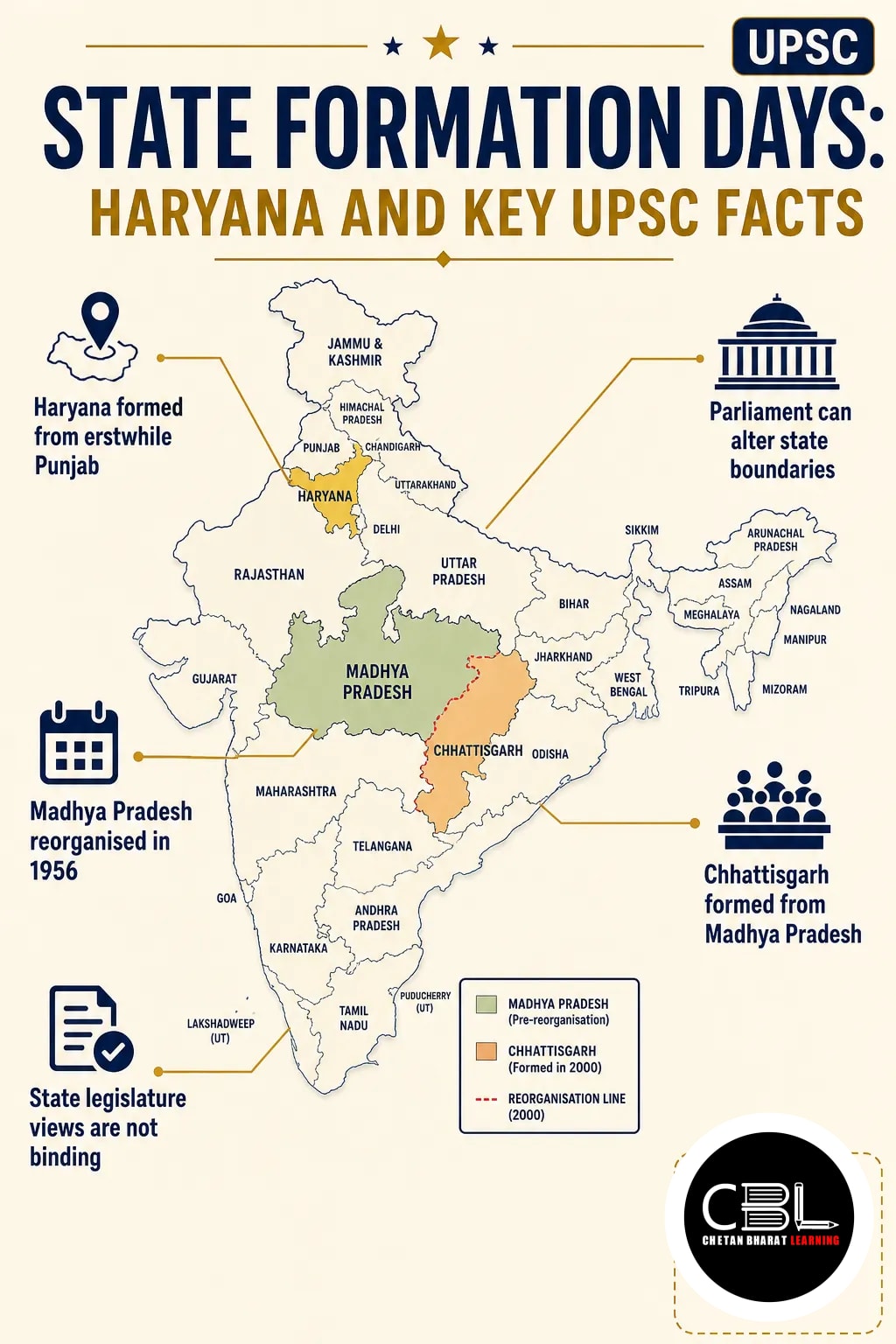

State formation days brought Haryana, Chhattisgarh and Madhya Pradesh into focus on 1 November 2026. Prime Minister Narendra Modi greeted their residents; the occasion also offers a chance to revise Indian polity and federalism.
Quick answer: On 1 November 2026, Prime Minister Narendra Modi extended state formation day greetings to Haryana, Chhattisgarh and Madhya Pradesh. Haryana was formed in 1966, Chhattisgarh in 2000 and the reorganised Madhya Pradesh in 1956. The occasion links state histories with Parliament’s constitutional powers over state boundaries.
Why are these states in the news?
Prime Minister Narendra Modi greeted residents of the three states on their formation days. In his Haryana message, he highlighted its folk traditions and rural culture. He also recognised contributions to agriculture, sports, defence services, industry, education and start-ups.
In particular, he linked farmers with food security and acknowledged the achievements of athletes. The greetings provide a factual starting point for studying state formation days and the laws behind them.
Which states mark 1 November?
Haryana, Chhattisgarh and Madhya Pradesh each observe their formation day on 1 November, although their histories differ.
| State and year | Formation fact |
|---|---|
| Haryana, 1966 | Created from the erstwhile Punjab under the Punjab Reorganisation Act, 1966. |
| Chhattisgarh, 2000 | Created from Madhya Pradesh under the Madhya Pradesh Reorganisation Act, 2000. |
| Madhya Pradesh, 1956 | Reorganised under the States Reorganisation Act, 1956. |
Thus, a common anniversary does not mean a common year of formation. Moreover, Chhattisgarh’s creation changed the boundaries of Madhya Pradesh. For wider context, see states reorganisation in India.
What does the Constitution say about state reorganisation?
Article 3 empowers Parliament to form new states and alter existing states’ areas, boundaries or names by law. However, a Bill for this purpose requires the President’s recommendation before introduction.
When a proposal affects a state, the President refers the Bill to its legislature for its views. Those views are not binding on Parliament. Moreover, under Article 4, a law under Article 3 is not treated as a constitutional amendment under Article 368.
Why does this matter for UPSC?
State formation days connect dates and parent states with the constitutional process of reorganisation. Therefore, aspirants should distinguish a state legislature’s opportunity to express its views from a requirement for its consent.
Source: Press Information Bureau, 1 November 2026
Haryana’s creation from the erstwhile Punjab is directly relevant to both Haryana and Punjab state examinations. Therefore, revise the Punjab Reorganisation Act, 1966, alongside Article 3.
Prelims Practice Corner
Mains Practice Questions
Frequently Asked Questions
When was Haryana formed?
Haryana was formed on 1 November 1966. It was created from the erstwhile Punjab under the Punjab Reorganisation Act, 1966.
Which state was Chhattisgarh formed from?
Chhattisgarh was formed from Madhya Pradesh on 1 November 2000. The Madhya Pradesh Reorganisation Act, 2000, provided for its creation.
Does state reorganisation require the state legislature’s consent?
No, because the affected state legislature’s views are not binding on Parliament. However, the President refers the relevant Bill to the legislature for its views.
Related Current Affairs
Preparing for UPSC, PCS or HCS?
Talk to a mentor at Chetan Bharat Learning, Chandigarh. Free guidance on choosing the right exam and building a study plan.
Chat on WhatsAppCall 97793 53345UPSC / IAS / PCS coaching in Chandigarh · Trusted by aspirants across Punjab & Haryana

 Ananya RanaIAS · AIR 60
 Aditya SharmaIAS · AIR 70
 Ria Kaur SethiIPS · AIR 89
 Aman AloonIRS · AIR 295
 Sumer Singh VirkIRS · AIR 335
 Shivani PanchalIAS

Leave a Reply
You must be logged in to post a comment.