
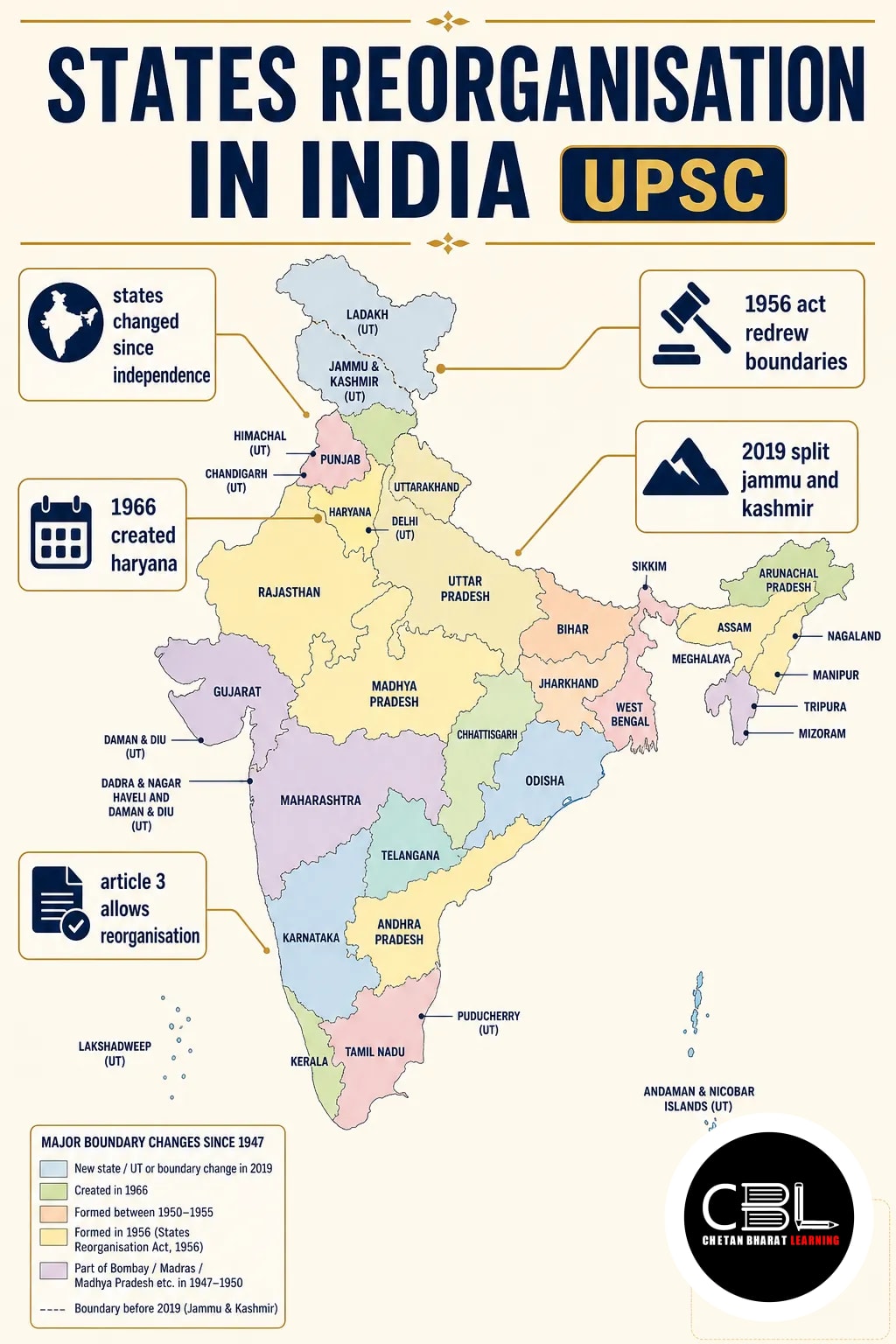

States reorganisation in India has reshaped internal boundaries since Independence. For broader constitutional context, explore CBL’s polity current affairs.
Quick answer: States reorganisation in India began after Independence in 1947 and continued through several phases. India now has 28 States and eight Union Territories. The latest reorganisation, in 2019, created the Union Territories of Jammu and Kashmir and Ladakh from the former State of Jammu and Kashmir.
How has India’s map changed since 1947?
India’s internal map changed through integration and subsequent reorganisation. The following milestones are useful for tracing states reorganisation in India.
| Year | Event |
|---|---|
| 1947 | British paramountcy lapsed; India and Pakistan became independent dominions. |
| 1953 | Andhra State was formed; the States Reorganisation Commission was appointed. |
| 1956 | The States Reorganisation Act redrew boundaries largely along linguistic lines. |
| 1960 | Bombay State was divided into Maharashtra and Gujarat. |
| 1966 | Punjab was reorganised; Haryana became a separate State. |
| 2000 | Chhattisgarh, Uttarakhand and Jharkhand were formed. |
| 2014 | Telangana was formed from Andhra Pradesh. |
| 2019 | Jammu and Kashmir was reorganised into two Union Territories: Jammu and Kashmir, and Ladakh. |
What happened to princely states in 1947?
British paramountcy over princely states lapsed under the Indian Independence Act, 1947. Before Independence, the subcontinent included provinces and more than 550 princely states.
Nearly 114 had joined India through the Instrument of Accession before 15 August 1947, according to the source. Most of the remaining princely states subsequently chose India rather than Pakistan.
Which constitutional provisions govern state boundaries?
Articles 1, 3 and 4 provide the principal constitutional framework for India’s territorial organisation and state boundary changes.
- Article 1: It describes India as a Union of States; the First Schedule lists States and Union Territories.
- Article 3: Parliament can form new States and alter existing States’ areas, boundaries or names.
- Procedure: An Article 3 Bill requires the President’s recommendation; the President refers a proposal affecting a State to its legislature for its views.
- Article 4: A law under Article 3 can amend the First and Fourth Schedules; it is not treated as a constitutional amendment under Article 368.
The concerned State legislature’s views do not bind Parliament. Therefore, its consent is not a prerequisite for reorganisation.
Why does this history matter for UPSC?
States reorganisation in India connects constitutional procedure with language, federalism and map-based questions. For example, candidates should distinguish the 1956 linguistic reorganisation from the 2019 creation of two Union Territories.
For a contemporary governance issue in one of those territories, see CBL’s coverage of Ladakh’s liquor policy protests.
Source: The Hindu, 1 November 2026
Punjab’s 1966 reorganisation created Haryana as a separate State. Therefore, revise this event alongside Article 3 and the status of Chandigarh as a Union Territory.
Prelims Practice Corner
Mains Practice Questions
Frequently Asked Questions
How many States and Union Territories does India have?
India has 28 States and eight Union Territories. The 2019 reorganisation created the Union Territories of Jammu and Kashmir and Ladakh.
Which Article allows Parliament to alter State boundaries?
Article 3 allows Parliament to alter State boundaries. It also covers the formation of new States and changes to existing States’ areas or names.
Was the 1956 reorganisation based on language?
Yes, largely: language was a major basis for the 1956 reorganisation. The States Reorganisation Commission’s recommendations informed that exercise.
Related Current Affairs
Preparing for UPSC, PCS or HCS?
Talk to a mentor at Chetan Bharat Learning, Chandigarh. Free guidance on choosing the right exam and building a study plan.
Chat on WhatsAppCall 97793 53345UPSC / IAS / PCS coaching in Chandigarh · Trusted by aspirants across Punjab & Haryana

 Ananya RanaIAS · AIR 60
 Aditya SharmaIAS · AIR 70
 Ria Kaur SethiIPS · AIR 89
 Aman AloonIRS · AIR 295
 Sumer Singh VirkIRS · AIR 335
 Shivani PanchalIAS

Leave a Reply
You must be logged in to post a comment.