
UPSC Mapping
| Prelims | Mains |
|---|---|
| Gandhi Sagar, NTCA and Species Reintroduction | GS Paper III — Biodiversity and Wildlife Conservation |
What is Project Cheetah?
Project Cheetah is India’s programme to re-establish a wild cheetah population after the species became extinct in the country. India introduced eight cheetahs from Namibia at Kuno National Park in September 2022 and received twelve from South Africa in February 2023. Additional animals from Botswana later strengthened the founder population.
The programme uses the southern African cheetah as the available founder stock because the surviving Asiatic population in Iran cannot support translocation. Its objective extends beyond maintaining individual animals inside enclosures. Managers seek a viable metapopulation across suitable landscapes while restoring prey, open habitats and ecological processes.
Why is Project Cheetah in News?
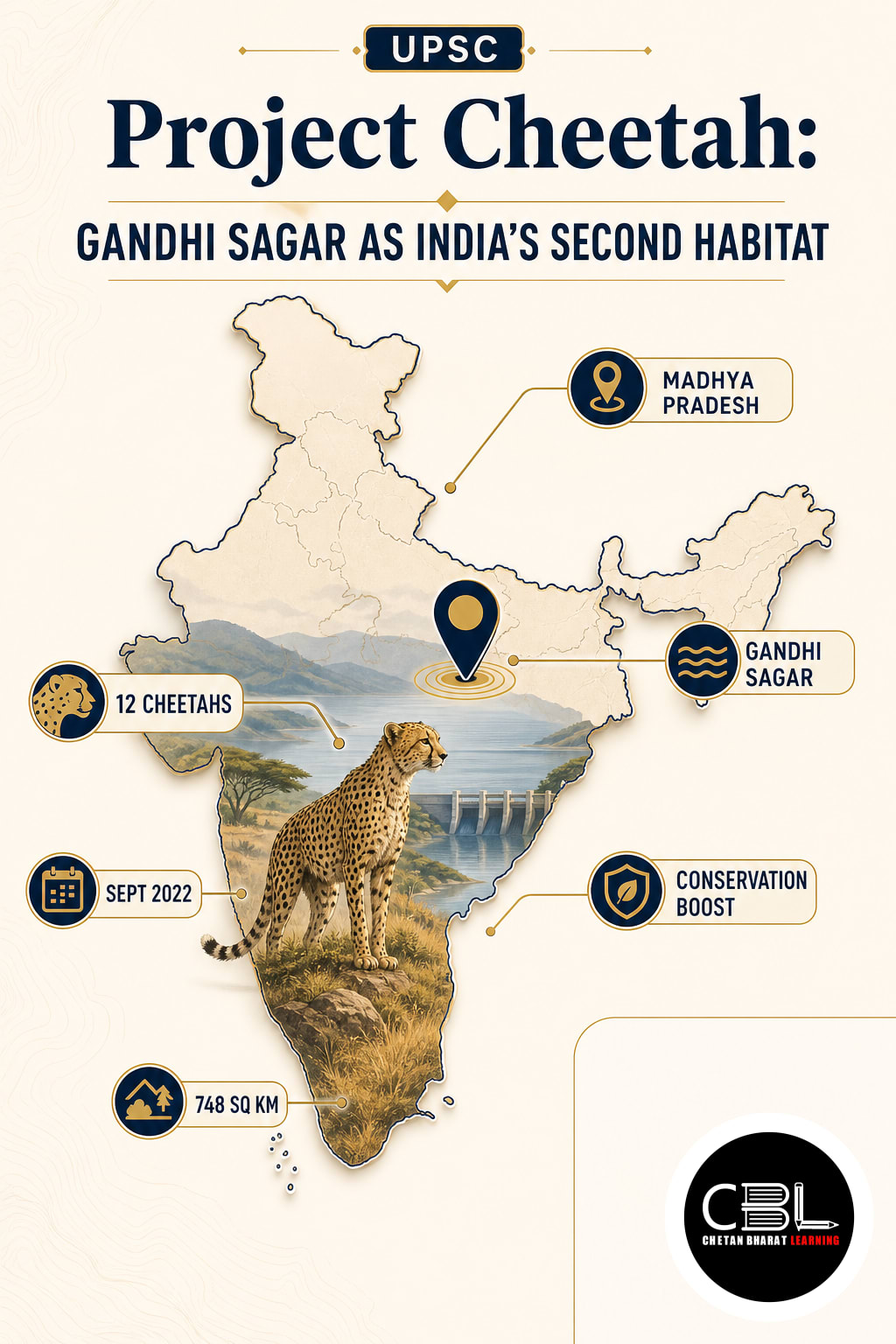
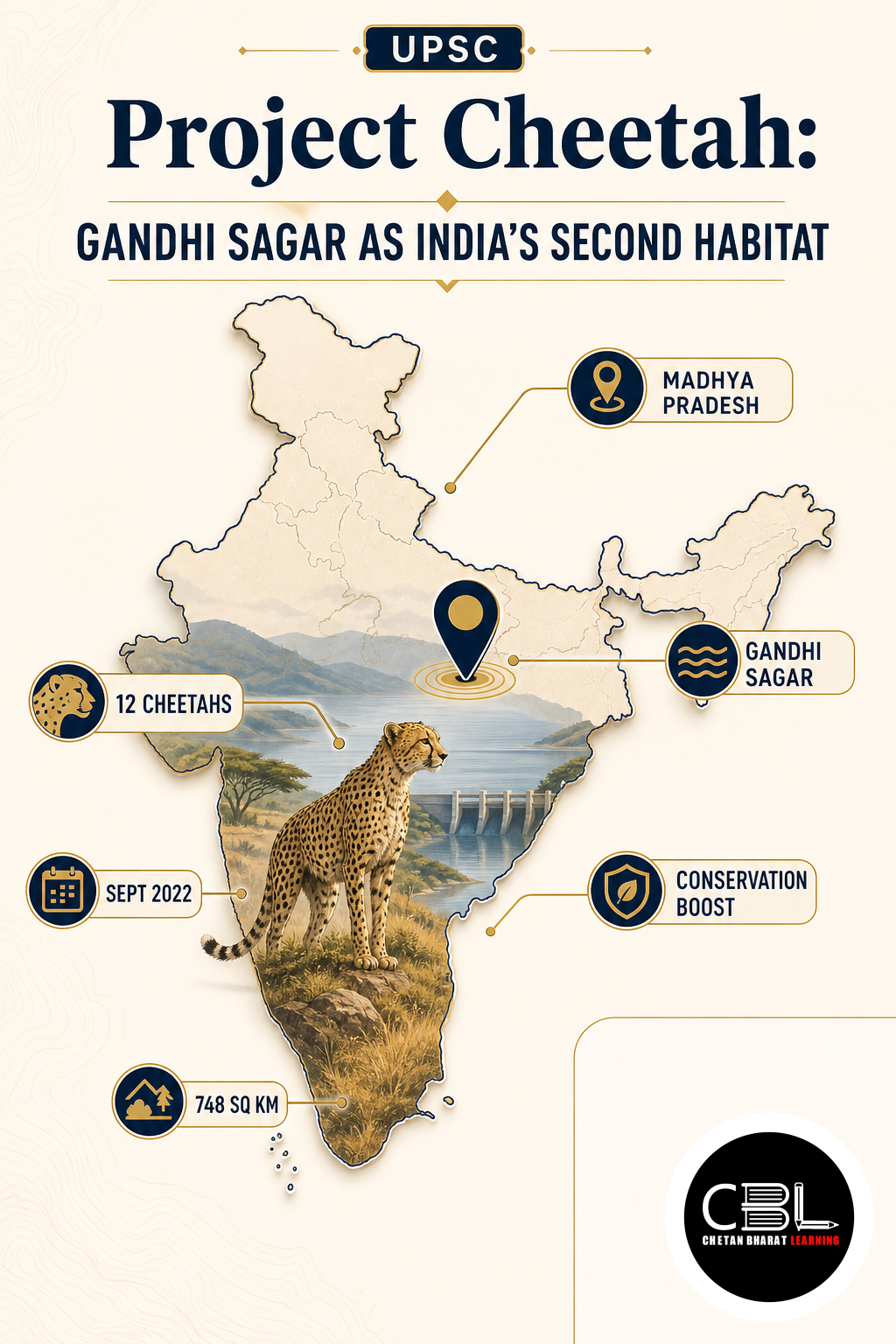
Project Cheetah marked a new step when Madhya Pradesh released CCB-2 at Gandhi Sagar Wildlife Sanctuary on September 20, 2026. The approximately three-year-old female, originally brought from Botswana, moved from Kuno to the second habitat. Gandhi Sagar consequently housed two males and two females, improving the opportunity to establish a breeding group.
The relocation followed the birth of four cubs to India-born female KGP12 at Kuno on September 18. Officials described the cubs as the second generation born in India and reported a national population of 56 at that time. The NTCA action plan for Gandhi Sagar provides the scientific framework for the second site.
Key Features
- Second conservation site: Two males, Pawak and Prabhas, moved from Kuno to Gandhi Sagar in April 2025, making the sanctuary India’s second cheetah habitat before subsequent female additions improved its sex balance; CCB-2’s arrival created a two-male, two-female group, although successful establishment will depend on behaviour, health and reproduction over time.
- Suitable open ecosystem: The sanctuary contains savanna-like grasslands, scrub and dry deciduous vegetation, while the wider landscape includes riverine valleys and habitat extending towards Rajasthan across the Chambal basin; this habitat mosaic offers hunting and resting opportunities but requires continuing management of invasive vegetation, grazing pressure, water and disturbance.
- Landscape-scale potential: The notified sanctuary covers about 368 square kilometres, but the 2024 action plan identifies roughly 2,500 square kilometres of potential habitat spanning Madhya Pradesh and adjoining Rajasthan; the wider area matters because cheetahs use space beyond fenced release enclosures and may disperse across administrative and protected-area boundaries.
- Metapopulation approach: NTCA envisages Kuno, Gandhi Sagar and adjacent forest patches as parts of a broader interstate conservation complex, allowing planned transfers and, where feasible, natural dispersal between managed subpopulations; such a system can reduce the consequences of local disease or ecological disturbance while enabling demographic and genetic exchange through carefully assessed movement.
- Ecological restoration: Protecting a wide-ranging predator requires better prey populations, grassland and scrub management, water availability, disease surveillance and control of pressures that also affect numerous other open-ecosystem species; conservation gains should therefore be measured through vegetation, prey and associated biodiversity indicators rather than through cheetah numbers or tourism revenue alone.
Challenges
Reintroduction success depends on survival, reproduction and ecological function over decades rather than a rising headcount alone, because births can increase numbers temporarily without proving that juveniles will survive, disperse and reproduce as independent adults. CBL tracks related conservation issues through its environment current affairs analysis.
- Health and mortality: Translocated carnivores face infection, injury, territorial conflict, heat stress and adaptation pressures, requiring veterinary capacity without allowing permanent intensive management to substitute for a functioning wild population; managers must balance rapid treatment of individuals with long-term selection, adaptation and minimal intervention once animals can safely range and hunt.
- Prey and carrying capacity: Each site must sustain sufficient wild prey through changing seasons, while managers should update estimates scientifically before adding animals or expanding free-ranging areas; prey augmentation should avoid ecological shortcuts and instead strengthen native herbivore populations, habitat quality, anti-poaching measures and natural predator-prey relationships.
- Genetic management: A small founder population risks loss of genetic diversity, so future imports and transfers must follow demographic records, pedigrees, health screening and coordinated breeding objectives; demographic planning must also prevent a few successful individuals from contributing disproportionately while other genetic lines disappear from the developing population.
- Connectivity and conflict: Cheetahs can travel beyond protected boundaries into farms, roads and settlements, making interstate coordination, safe passage, rapid response and fair compensation important for community tolerance; livestock protection, verified loss assessment and locally trusted communication can prevent isolated incidents or rumours from creating wider resistance to conservation measures.
- Transparent evaluation: Public debate remains divided over costs, welfare and ecological suitability, so authorities need regular independent reporting on survival, reproduction, prey trends, habitat use and management interventions; evaluation should separate routine adaptive changes from evidence of systemic problems and make methods available for scientific scrutiny and public accountability.
Way Forward
Project Cheetah should use adaptive management based on measurable ecological outcomes, institutional learning and transparent thresholds for changing course when field evidence contradicts earlier assumptions. Teams must monitor individual health, breeding, prey density, habitat selection and causes of mortality while publishing comparable site-level data. New releases should follow updated carrying-capacity assessments rather than fixed numerical targets.
The National Tiger Conservation Authority, state forest departments and the Wildlife Institute of India should coordinate long-term landscape planning. Local communities need livelihood opportunities, timely compensation, credible safety information and meaningful participation as Cheetah Mitras. Habitat restoration, interstate corridors and carefully planned genetic supplementation can improve resilience without treating conservation as a tourism-only initiative.
Prelims Practice Corner
Q1. India declared the cheetah extinct within the country in which year?
- (a) 1947
- (b) 1952
- (c) 1961
- (d) 1972
Answer: (b) India declared the cheetah extinct in 1952 after its disappearance from the wild.
Q2. The first batch of cheetahs introduced at Kuno National Park in 2022 came from:
- (a) Kenya
- (b) Botswana
- (c) Namibia
- (d) Tanzania
Answer: (c) Eight cheetahs arrived from Namibia in September 2022.
Q3. Gandhi Sagar Wildlife Sanctuary extends across which Madhya Pradesh districts?
- (a) Mandsaur and Neemuch
- (b) Sheopur and Shivpuri
- (c) Seoni and Chhindwara
- (d) Umaria and Katni
Answer: (a) The sanctuary lies across Mandsaur and Neemuch near the Rajasthan border.
Q4. Which river divides the Gandhi Sagar landscape and supports its riverine ecosystem?
- (a) Narmada
- (b) Chambal
- (c) Betwa
- (d) Son
Answer: (b) The Chambal River passes through the sanctuary landscape.
Q5. Consider the following statements about NTCA: 1. It is a statutory body. 2. It functions under the Union environment ministry. Which statements are correct?
- (a) 1 only
- (b) 2 only
- (c) Both 1 and 2
- (d) Neither 1 nor 2
Answer: (c) NTCA is a statutory body under the Ministry of Environment, Forest and Climate Change.
Mains Practice Questions
Q1. Explain why developing Gandhi Sagar as a second cheetah habitat is significant for species reintroduction in India. (10 marks)
Answer Structure
- Intro: Introduce the shift from a single release site to a multi-site conservation strategy.
- Body: Cover risk diversification, breeding, habitat restoration, genetic management, landscape connectivity and regional conservation value.
- Conclusion: Link the second habitat with the objective of a viable and resilient wild population.
Q2. Species reintroduction requires ecological science and social legitimacy in equal measure. Discuss with reference to India’s cheetah programme. (15 marks)
Answer Structure
- Intro: Define reintroduction as restoring a species within its historical range through planned conservation action.
- Body: Examine habitat, prey, health, genetics, monitoring, corridors, costs, community participation, compensation and transparent evaluation.
- Conclusion: Advocate adaptive, evidence-led and community-supported landscape conservation.
FAQs on Project Cheetah
Why does Project Cheetah need a second habitat?
A second habitat reduces dependence on one site and supports planned breeding and population management. It also spreads ecological and disease-related risks across separate locations.
Why was Gandhi Sagar selected?
The sanctuary and surrounding landscape contain extensive open habitat suitable for cheetahs. Its location also supports a broader Madhya Pradesh–Rajasthan conservation landscape.
What determines whether cheetah reintroduction succeeds?
Success requires sustained survival, reproduction, genetic diversity and ecological adaptation. Adequate prey, habitat connectivity, transparent monitoring and community support are equally important.
Related Current Affairs
Preparing for UPSC, PCS or HCS?
Talk to a mentor at Chetan Bharat Learning, Chandigarh. Free guidance on choosing the right exam and building a study plan.
Chat on WhatsAppCall 97793 53345UPSC / IAS / PCS coaching in Chandigarh · Trusted by aspirants across Punjab & Haryana
Leave a Reply
You must be logged in to post a comment.