
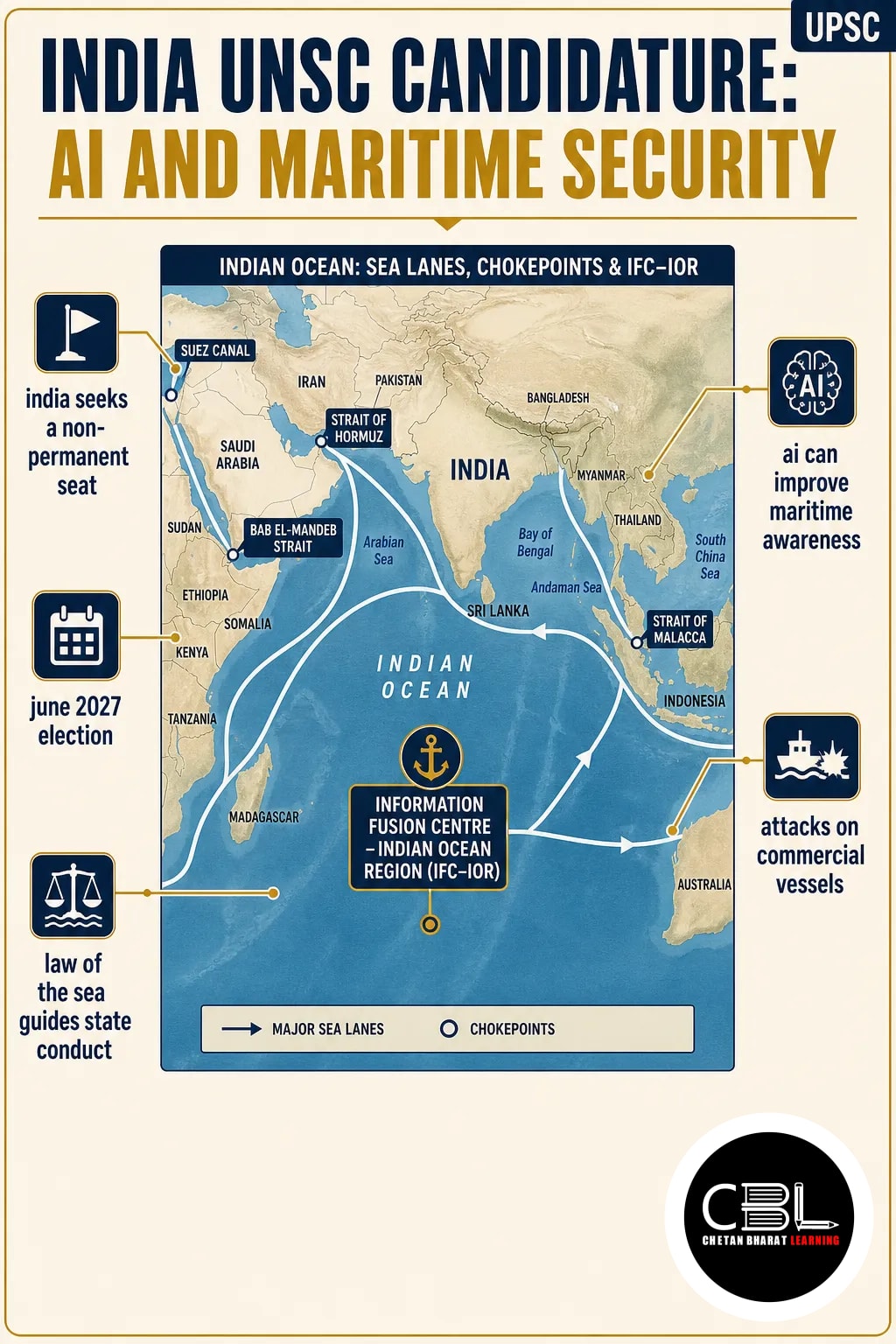
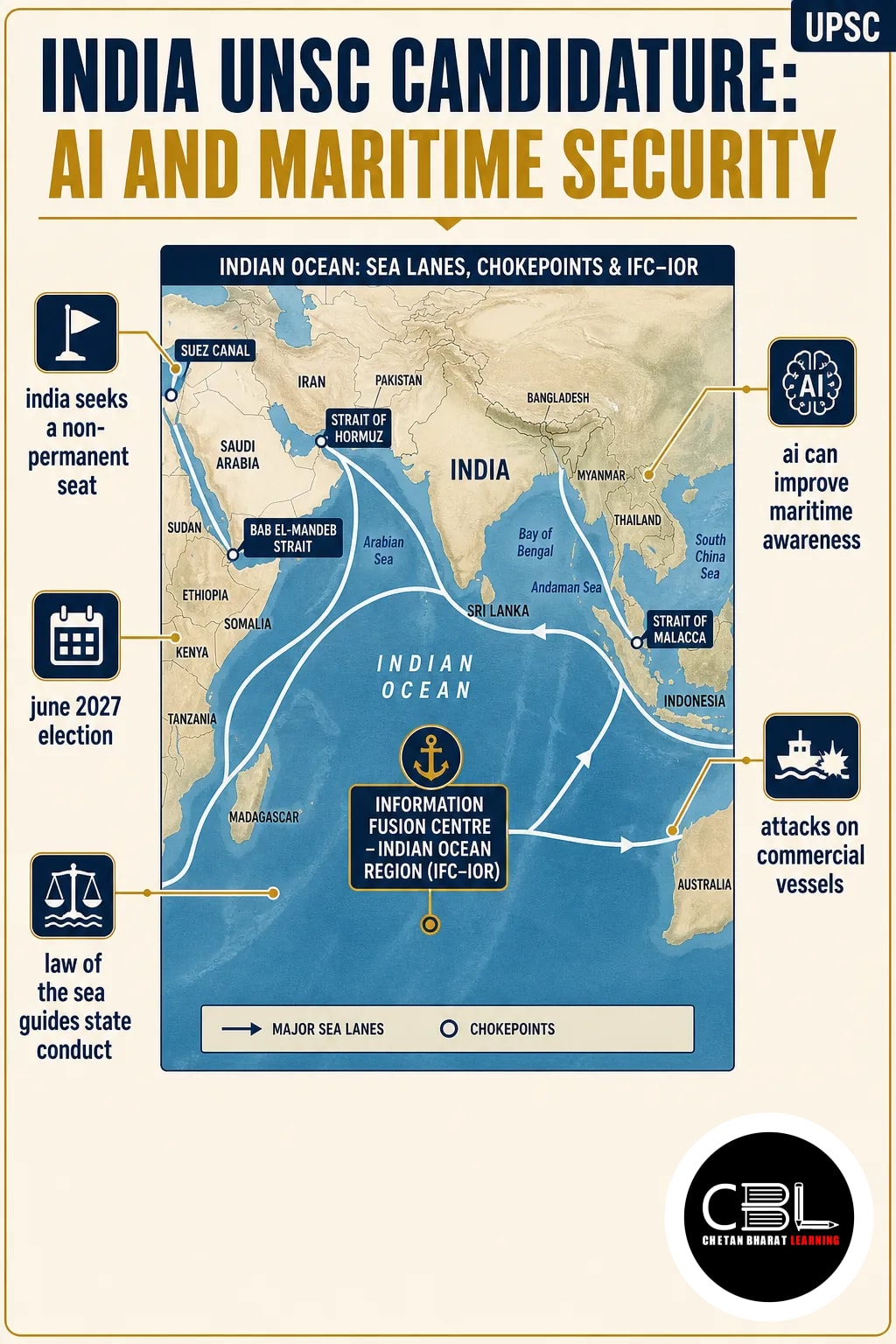
India UNSC candidature for the 2028–29 United Nations Security Council (UNSC) term now highlights artificial intelligence and maritime security. The announcement links technology governance with India’s international relations priorities.
Quick answer: India UNSC candidature for 2028–29 prioritises artificial intelligence and maritime security. On 29 October 2026, India’s UN envoy Parvathaneni Harish highlighted safer shipping, technological safeguards and cooperation at a Security Council debate. India and Tajikistan will compete for one Asia-Pacific seat in the June 2027 election.
What happened at the Security Council debate?
India identified artificial intelligence (AI) and maritime security as priorities for its 2028–29 bid. Ambassador Parvathaneni Harish addressed a high-level open debate on emerging technologies and maritime security on 29 October 2026.
Greece held the Council presidency in October. Earlier, in September, External Affairs Minister S. Jaishankar co-chaired an event on AI and maritime security with Greek Foreign Minister George Gerapetritis.
The India UNSC candidature concerns an elected, non-permanent seat, not a permanent seat. For earlier context, see CBL’s coverage of support for India’s 2028–29 bid.
What are the election rules and key facts?
The UN General Assembly elects non-permanent Council members for two-year terms. The Charter requires a two-thirds majority of members present and voting.
| Indicator | Key fact |
|---|---|
| Council composition | 15 members: five permanent and 10 non-permanent |
| 2028–29 contest | India and Tajikistan seek one Asia-Pacific Group seat |
| Election schedule | June 2027 |
| Re-election | A retiring non-permanent member cannot seek immediate re-election |
Non-permanent members do not possess the permanent members’ veto. Consequently, the India UNSC candidature is distinct from its longer-term permanent membership claim. See also UNSC reform and India’s permanent membership claim.
What priorities did India outline?
India called for safer maritime commerce, responsible technology use and international cooperation.
- Navigation and shipping: India condemned attacks on commercial vessels and called for safe seafarers and unimpeded lawful commerce.
- Maritime awareness: AI can analyse satellite imagery, radar and vessel-tracking data. Consequently, authorities can better detect suspicious activity and support search and rescue.
- Information-sharing: India cited the Information Fusion Centre–Indian Ocean Region, located near New Delhi, as an example of cooperation.
- Inclusive capacity: Developing countries need access to technology, training and institutions. Therefore, they can better protect infrastructure and participate in technology governance.
- Legal framework: The UN Charter and the law of the sea, as reflected in the United Nations Convention on the Law of the Sea (UNCLOS), guide State conduct.
India linked its approach to SAGAR: Security and Growth for All in the Region. It also asked the Council to focus on technologies with demonstrable implications for international peace and security.
Why do these priorities matter for India?
Secure sea routes support trade, energy supplies and the safety of seafarers. Attacks near maritime chokepoints can disrupt supply chains beyond the immediate area. Moreover, higher costs and uncertainty can disproportionately affect developing countries.
AI-assisted awareness can help authorities respond faster to suspicious activity and emergencies. However, improved detection alone does not establish responsibility for an incident. Cooperation and reliable information-sharing therefore remain important.
The bid also gives India an opportunity to connect maritime security with broader multilateral concerns. In addition, its emphasis on developing-country access addresses the risk that technological gains remain uneven. For institutional context, see the debate on trust and reform at the UN.
What challenges do emerging technologies create?
Digitalisation improves maritime operations but also exposes infrastructure to new vulnerabilities.
- Cyber risk: Ports, vessels, communication networks and undersea infrastructure face threats as they become more connected.
- Autonomous systems: Their use raises questions about attribution, accountability and unintended escalation. Consequently, identifying responsibility can become harder.
- Unequal access: Countries without adequate technology or training may struggle to secure infrastructure and shape governance.
- Institutional overlap: The Council must avoid duplicating existing work. India therefore called for reinforcing the International Maritime Organisation (IMO) and other relevant institutions.
What is the way forward?
India’s proposed approach combines practical cooperation with safeguards and respect for institutional mandates.
First, partners can strengthen maritime information-sharing and search-and-rescue cooperation. Second, technology deployment needs meaningful human oversight and clear responsibility. In addition, training and institutional support can help developing countries participate on more equal terms.
Finally, the Security Council should address threats to international peace while working alongside the IMO. This division can connect security discussions with existing maritime expertise without duplicating mandates.
Source: The Hindu, 30 October 2026
- Palestine UNSC Support: India’s Bid for 2028-29 Non-Permanent Seat (20 Aug 2026)
- UNSC Reform: Veto Restraint and India’s Claim (27 Sep 2026)
- UN Trust Deficit: Causes and Reform Priorities (28 Oct 2026)
Asked in UPSC: Previous Year Questions
- UPSC CSE Mains 2025 (GS Paper III): Why is maritime security vital to protect India’s sea trade? Discuss maritime and coastal security challenges and the way forward.
- UPSC CSE Mains 2022 (GS Paper III): What are India’s maritime security challenges? Discuss organisational, technical and procedural initiatives to improve maritime security.
UPSC connects maritime security with trade, challenges and the institutional response.
Punjab PCS and Haryana HCS General Studies may test UN institutions, maritime law and India’s external relations. In addition, candidates should distinguish elected Council seats from permanent membership.
Prelims Practice Corner
Mains Practice Questions
Frequently Asked Questions
Which UNSC seat is India seeking for 2028–29?
India seeks a non-permanent Asia-Pacific Group seat. It will compete with Tajikistan in the June 2027 election.
Why does India link AI with maritime security?
AI can improve maritime awareness and support search and rescue. However, its use also requires safeguards against cyber risks and accountability gaps.
Do elected UNSC members have a veto?
No, because the veto belongs to permanent members. Elected members instead serve two-year terms.
What is the Information Fusion Centre–Indian Ocean Region?
It is a maritime information-sharing centre located near New Delhi. India cited it as an example of cooperation for maritime security.
Related Current Affairs
Preparing for UPSC, PCS or HCS?
Talk to a mentor at Chetan Bharat Learning, Chandigarh. Free guidance on choosing the right exam and building a study plan.
Chat on WhatsAppCall 97793 53345UPSC / IAS / PCS coaching in Chandigarh · Trusted by aspirants across Punjab & Haryana
Leave a Reply
You must be logged in to post a comment.