

UPSC Syllabus Mapping
GS Paper: GS Paper III
Subject: Indian Economy 6 Financial Markets, Investment and Regulatory Institutions
What is Portfolio Management Service?
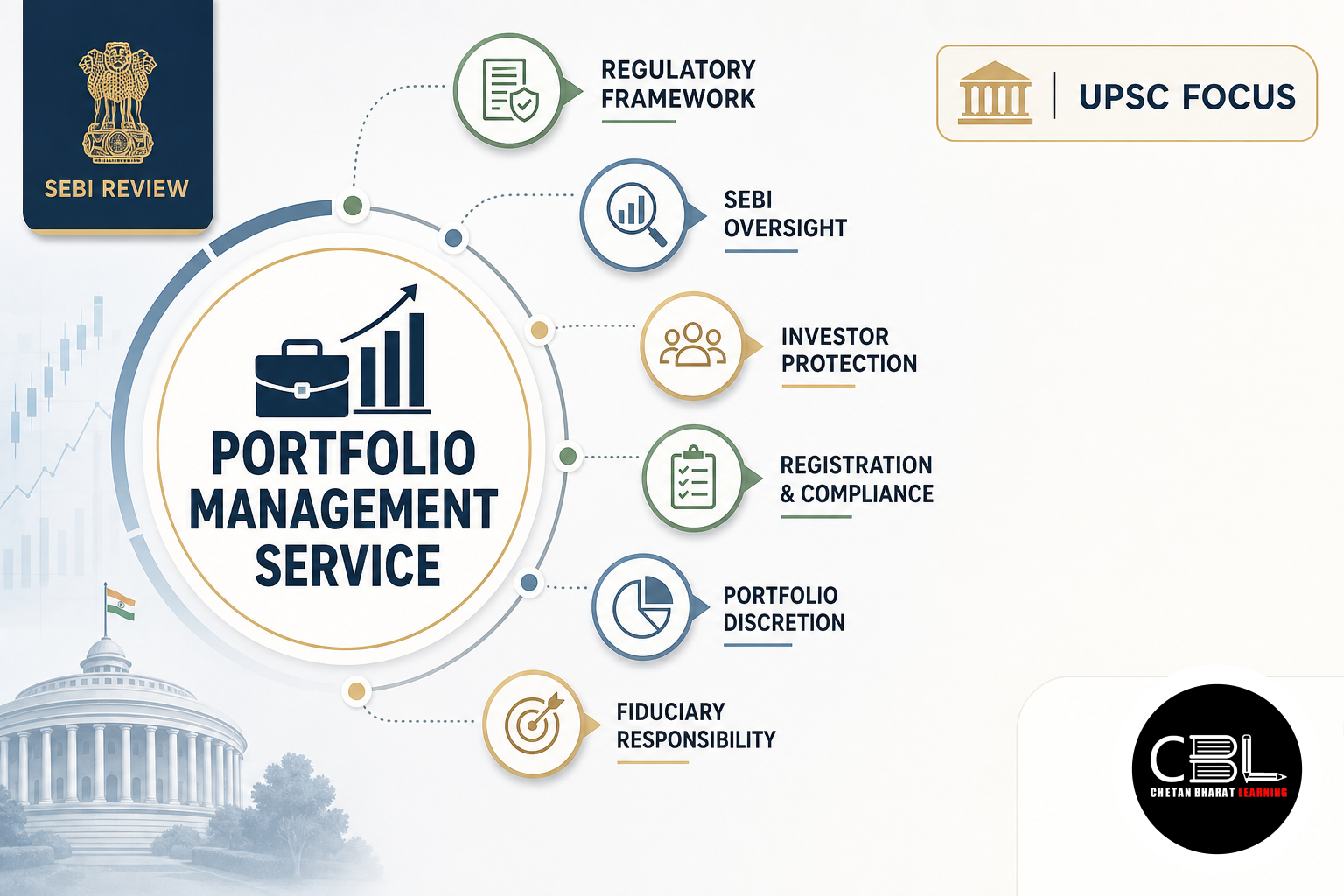
A PMS is a professional investment arrangement in which a registered portfolio manager manages or advises on a client’s securities and funds. Unlike a pooled mutual fund, the arrangement relates to the portfolio of an individual client. Therefore, the investor retains a distinct portfolio under the contractual framework with the portfolio manager.
SEBI regulates portfolio managers under the SEBI (Portfolio Managers) Regulations, 2020. The regulations operate within the broader statutory framework of the SEBI Act, 1992. Consequently, an entity cannot offer regulated portfolio management merely by describing itself as an investment expert. It must satisfy SEBI’s registration and regulatory requirements.
Portfolio managers may deal with securities such as equity and debt instruments according to the mandate agreed with the client. However, the precise authority of the manager depends on whether the arrangement is discretionary, non-discretionary or advisory. This distinction determines who takes the final investment decision and who executes it.
SEBI’s investor guidance states that a portfolio manager must generally accept at least ₹50 lakh in funds or securities from a client when opening the PMS account. Thus, the framework primarily serves investors capable of committing a substantial investment amount. For UPSC purposes, Portfolio Management Service should be distinguished from ordinary retail investment products because it involves personalised portfolio management and a high entry threshold.
Why is Portfolio Management Service in News?
On 23 July 2026, SEBI released a consultation paper for a comprehensive review of the SEBI (Portfolio Managers) Regulations, 2020. The regulator invited public comments on the proposed review. Aspirants can consult the SEBI official website for regulatory publications and consultation papers.
The development represents a regulatory review rather than an automatic change in the law. Therefore, aspirants should distinguish between proposals contained in a consultation process and rules that SEBI finally notifies. This distinction is important because consultation papers allow stakeholders to comment before the regulator decides whether and how to modify the framework.
The review also reflects the evolving nature of India’s securities market. As investment products, digital processes and compliance practices change, regulators periodically reassess existing rules. Moreover, a comprehensive review can address operational clarity while preserving transparency, accountability and investor safeguards.
For UPSC, the news provides a useful example of SEBI’s regulatory role in the securities market. It also demonstrates the use of stakeholder consultation in financial regulation. Consequently, Portfolio Management Service can appear in questions involving capital markets, financial intermediaries, SEBI or investor protection.
Key Features
The first important feature is regulatory registration. Portfolio managers operate within a SEBI-supervised framework and must comply with prescribed eligibility and conduct requirements. Therefore, registration creates an identifiable regulated intermediary between investors and the securities market.
Second, PMS arrangements can differ according to the manager’s authority. Under discretionary PMS, the portfolio manager takes investment decisions on the client’s behalf within the agreed mandate. In contrast, under non-discretionary PMS, the manager advises the client while the client retains the final investment decision.
Advisory arrangements place even greater responsibility on the investor. The portfolio manager provides investment advice, while the client independently implements the transactions. Thus, the three models differ primarily in decision-making authority and execution responsibility rather than merely in the type of securities involved.
Another important feature concerns disclosure and accountability. SEBI’s investor guidance highlights performance reporting, fees and risk disclosures as key regulatory elements. In addition, the framework includes compliance responsibilities and custodial arrangements. These safeguards help investors assess performance, costs and risks rather than relying only on return claims.
The ₹50 lakh minimum investment requirement also distinguishes PMS from many mass-market products. However, a high investment threshold does not remove market risk. Equity prices can fall, debt instruments can face credit or interest-rate risks, and concentrated portfolios can magnify losses. Therefore, suitability and informed decision-making remain important even for financially sophisticated clients.
Challenges
A central challenge is market risk. Professional management cannot guarantee positive returns because securities respond to economic conditions, company performance, interest rates and global developments. Consequently, investors may suffer losses despite relying on an experienced portfolio manager.
Concentration can create another vulnerability. A personalised strategy may hold fewer securities than a broadly diversified pooled product. Therefore, poor performance in a limited number of large holdings can have a significant effect on the overall portfolio. Investors must understand both the investment strategy and its concentration risks.
Costs and performance assessment also require attention. Management fees, performance-linked charges and other expenses can affect net investor returns. Moreover, investors need consistent disclosures to compare results meaningfully and understand whether returns justify the risks and costs involved.
Regulators also face the challenge of balancing investor protection with ease of doing business. Excessive complexity can increase compliance costs, while weak safeguards can expose investors to conflicts or inadequate disclosure. For related explanations of financial and economic developments, aspirants can use the UPSC current affairs library.
Finally, investors may misunderstand the difference between personalised management and guaranteed performance. Portfolio Management Service provides professional expertise, but it does not eliminate investment risk. Therefore, transparent communication about strategy, benchmarks, costs and risks remains central to informed participation.
Way Forward
SEBI can continue to strengthen disclosure standards so clients receive clear and comparable information about fees, risks and performance. Standardised disclosures can reduce information asymmetry. Moreover, they can help investors compare different managers without relying solely on promotional material.
The regulatory framework should also keep responsibilities clear across discretionary, non-discretionary and advisory arrangements. Clients need to know who makes investment decisions and who executes transactions. Consequently, clear contractual obligations can reduce disputes and improve accountability.
Technology can improve onboarding, reporting and compliance monitoring. However, digital convenience should operate alongside strong data protection, grievance redressal and audit mechanisms. Therefore, regulatory modernisation should combine operational efficiency with investor safeguards.
SEBI should also continue stakeholder consultation before making major regulatory changes. Consultation allows portfolio managers, investors and other market participants to identify practical consequences of proposed rules. Aspirants can track final regulations and amendments through SEBI regulations and legal resources.
Above all, regulation should preserve market integrity while enabling professional investment management to evolve with India’s financial system. Clear rules can encourage compliance and informed participation. At the same time, effective supervision can address conflicts of interest, disclosure gaps and misconduct without treating professional management as a substitute for investor due diligence.
Prelims Practice Corner
Q1. What is the minimum value of funds or securities generally required from a client while opening a PMS account under the SEBI framework?
- ₹5 lakh
- ₹10 lakh
- ₹25 lakh
- ₹50 lakh
Answer: ₹50 lakh. SEBI’s investor guidance specifies the ₹50 lakh minimum investment requirement.
Q2. Which institution regulates portfolio managers in India?
- RBI
- SEBI
- PFRDA
- IFSCA in all cases
Answer: SEBI. Portfolio managers in the domestic securities market operate under SEBI’s regulatory framework.
Q3. In which type of PMS does the portfolio manager take investment decisions on behalf of the client within the agreed mandate?
- Discretionary PMS
- Non-discretionary PMS
- Advisory PMS
- Depository PMS
Answer: Discretionary PMS. The portfolio manager exercises investment discretion according to the client’s mandate.
Q4. Consider the following statements:
- 1. PMS investments are free from market risk because professional managers manage them.
- 2. Portfolio managers operate under SEBI regulation.
Which statement is correct?
- 1 only
- 2 only
- Both 1 and 2
- Neither 1 nor 2
Answer: 2 only. Professional management does not eliminate market risk.
Q5. In a non-discretionary PMS arrangement, who retains the final investment decision?
- SEBI
- Custodian
- Investor
- Stock exchange
Answer: Investor. The manager provides recommendations, while the client retains the final decision.
Mains Practice Questions
Q1. Explain the role of SEBI in regulating portfolio management in India. Why are disclosure and investor-protection requirements important?
Answer outline: Define PMS → SEBI’s statutory and regulatory role → registration → disclosures → minimum investment framework → custody and compliance → market and concentration risks → need for transparent and proportionate regulation.
Q2. A modern securities market requires both regulatory safeguards and ease of doing business. Discuss in the context of SEBI’s review of portfolio manager regulations.
Answer outline: Context of 2026 consultation → evolving financial markets → investor protection → compliance burden → disclosure quality → technology → grievance redressal → stakeholder consultation → balanced regulatory approach.
FAQs on PMS
What is the minimum investment required for PMS as per SEBI?
SEBI’s investor guidance states that a portfolio manager must generally accept at least ₹50 lakh in funds or securities from a client when opening the account.
Who regulates PMS providers in India?
SEBI regulates portfolio managers under the SEBI (Portfolio Managers) Regulations, 2020 and related regulatory directions.
What are the main types of PMS?
The commonly discussed categories are discretionary, non-discretionary and advisory arrangements. They differ mainly in who makes the final investment decision and who executes the transaction.
Related Current Affairs
Preparing for UPSC, PCS or HCS?
Talk to a mentor at Chetan Bharat Learning, Chandigarh. Free guidance on choosing the right exam and building a study plan.
Chat on WhatsAppCall 97793 53345UPSC / IAS / PCS coaching in Chandigarh · Trusted by aspirants across Punjab & Haryana
Leave a Reply
You must be logged in to post a comment.