

UPSC Mapping
| Prelims | Economy & Energy |
|---|---|
| Mains | GS Paper 3 (Energy & Manufacturing) |
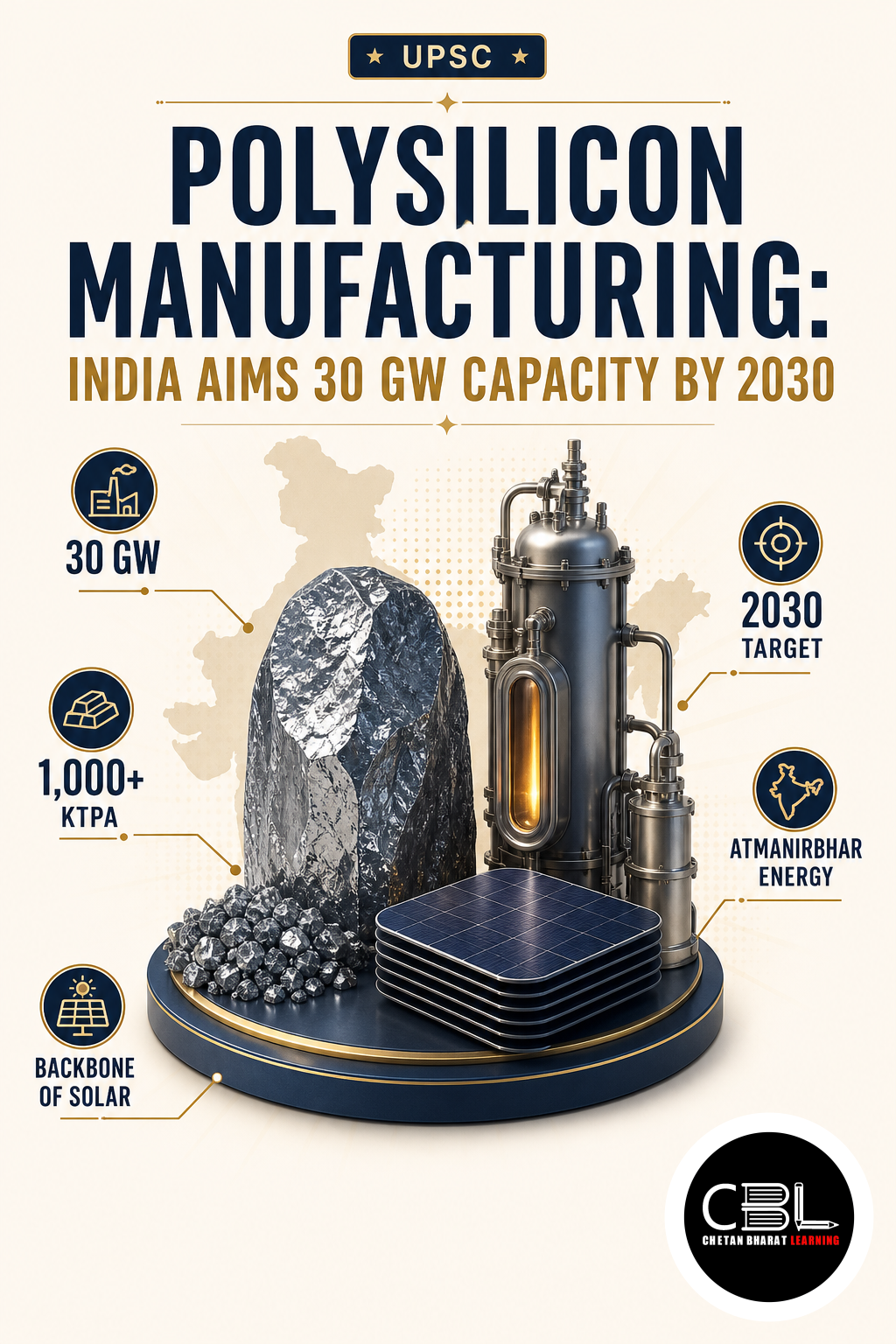
| Target | 30 GW by 2030 |
| Global Dominance | China controls 90%+ |
What is Polysilicon?
Polysilicon (polycrystalline silicon) is a high-purity form of silicon composed of multiple small silicon crystals. It is a critical semiconductor material used in the production of solar photovoltaic (PV) cells and in the electronics industry for integrated circuits. The production process involves chemical vapor deposition to achieve extremely high purity levels (99.9999% or more).
Polysilicon is processed into ingots, which are then sliced into thin wafers. These wafers form the base material for solar cells, which are assembled into solar panels. The quality and cost of polysilicon directly impact the price and efficiency of solar energy systems, making it a strategic material for the renewable energy transition.
Why is Polysilicon Manufacturing in News?
Polysilicon manufacturing is in the news because the Indian government has announced plans to add 30 GW of domestic capacity by 2030, aiming to reduce reliance on imports from China. Currently, China dominates the global polysilicon supply chain, controlling over 90%–93% of production. This concentration poses a supply chain risk, especially given geopolitical tensions and trade disputes.
The government is exploring a subsidy scheme to support indigenous production, which would help India become self-reliant in the solar value chain. This move aligns with the broader ‘Atmanirbhar Bharat’ initiative and the target of achieving 500 GW of renewable energy capacity by 2030. For official updates, refer to the PIB release on renewable energy targets.
Key Features of Polysilicon Manufacturing
- High-Purity Material: Requires purity levels above 99.9999% for use in solar and semiconductor applications.
- Energy-Intensive Process: Manufacturing involves high-temperature chemical reactions and significant electricity consumption.
- Strategic Importance: Critical for solar PV and electronics, making it a matter of energy security and economic competitiveness.
- Supply Chain Concentration: China’s dominance creates vulnerabilities for countries dependent on imports.
- Government Support: India is planning subsidies and incentives to attract investment in the sector. For more on renewable energy, explore the renewable energy archive.
Challenges in Domestic Manufacturing
- High Capital Costs: Setting up polysilicon plants requires significant investment, often exceeding ₹10,000 crore per plant.
- Technology Gap: Advanced manufacturing technology is mostly held by a few global players, mainly in China.
- Energy Costs: The process is electricity-intensive, and high power costs in India can affect competitiveness.
- Skilled Workforce: Requires specialised technical expertise, which is currently limited in India.
Way Forward for Polysilicon Production
To make polysilicon manufacturing viable in India, the government must provide robust policy support, including subsidies, tax incentives, and long-term power purchase agreements at competitive rates. Partnerships with global technology leaders can help bridge the knowledge gap. Additionally, building a domestic ecosystem for ancillary materials and equipment will reduce costs.
As per an IRENA report, diversifying the polysilicon supply chain is essential for global energy security. India’s entry into this sector can not only serve its domestic demand but also position it as an export hub for solar-grade polysilicon.
Prelims Practice Corner
Q1. What is polysilicon primarily used for?
- (a) Batteries
- (b) Solar PV cells & semiconductors
- (c) Fertilizers
- (d) Construction
Answer: (b) Solar PV cells and semiconductors.
Q2. Which country dominates global polysilicon production?
- (a) USA
- (b) Germany
- (c) China
- (d) Japan
Answer: (c) China.
Q3. What is India’s target for domestic polysilicon manufacturing capacity by 2030?
- (a) 10 GW
- (b) 20 GW
- (c) 30 GW
- (d) 50 GW
Answer: (c) 30 GW.
Q4. What is a major challenge for Indian polysilicon manufacturing?
- (a) Abundant cheap labor
- (b) High capital costs and energy intensity
- (c) Lack of domestic demand
- (d) Excess technology transfer
Answer: (b) High capital costs and energy intensity.
Q5. Polysilicon is processed into which intermediate product before making solar cells?
- (a) Ingots & wafers
- (b) Powder
- (c) Liquid
- (d) Sheets
Answer: (a) Ingots and wafers.
Mains Practice Questions
Q1. “India’s plan to boost domestic polysilicon manufacturing is crucial for its renewable energy goals and supply chain security.” (250 words, 15 marks)
Answer Structure:
- Intro: Introduce polysilicon and its significance for the solar industry.
- Body: Discuss India’s reliance on imports, the target of 30 GW, challenges (capital, technology, energy costs), and the need for policy support.
- Conclusion: Emphasise the strategic importance of self-reliance in the solar value chain.
Q2. “Supply chain diversification in critical materials like polysilicon is essential for global energy security.” (250 words, 15 marks)
Answer Structure:
- Intro: Highlight the dominance of China and the risks of over-concentration.
- Body: Discuss India’s proposed capacity, the importance of subsidies, technology partnerships, and the potential to become an export hub.
- Conclusion: Conclude that India’s entry into polysilicon manufacturing can contribute to global supply chain resilience.
FAQs on Polysilicon Manufacturing
What is polysilicon used for?
Polysilicon is used primarily in the production of solar photovoltaic cells and semiconductor devices, making it a critical material for renewable energy and electronics.
Why does India need to manufacture polysilicon domestically?
To reduce dependence on imports from China, secure supply chains for the solar industry, and achieve self-reliance in the renewable energy value chain.
What is India’s target for polysilicon capacity by 2030?
India aims to add 30 GW of domestic polysilicon manufacturing capacity by 2030.
Related Current Affairs
Preparing for UPSC, PCS or HCS?
Talk to a mentor at Chetan Bharat Learning, Chandigarh. Free guidance on choosing the right exam and building a study plan.
Chat on WhatsAppCall 97793 53345UPSC / IAS / PCS coaching in Chandigarh · Trusted by aspirants across Punjab & Haryana
Leave a Reply
You must be logged in to post a comment.