
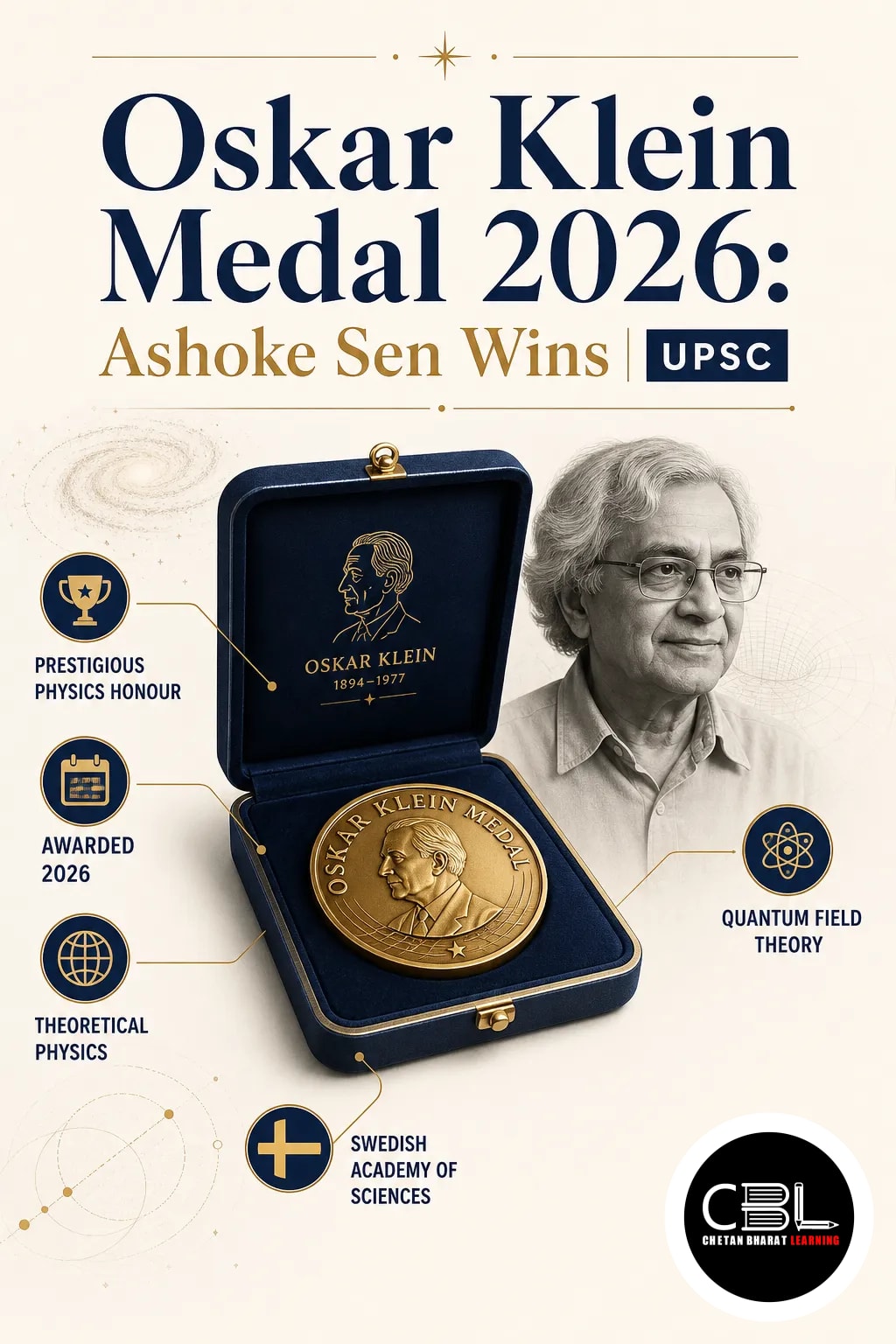

The Oskar Klein Medal for 2026 has been awarded to renowned Indian theoretical physicist Professor Ashoke Sen, making him the first Indian physicist to receive the prestigious international honour. The award recognises his pioneering contributions to string theory, S-duality and the quantum understanding of black holes. The International Centre for Theoretical Sciences (ICTS), Bengaluru, announced the achievement in October 2026. The development is important for UPSC Science and Technology, particularly fundamental physics and India’s contribution to scientific research. Explore related developments through the daily current affairs archive.
Who Is Professor Ashoke Sen?
Professor Ashoke Sen is an internationally acclaimed Indian theoretical physicist known for influential research in string theory, quantum gravity and black hole physics. His scientific work has helped establish connections between different formulations of string theory and improved understanding of fundamental interactions.
He currently serves as the ICTS-Infosys Madhava Chair Professor at the International Centre for Theoretical Sciences, a centre of the Tata Institute of Fundamental Research in Bengaluru.
Sen previously worked with prominent research institutions, including the Harish-Chandra Research Institute, Prayagraj. His career reflects India’s longstanding contribution to fundamental research in theoretical physics.
His achievements have earned recognition through major national and international scientific awards. In 2026, he became the first Indian physicist to receive the international honour established in memory of Swedish physicist Oskar Klein.
Why in News?
On 22 October 2026, Ashoke Sen delivered the Oskar Klein Memorial Lecture at Stockholm University’s AlbaNova Centre in Sweden. The lecture was titled Gravity from Strings and Strings from Gravity.
His lecture examined how string theory may provide a consistent quantum description of gravity. It also discussed the relationship between black hole physics, quantum mechanics and the theoretical landscape of string theory.
ICTS confirmed that Sen had received the award for his groundbreaking contributions to modern theoretical physics. His recognition places an Indian researcher among an internationally distinguished group of physicists.
Source: International Centre for Theoretical Sciences official announcement.
About the Oskar Klein Medal
The Oskar Klein Medal is an international honour recognising outstanding contributions to theoretical physics and fundamental scientific understanding. It is awarded annually by Stockholm University and the Nobel Committee for Physics of the Royal Swedish Academy of Sciences.
Established in 1988, the medal commemorates Swedish theoretical physicist Oskar Klein, who made important contributions to quantum theory and the unification of fundamental forces.
Klein is particularly associated with the Kaluza-Klein theory, which explored the possibility of unifying gravity and electromagnetism through additional spatial dimensions.
Recipients are invited to Stockholm to deliver the Oskar Klein Memorial Lecture. The lecture provides an opportunity to communicate important theoretical discoveries to the international scientific community.
Previous recipients include Nobel laureates Chen-Ning Yang, Steven Weinberg and Hans Bethe. Other distinguished recipients have included Stephen Hawking, Peter Higgs and Kip Thorne.
Source: Stockholm University historical list of memorial lectures.
Major Scientific Contributions of Ashoke Sen
Professor Sen has made several influential contributions to modern string theory. His research addresses fundamental questions about the relationship between gravity, quantum mechanics and the structure of the universe.
- S-Duality: Sen demonstrated important relationships between strongly interacting and weakly interacting descriptions of certain theories, allowing researchers to investigate difficult physical problems using more manageable mathematical formulations.
- Unification of String Theories: His work contributed to understanding the connections between different string theories and their relationship within a broader theoretical framework.
- Black Hole Entropy: Sen developed precise techniques for counting microscopic quantum states associated with black holes, helping explain their thermodynamic entropy.
- String Field Theory: His research advanced the mathematical description of interacting strings, including investigations involving tachyon condensation.
- Quantum Gravity: His theoretical investigations helped improve understanding of how gravitational phenomena may be reconciled with quantum principles.
These contributions have influenced research worldwide and established Sen as a leading figure in fundamental theoretical physics.
Understanding String Theory
String theory proposes that the most fundamental constituents of matter are extremely small, one-dimensional vibrating strings rather than dimensionless point particles.
Different vibrational states of these strings may correspond to different particles and their physical properties. The theory seeks a unified mathematical framework describing matter and fundamental interactions, including gravity.
String theory is especially important because conventional quantum field theory successfully describes three fundamental interactions, while gravity remains difficult to reconcile with quantum mechanics.
Many formulations of string theory involve additional spatial dimensions beyond the three directly observed. These extra dimensions may be compactified or otherwise inaccessible at ordinary observational scales.
Although string theory provides promising mathematical insights, it remains an active research framework. Its central predictions have not yet received decisive experimental confirmation.
Black Hole Entropy and Its Scientific Importance
Black holes possess thermodynamic properties, including entropy and temperature. The Bekenstein-Hawking entropy formula relates a black hole’s entropy to the area of its event horizon.
The formula is expressed as S = kBc³A/(4Għ), where A represents the horizon area, G is the gravitational constant and ħ is the reduced Planck constant.
A major scientific question concerns the microscopic quantum states responsible for this entropy. Sen’s research developed powerful methods for calculating black hole entropy within string theory.
Such calculations are significant because they connect quantum physics, statistical mechanics and gravity. They provide theoretical tests for understanding the microscopic structure of black holes.
Major Awards and Honours Received by Ashoke Sen
| Year | Award or Recognition |
|---|---|
| 1989 | ICTP Prize |
| 1994 | Shanti Swarup Bhatnagar Prize |
| 1998 | Elected Fellow of the Royal Society |
| 2001 | Padma Shri |
| 2009 | Infosys Prize in Mathematical Sciences |
| 2012 | Breakthrough Prize in Fundamental Physics |
| 2013 | Padma Bhushan |
| 2014 | Dirac Medal |
| 2026 | Oskar Klein Medal |
Prelims fact: Ashoke Sen received the Breakthrough Prize in Fundamental Physics in 2012 and the Dirac Medal in 2014. He became the first Indian physicist to receive the Oskar Klein honour in 2026.
Legacy and Present-Day Relevance
Sen’s scientific achievements demonstrate India’s capacity to contribute to highly specialised areas of fundamental physics. His work has influenced international discussions on the unification of physical laws and the quantum properties of gravity.
The recognition also highlights the importance of public research institutions in supporting long-term scientific discoveries. Fundamental physics may not always produce immediate commercial applications, but it expands scientific knowledge and develops advanced research capabilities.
India’s institutions, including ICTS, TIFR and the Harish-Chandra Research Institute, provide opportunities for theoretical research and international scientific collaboration.
Strengthening research funding, advanced education and international partnerships can help sustain India’s contribution to frontier science. Sen’s achievement provides a contemporary example of the global impact of Indian scientific scholarship.
Punjab PCS and Haryana HCS aspirants should prepare the recipient, awarding institutions, establishment year and field associated with the 2026 Oskar Klein Medal. The topic is relevant to awards and honours, Indian scientific achievements and basic Science and Technology. Mains questions may examine how Indian research institutions contribute to global scientific knowledge and why fundamental research requires sustained institutional support.
Frequently Asked Questions
Who won the Oskar Klein Medal in 2026?
Indian theoretical physicist Professor Ashoke Sen received the 2026 medal, becoming the first Indian physicist to win the award. He is known for pioneering contributions to string theory and black hole physics.
Which institutions award the Oskar Klein Medal?
The award is jointly administered by Stockholm University and the Nobel Committee for Physics of the Royal Swedish Academy of Sciences. It recognises outstanding contributions to theoretical physics.
What was the title of Ashoke Sen’s 2026 memorial lecture?
His lecture was titled Gravity from Strings and Strings from Gravity. He delivered it on 22 October 2026 at Stockholm University’s AlbaNova Centre, discussing string theory, quantum gravity and black hole physics.
Related Current Affairs
Preparing for UPSC, PCS or HCS?
Talk to a mentor at Chetan Bharat Learning, Chandigarh. Free guidance on choosing the right exam and building a study plan.
Chat on WhatsAppCall 97793 53345UPSC / IAS / PCS coaching in Chandigarh · Trusted by aspirants across Punjab & Haryana
Leave a Reply
You must be logged in to post a comment.