
In India’s rapidly growing metropolitan cities, the dream of personal car ownership has collided with the harsh reality of limited urban space. As vehicle registrations continue to rise and urban density increases, Indian cities are facing a silent yet severe crisis: the Parking Crisis.
In cities such as Delhi, Bengaluru, Mumbai, and Hyderabad, parking is no longer just an inconvenience. It has evolved into a major source of:
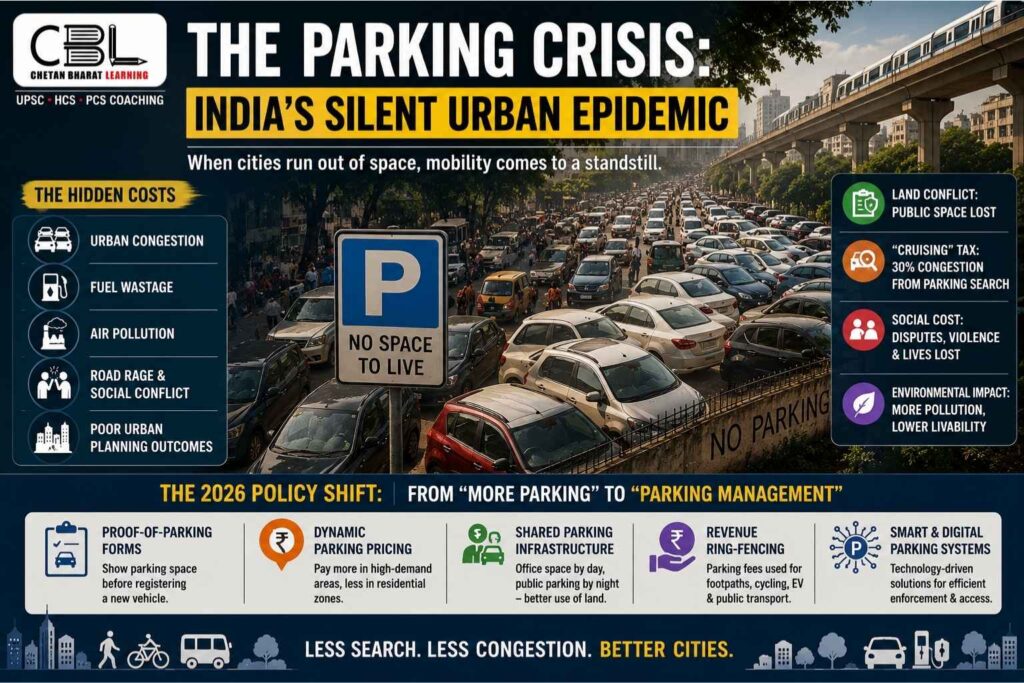
- Urban congestion
- Fuel wastage
- Air pollution
- Road rage and social conflict
- Poor urban planning outcomes
The issue reflects a deeper structural challenge in India’s urban governance — cities designed for mobility are increasingly being consumed by stationary vehicles.
The Urban Paradox: Why Are Indian Cities Choking?
The parking crisis arises from a fundamental mismatch:
India encourages private vehicle ownership, but its cities lack the physical capacity to accommodate them.
As urban populations expand, public roads and open spaces are increasingly converted into informal parking zones, reducing the efficiency and livability of cities.
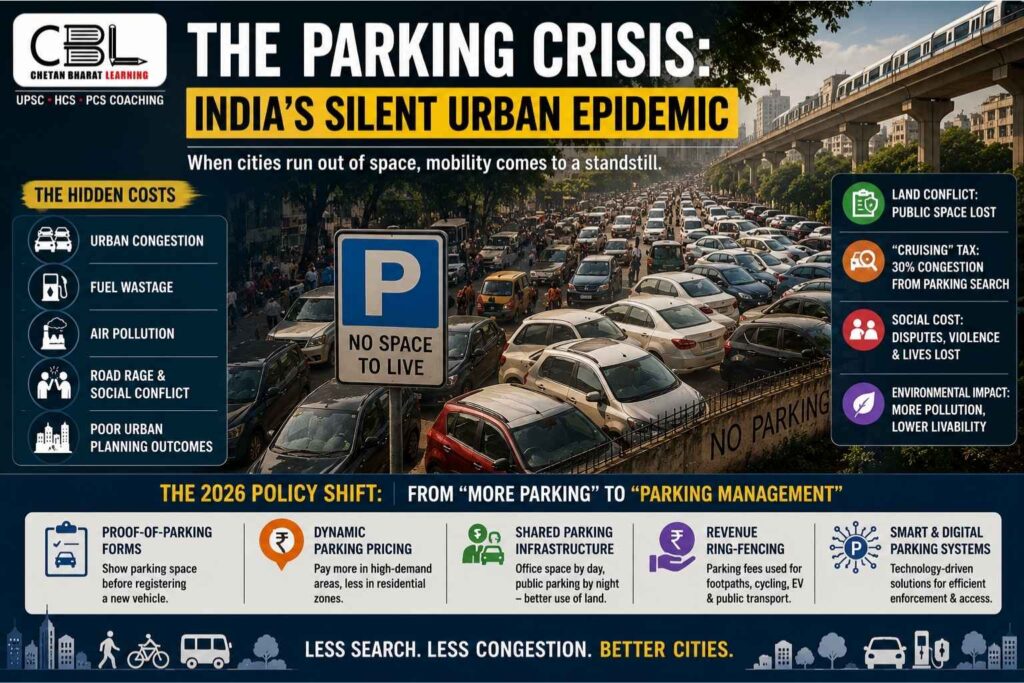
1. The Land Conflict
Parking consumes enormous amounts of valuable urban land.
A single car parking slot requires approximately 23–28 square meters, which is nearly equivalent to the size of a low-income housing unit.
In densely populated cities where land prices are extremely high, dedicating scarce land to parked vehicles instead of:
- Affordable housing
- Public parks
- Footpaths
- Community spaces
represents a serious planning failure.
In effect, cities are sacrificing public space for private vehicle storage.
2. The “Cruising” Tax
A significant share of urban traffic is caused not by movement, but by the search for parking.
Studies suggest that nearly 30% of urban congestion comes from drivers “cruising” around streets searching for parking spots.
This leads to:
- Increased fuel consumption
- Higher greenhouse gas emissions
- Longer travel times
- Greater traffic bottlenecks
Thus, poor parking management directly worsens urban pollution and mobility inefficiency.
3. The Social Cost of Parking
Parking shortages have also become a source of everyday urban conflict.
In cities like Delhi, disputes over parking spaces frequently lead to:
- Verbal altercations
- Neighborhood tensions
- Violence and physical assaults
- Damage to property
In extreme cases, parking disputes have even resulted in fatalities.
This highlights how the parking crisis is not merely an infrastructure issue, but also a challenge to urban social harmony and public order.
The 2026 Policy Shift: From “More Parking” to “Parking Management”
For decades, Indian cities responded to parking shortages by attempting to increase parking supply through:
- Multi-level parking complexes
- Surface parking lots
- Roadside parking expansion
However, policymakers now increasingly recognize that building more parking often encourages greater private vehicle usage.
As a result, 2026 marks a strategic shift toward Demand-Based Parking Management.
1. Proof-of-Parking Norms
Cities like Bhubaneswar are considering policies requiring vehicle owners to provide Proof-of-Parking before registering new vehicles.
The principle is simple:
If you own a car, you must also demonstrate that you have space to park it.
The objective is to reduce indiscriminate vehicle ownership in already congested urban areas.
This policy attempts to shift responsibility from the government to the vehicle owner.
2. Dynamic Parking Pricing
Indian cities are gradually moving away from the idea of “free parking.”
Under Dynamic Pricing, parking charges vary according to:
- Location
- Traffic density
- Demand levels
- Time of day
For example:
- Parking in high-density commercial zones becomes expensive
- Residential parking remains relatively affordable
The goal is to discourage unnecessary private vehicle use and encourage public transport adoption.
This is a major component of Travel Demand Management (TDM).
3. Shared Parking Infrastructure
Many parking spaces remain unused for large parts of the day.
For example:
- Office parking remains vacant at night
- Residential parking remains underutilized during working hours
New urban policies encourage Shared Parking Models, where these spaces can be temporarily leased for public use.
Benefits include:
- Better land utilization
- Reduced need for new construction
- Lower infrastructure costs
- Improved parking efficiency
4. Revenue Ring-Fencing
Modern parking policies increasingly emphasize that parking revenue should not disappear into general municipal funds.
Instead, revenues are being “ring-fenced” for sustainable mobility projects such as:
- Footpaths
- Cycle tracks
- EV charging stations
- Public transport systems
- Smart mobility infrastructure
This creates a feedback loop where parking charges help improve urban mobility alternatives.
Parking and Urban Governance
Parking management falls under the jurisdiction of Urban Local Bodies (ULBs) under the provisions of the 74th Constitutional Amendment Act.
However, many Indian cities still suffer from:
- Weak enforcement
- Fragmented urban planning
- Lack of digital monitoring systems
- Political resistance to paid parking reforms
As a result, illegal and unregulated parking remains widespread.
Smart Cities and Digital Parking Systems
Smart city projects are increasingly integrating technology into parking management through:
- GIS-tagged enforcement systems
- Real-time parking availability apps
- Automated parking sensors
- Digital payment systems
Cities such as Chennai and Pimpri Chinchwad have experimented with smart parking models to reduce congestion and improve enforcement efficiency.
Parking as a Tool for Sustainable Urban Mobility
Globally, urban planners increasingly view parking policy as one of the most effective tools for reducing traffic congestion.
The logic is simple:
Easier parking encourages more cars.
Expensive and limited parking encourages public transport.
Thus, parking management is central to sustainable urban development.
It aligns closely with India’s National Urban Transport Policy (NUTP), which prioritizes:
- Public transport
- Non-motorized transport
- Walkability
- Sustainable mobility
over excessive dependence on private vehicles.
Prelims Pointers
- Parking regulation falls under Urban Local Bodies (ULBs).
- The 74th Constitutional Amendment Act strengthens urban governance institutions.
- The National Urban Transport Policy (NUTP) emphasizes “moving people, not vehicles.”
- Smart parking systems use:
- GIS mapping
- Real-time tracking
- Digital enforcement tools
Mains Analysis
Topic:
“Parking management is the most effective, yet underutilized, tool for Travel Demand Management (TDM) in India.”
Key Arguments
Supply-Side Approach
Focuses on:
- Building more parking spaces
- Multi-level parking infrastructure
- Road expansion
Limitations
- Encourages car dependency
- Consumes valuable urban land
- Fails to solve long-term congestion
Demand-Side Approach
Focuses on:
- Pricing mechanisms
- Parking restrictions
- Public transport incentives
- Shared mobility solutions
Advantages
- Reduces unnecessary vehicle use
- Improves public transport adoption
- Promotes sustainable urban planning
A strong answer should also discuss the balance between:
The “right to own a vehicle”
and
The “right to equitable public space.”
FAQ’s
1. Cars Occupy More Space Than We Realize
Most cars remain parked nearly 90% of the time.
This means cities dedicate enormous amounts of valuable land simply to storing inactive vehicles.
2. “Free Parking” Is Never Truly Free
Even when parking appears free, society still pays through:
- Traffic congestion
- Pollution
- Encroached public spaces
- Reduced pedestrian infrastructure
Someone always bears the hidden cost.
3. Smart Cities Use Pricing to Control Demand
If parking in crowded areas becomes expensive, many people shift toward:
- Buses
- Metro systems
- Shared mobility
This helps reduce road congestion.
4. Ownership Must Include Responsibility
Modern urban policy increasingly argues that:
Owning a vehicle should also mean taking responsibility for where it will be parked.
Governments cannot endlessly build parking infrastructure in already overcrowded cities.
Conclusion
India’s parking crisis is ultimately a crisis of urban priorities.
For decades, cities focused on accommodating more vehicles rather than creating more livable urban spaces.
However, sustainable urban planning requires a shift from:
Vehicle-centric development
to
People-centric mobility systems
The future of Indian cities will depend not on how many parking lots they can build, but on how effectively they can reduce unnecessary dependence on private vehicles.
“Solving the parking crisis is not about building more concrete lots — it is about recognizing public space as a scarce resource and pricing it responsibly.”
Related Current Affairs
Preparing for UPSC, PCS or HCS?
Talk to a mentor at Chetan Bharat Learning, Chandigarh. Free guidance on choosing the right exam and building a study plan.
Chat on WhatsAppCall 97793 53345UPSC / IAS / PCS coaching in Chandigarh · Trusted by aspirants across Punjab & Haryana
Leave a Reply
You must be logged in to post a comment.