
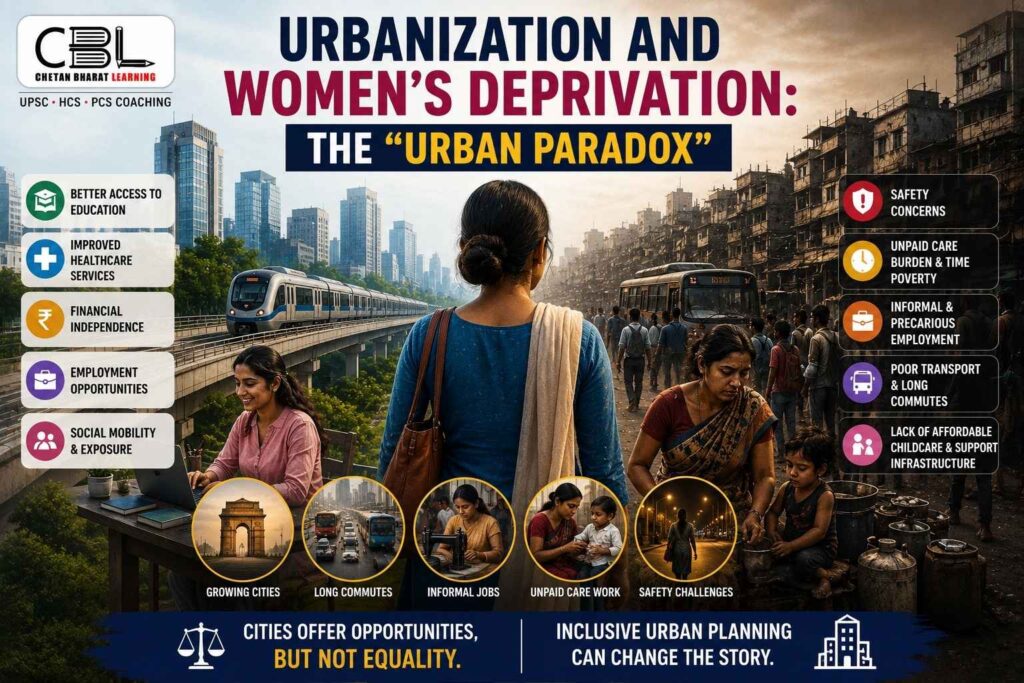
Urbanization is often celebrated as a driver of growth, modernization, and social liberation. Cities are viewed as spaces of opportunity where women can access better education, healthcare, employment, and independence.
However, for millions of women in India, urbanization also creates a different reality — one marked by insecurity, unpaid care burdens, informal employment, and exclusion. This contradiction is commonly described as the “Urban Paradox.”
While cities promise empowerment, they also reproduce new forms of deprivation that often remain invisible in mainstream development narratives.
The Urban Paradox: Empowerment vs. Exclusion
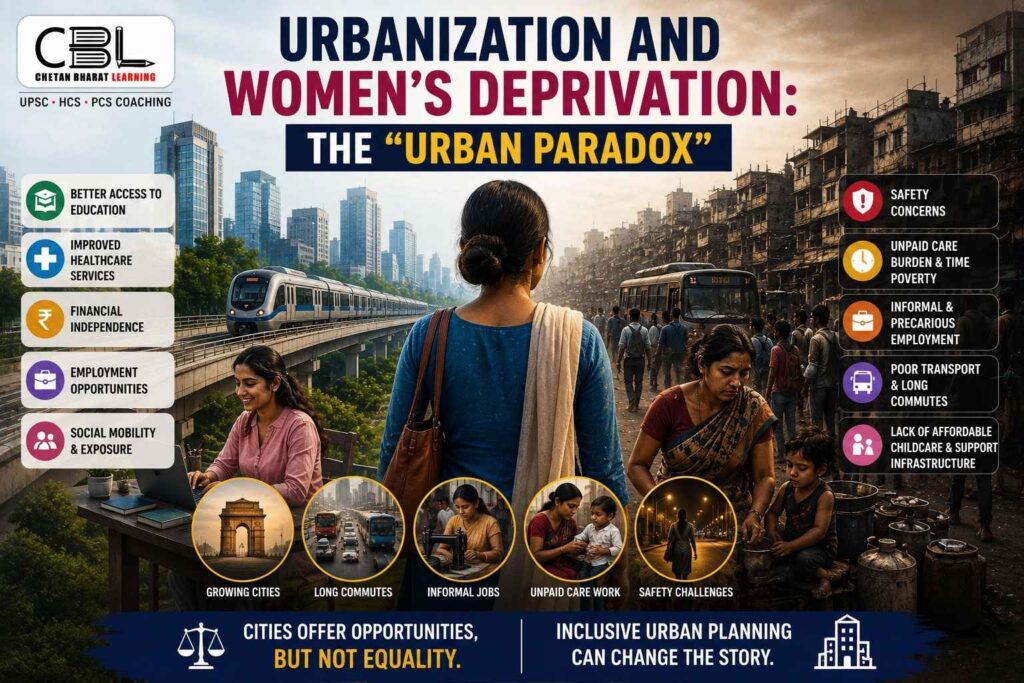
India’s urban population is projected to reach nearly 37.6% by 2026, reflecting the country’s rapid shift toward an urban-centric economy. Yet, the benefits of this transition have not been distributed equally.
The Empowerment Narrative
Urbanization can weaken rigid social hierarchies and create new opportunities for women by providing:
- Better access to formal education
- Improved reproductive and healthcare services
- Greater financial independence
- Employment opportunities in the service sector
- Increased social mobility and exposure
Cities often provide women with anonymity and freedom that may not be available in conservative rural settings.
The Deprivation Reality
Despite these advantages, data shows that the Urban Female Labour Force Participation Rate (U-FLFPR) has historically remained lower than rural participation rates.
This suggests that urban spaces continue to create gender-specific barriers such as:
- Safety concerns
- Social expectations around caregiving
- Long commuting hours
- High living costs
- Lack of affordable childcare
- Limited support infrastructure
As a result, many women either leave the workforce or never enter it in the first place.
Dimensions of Urban Deprivation for Women
1. Time Poverty and the Double Burden
One of the biggest invisible challenges faced by urban women is time poverty.
Even when women participate in paid work, they continue to shoulder the majority of:
- Household chores
- Childcare responsibilities
- Elderly care
- Water and sanitation management
In many urban areas, inadequate public services such as:
- Irregular water supply
- Poor sanitation
- Lack of affordable daycare facilities
force women to spend several additional hours on unpaid labor.
This creates a “double burden” where women manage both paid employment and unpaid domestic work. As a result, opportunities for:
- Skill development
- Higher education
- Career growth
- Economic independence
become limited.
2. Safety as a “Tax” on Mobility
For women, safety is not merely a social issue — it is also an economic constraint.
Many women plan their education, jobs, and daily mobility around concerns such as:
- Unsafe public transport
- Poor street lighting
- Harassment in public spaces
- Unsafe night-time travel
As a result, women often:
- Avoid late-night shifts
- Reject jobs located far away
- Prefer lower-paying but safer workplaces
- Restrict movement after dark
This acts like an invisible “tax” on women’s freedom and economic participation.
In effect, unsafe urban spaces reduce women’s access to high-growth sectors and better-paying employment opportunities.
3. The “Informal Employment” Trap
India’s urban growth has largely been driven by the service sector rather than large-scale industrialization.
This has resulted in the expansion of informal and precarious employment where many women work as:
- Domestic workers
- Street vendors
- Home-based workers
- Gig workers
- Temporary service employees
These jobs are usually characterized by:
- Low wages
- Lack of job security
- Absence of maternity benefits
- No social security protection
- Limited legal safeguards
This phenomenon is often described as the “feminization of precarious labor.”
Women become economically active, but without stable rights, dignity, or long-term financial security.
Government Initiatives: The Policy Framework
India’s urban policy framework is increasingly recognizing the need for gender-responsive planning and inclusive infrastructure.
1. Gender-Inclusive Urban Infrastructure Policy (2023)
This policy marked a major shift in urban planning by mandating Gender Impact Assessments (GIA) for new infrastructure projects.
The policy emphasizes:
- Safer public spaces
- Better street lighting
- Inclusive transport systems
- Accessible urban design
- Surveillance and safety measures
- Gender-sensitive infrastructure planning
The objective is to ensure that cities are designed according to the lived experiences of women rather than assuming gender neutrality.
2. Mission Shakti
Mission Shakti serves as the umbrella framework for women’s empowerment and safety.
Sambal
Focuses on women’s safety through initiatives such as:
- One-Stop Centres
- Women Helplines
- Emergency response systems
Samarthya
Focuses on economic and social empowerment through schemes like:
- PMMVY (Pradhan Mantri Matru Vandana Yojana)
- Maternity assistance programs
- Support services for women workers
3. DAY-NULM (National Urban Livelihoods Mission)
The Deendayal Antyodaya Yojana–National Urban Livelihoods Mission supports urban poor women through:
- Self-Help Groups (SHGs)
- Skill development programs
- Access to credit
- Micro-enterprise support
The mission aims to improve women’s financial independence and urban livelihood security.
4. PMAY-U (Pradhan Mantri Awas Yojana–Urban)
PMAY-U promotes female-led housing ownership.
By ensuring women’s names are included in property ownership documents, the scheme provides:
- Economic security
- Social recognition
- Greater household bargaining power
- Protection against urban vulnerability
Property ownership also improves women’s long-term financial stability in rapidly changing urban environments.
The Way Forward: Gender-Responsive Urban Planning
Urban planning in India must move beyond gender-neutral infrastructure models and adopt a more inclusive approach.
1. Gender-Disaggregated Data
Urban planning should be based on data that separately analyzes the experiences of men and women.
For example:
- Women use public transport differently
- Women’s travel patterns are often multi-purpose and care-oriented
- Women face unique safety challenges
Without gender-specific data, policy design remains incomplete.
2. Inclusive Urban Infrastructure
Cities should prioritize infrastructure that directly improves women’s daily experiences, including:
- Well-lit streets and bus stops
- Affordable and reliable public transport
- Gender-sensitive public toilets
- Safe pedestrian spaces
- Affordable childcare centers
Initiatives such as “Pink Bus” services reflect attempts to make public transport safer and more accessible for women.
3. Inclusive Decision-Making
Women must be included in urban governance and planning institutions.
Policies recommending greater representation of women and gender minorities in planning committees can ensure that urban design reflects real social needs rather than abstract technical priorities.
Inclusive governance creates more responsive and equitable cities.
4. Gender Budgeting
Municipal budgets should specifically allocate funds for:
- Safety infrastructure
- Childcare services
- Public sanitation
- Women-friendly transport systems
Without dedicated budgeting, these priorities are often sidelined in favor of large-scale construction projects that may remain “gender-blind.”
Prelims Pointers
- The Gender-Inclusive Urban Infrastructure Policy (2023) emphasizes gender-sensitive urban planning.
- Mission Shakti consists of two major components:
- Sambal
- Samarthya
- PMAY-U promotes female-led ownership in urban housing.
- Rapid urbanization often outpaces infrastructure development in:
- Water supply
- Waste management
- Public services
Mains Analysis
Topic: “Feminization of Poverty in Urban Spaces”
Key Dimensions to Mention
- Gender-blind urban infrastructure
- Time poverty and unpaid care work
- Safety as an economic constraint
- Informalization of female labor
- Need for gender budgeting
- Inclusive public transport and sanitation
- Women-centric urban governance
A strong answer should argue that inclusivity must become the foundation of urban planning rather than an afterthought.
Question
“If urbanization empowers women, why is the Urban Female Labour Force Participation Rate lower than rural participation?”
Points to Discuss
- High unpaid care burden in cities
- Safety-related mobility restrictions
- Lack of affordable childcare infrastructure
- Rising urban living costs
- Informal and insecure employment patterns
- Social expectations regarding household responsibilities
You may also mention the concept of the “backward-bending labour supply curve” in urban middle-class households.
FAQ’s
1. The “Hidden Tax” on Women
Women in cities often spend extra time and energy managing safety and household responsibilities. This limits their ability to work freely.
2. Jobs Alone Are Not Enough
Even if jobs are available, women cannot fully benefit unless cities provide:
- Safe transport
- Childcare facilities
- Public toilets
- Reliable services
3. Invisible but Essential Infrastructure
Things like:
- Street lighting
- Clean toilets
- Safe buses
- Daycare centers
may seem small, but they are critical for women’s participation in public life.
4. Ownership Creates Security
Schemes like PMAY-U give women legal ownership of homes, improving both economic security and social empowerment.
Conclusion
Urbanization can become a powerful force for women’s empowerment only when cities are designed through a gender-sensitive lens.
A truly inclusive city is not defined merely by:
- Flyovers
- Metro networks
- High-rise buildings
but by whether women can:
- Move safely
- Work with dignity
- Access public services
- Participate equally in economic life
Ultimately, the success of urbanization should be measured not only by economic growth, but also by how effectively cities reduce gender-based inequalities.
“Urbanization empowers women only when cities are designed with gender-sensitive planning that prioritizes safety, care-support, and inclusive economic infrastructure over mere concrete expansion.”
Related Current Affairs
Preparing for UPSC, PCS or HCS?
Talk to a mentor at Chetan Bharat Learning, Chandigarh. Free guidance on choosing the right exam and building a study plan.
Chat on WhatsAppCall 97793 53345UPSC / IAS / PCS coaching in Chandigarh · Trusted by aspirants across Punjab & Haryana
Leave a Reply
You must be logged in to post a comment.