
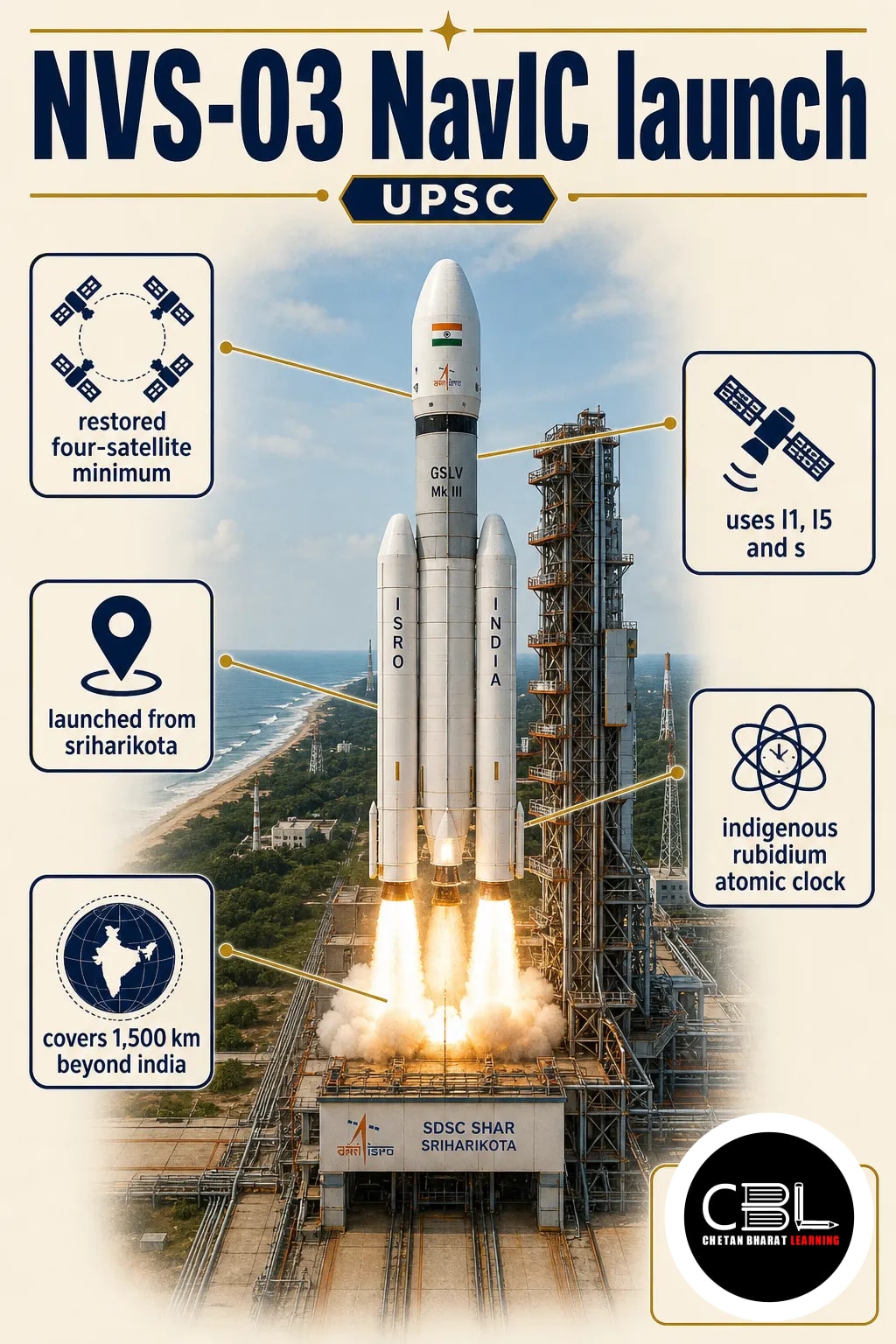

The NVS-03 NavIC launch on 30 October 2026 restored the minimum satellite configuration for India’s regional navigation system. The mission is an important development in India’s space technology and science coverage.
Quick answer: The Indian Space Research Organisation (ISRO) launched the 2,250 kg NVS-03 from Sriharikota on 30 October 2026. The NVS-03 NavIC launch restored the four-satellite minimum for standalone navigation. Its indigenous atomic clock and L1 signal also support the modernisation of India’s regional positioning and timing network.
NVS-03 NavIC launch: key mission facts
ISRO used the Geosynchronous Satellite Launch Vehicle (GSLV-F18) to place NVS-03 in its intended transfer orbit. The launch took place at Satish Dhawan Space Centre, Sriharikota, Andhra Pradesh.
| Feature | Fact |
|---|---|
| Satellite series | Third satellite in the next-generation NVS series |
| Initial orbit | Geosynchronous Transfer Orbit (GTO) |
| Launch vehicle | GSLV-F18; the 20th GSLV flight |
| Signal bands | L1, L5 and S |
| Clock | Indigenous rubidium atomic clock, alongside imported clocks |
The satellite separated successfully from the rocket after launch. For background, see CBL’s earlier account of the NavIC recovery plan.
What is NavIC and why did it need NVS-03?
NavIC, or Navigation with Indian Constellation, is India’s independent regional satellite navigation system. It is also known as the Indian Regional Navigation Satellite System (IRNSS).
The system needs at least four active satellites for standalone positioning, navigation and timing services. However, clock failures on older satellites and NVS-02’s failure to reach its final orbit had reduced the operational fleet to three.
The NVS-03 NavIC launch supplied the fourth satellite needed for the minimum configuration. The planned full constellation has seven satellites; see the regional navigation system explainer for earlier context.
How do the atomic clock and L1 signal help?
The atomic clock supports accurate navigation by measuring signal travel time, which helps calculate distance. ISRO’s Space Applications Centre developed the indigenous rubidium clock; older IRNSS satellites relied on imported Swiss clocks that suffered failures.
In addition, NVS-03 transmits in the L1 band, used widely in commercial Global Positioning System (GPS) receivers. This can ease access through mobile chipsets; however, ISRO chief V. Narayanan said wider mobile integration would follow completion of the seven-satellite constellation.
Why does the mission matter?
The mission supports independent navigation and timing across India and the surrounding region. NavIC is designed to cover India and up to 1,500 km beyond its geopolitical boundary.
Its open service supports public navigation, mapping and logistics. In contrast, its encrypted restricted service supports military uses. Narayanan said 10,400 locomotives and 64,000 fishing vessels were being tracked in real time.
Source: The Hindu, 31 October 2026
- NVS-03 and India’s NavIC Recovery Plan (28 Oct 2026)
- Regional GPS: India’s NAVIC Update Explained (28 Oct 2026)
- NVS-03 and India’s NavIC Recovery Plan (20 Oct 2026)
Asked in UPSC: Previous Year Questions
- UPSC CSE Prelims 2018 (GS Paper I): Consider IRNSS claims: three geostationary and four geosynchronous satellites; coverage to 5,500 sq km beyond India; full global coverage by mid-2019. Which are correct?
UPSC tests the system’s orbital configuration and coverage; therefore, distinguish regional coverage from global coverage.
Punjab PCS and Haryana HCS General Studies can test NavIC’s coverage, services and launch vehicle. In addition, revise how satellite navigation supports transport and logistics.
Prelims Practice Corner
Mains Practice Questions
Frequently Asked Questions
When and where was NVS-03 launched?
NVS-03 was launched on 30 October 2026 from Sriharikota, Andhra Pradesh. ISRO used GSLV-F18 for the mission.
How many satellites does NavIC need?
NavIC needs at least four active satellites for standalone services. Its planned full constellation, however, consists of seven satellites.
Does NVS-03 carry an Indian atomic clock?
Yes, NVS-03 carries an indigenous rubidium atomic clock alongside imported clocks. ISRO’s Space Applications Centre developed the Indian clock.
Related Current Affairs
Preparing for UPSC, PCS or HCS?
Talk to a mentor at Chetan Bharat Learning, Chandigarh. Free guidance on choosing the right exam and building a study plan.
Chat on WhatsAppCall 97793 53345UPSC / IAS / PCS coaching in Chandigarh · Trusted by aspirants across Punjab & Haryana

 Ananya RanaIAS · AIR 60
 Aditya SharmaIAS · AIR 70
 Ria Kaur SethiIPS · AIR 89
 Aman AloonIRS · AIR 295
 Sumer Singh VirkIRS · AIR 335
 Shivani PanchalIAS

Leave a Reply
You must be logged in to post a comment.