
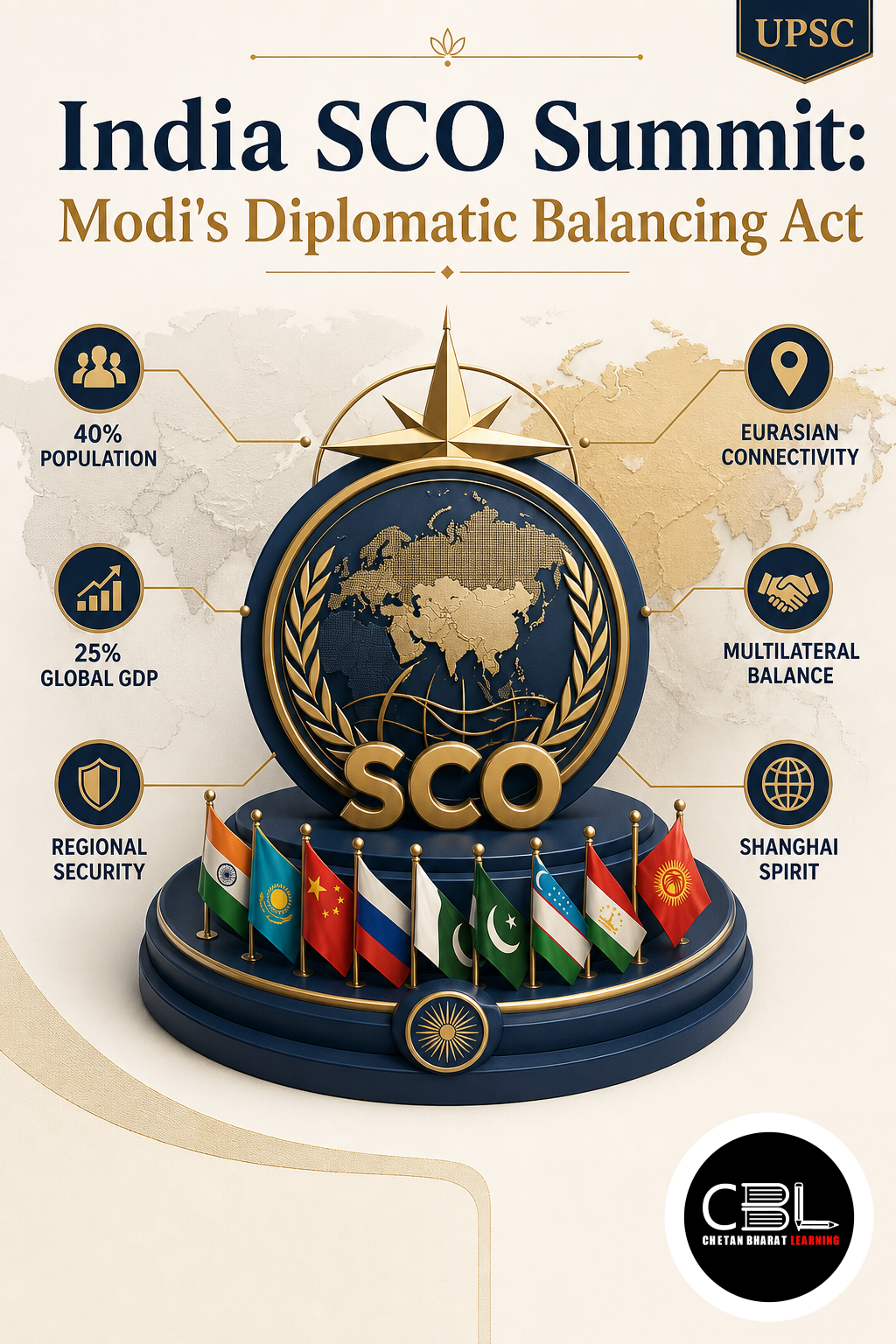

UPSC Mapping
- Prelims: International Relations, Current Events
- Mains: GS Paper 2 – International Relations
Quick Facts
| SCO Founded | 2001 |
|---|---|
| India Joined | Full Member Since 2017 |
| Member States | 10 Countries |
| Secretariat | Beijing |
What is the India SCO Summit?
The Shanghai Cooperation Organisation grew out of the Shanghai Five and was formally established in 2001. It today includes China, Russia, Pakistan, Iran, Belarus, Kazakhstan, Kyrgyzstan, Tajikistan, Uzbekistan and India, alongside several observer and dialogue partners. Originally built to fight the “three evils” of terrorism, separatism and extremism, its agenda has broadened into trade, connectivity, energy and regional stability.
India became a full member of the grouping in 2017, gaining a seat that connects South Asia with Central Asia, Russia, China and Iran. The India SCO Summit therefore functions as a single table where India can pursue security cooperation, energy access and great-power diplomacy at once, rather than through separate bilateral channels.
Why is the India SCO Summit in News?
The 2026 gathering in Tianjin drew attention because it brought Modi, Putin and Xi to the same venue while the Ukraine war and West Asia conflict continue to reshape global supply chains. Delhi used the platform to hold a dedicated Modi-Putin meeting on defence, energy and connectivity, even as speculation grew over a possible Modi-Xi exchange on the unresolved border dispute.
Officials frame this as a test of India’s strategic autonomy: engaging rivals without joining either camp. Background and related briefings are available through the PIB release on the visit.
Key Features
- Multi-alignment approach: India works with the US, Europe, Japan and Australia even as it deepens SCO ties with Russia and China.
- Traditional Russia pillars: Defence, nuclear energy, oil and space cooperation anchor the Modi-Putin relationship.
- Competitive coexistence with China: Cooperation continues in BRICS, SCO and G20 even as border and Indo-Pacific tensions persist.
- West Asia spillover: Conflict there threatens oil security, shipping routes and inflation, all of direct concern to India.
- Regional Anti-Terrorist Structure (RATS): Headquartered in Tashkent, it remains India’s main counter-terrorism link within the bloc.
Challenges
- Internal contradictions: India-Pakistan and India-China frictions sit inside the same bloc that seeks unified action.
- Divergent Russia-China alignment: Moscow’s deepening tilt toward Beijing complicates India’s balancing act.
- Limited leverage on Ukraine: India’s calls for dialogue carry little enforcement power within the grouping.
- Connectivity gaps: Without land access through Pakistan, India depends on alternatives like Chabahar for Central Asian trade.
- Bloc versus bilateral tension: Balancing SCO obligations against bilateral US and Quad commitments remains delicate.
Way Forward
Analysts suggest India should continue treating the SCO as one node in a wider multi-alignment strategy rather than a primary alliance. Engaging where interests align, such as connectivity, counter-terrorism and energy security, while preparing separately for areas of divergence, keeps options open.
Sustained diplomatic investment in Central Asia, deeper use of platforms like MEA statements, and issue-based partnerships over permanent alliances are likely to define India’s approach going forward. The core UPSC takeaway is that India seeks security, connectivity and regional cooperation without surrendering strategic autonomy.
Prelims Practice Corner
Q1. The Shanghai Cooperation Organisation was established in which year?
- (a) 1996
- (b) 2001
- (c) 2005
- (d) 2017
Answer: (b) SCO was formally established in 2001, evolving from the Shanghai Five.
Q2. India became a full member of the SCO in which year?
- (a) 2001
- (b) 2010
- (c) 2017
- (d) 2020
Answer: (c) India and Pakistan both became full members in 2017.
Q3. Where is the SCO’s Regional Anti-Terrorist Structure (RATS) headquartered?
- (a) Beijing
- (b) Moscow
- (c) Tashkent
- (d) Astana
Answer: (c) RATS is headquartered in Tashkent, Uzbekistan.
Q4. Which of the following is NOT a founding focus area of the SCO, known as the “three evils”?
- (a) Terrorism
- (b) Separatism
- (c) Extremism
- (d) Protectionism
Answer: (d) The three evils are terrorism, separatism and extremism.
Q5. The SCO Secretariat is located in which city?
- (a) Tashkent
- (b) Beijing
- (c) New Delhi
- (d) Moscow
Answer: (b) The SCO Secretariat is based in Beijing.
Mains Practice Questions
Q1. Discuss the significance of the SCO for India’s strategic autonomy amid great-power rivalry. (250 words, 15 marks)
Answer Structure:
- Intro: Briefly define SCO and India’s membership status since 2017.
- Body: Cover connectivity with Central Asia, counter-terrorism via RATS, energy and trade access, and the balancing act between cooperation and competition with China and Pakistan.
- Conclusion: Emphasise issue-based engagement as the core of India’s multi-alignment strategy.
Q2. “Cooperators and competitors can coexist in the same platform.” Examine this in the context of India-China relations within the SCO. (250 words, 15 marks)
Answer Structure:
- Intro: Frame India-China ties as one of competitive coexistence.
- Body: Discuss areas of cooperation (BRICS, SCO, G20, climate) versus competition (border, Indo-Pacific, South Asia, Central Asia influence).
- Conclusion: Note India’s challenge of managing competition without confrontation.
FAQs on India SCO Summit
What is the main purpose of the SCO?
The SCO was formed to counter terrorism, separatism and extremism, and has since expanded to cover trade, energy, connectivity and regional security among its member states.
Why does the India SCO Summit matter for UPSC aspirants?
It illustrates core GS Paper 2 themes such as multi-alignment, strategic autonomy and regional groupings, making it a recurring source of prelims and mains questions.
Is India a founding member of the SCO?
No, India was not a founding member in 2001. It joined as a full member in 2017 along with Pakistan.
Related Current Affairs
Preparing for UPSC, PCS or HCS?
Talk to a mentor at Chetan Bharat Learning, Chandigarh. Free guidance on choosing the right exam and building a study plan.
Chat on WhatsAppCall 97793 53345UPSC / IAS / PCS coaching in Chandigarh · Trusted by aspirants across Punjab & Haryana
Leave a Reply
You must be logged in to post a comment.