
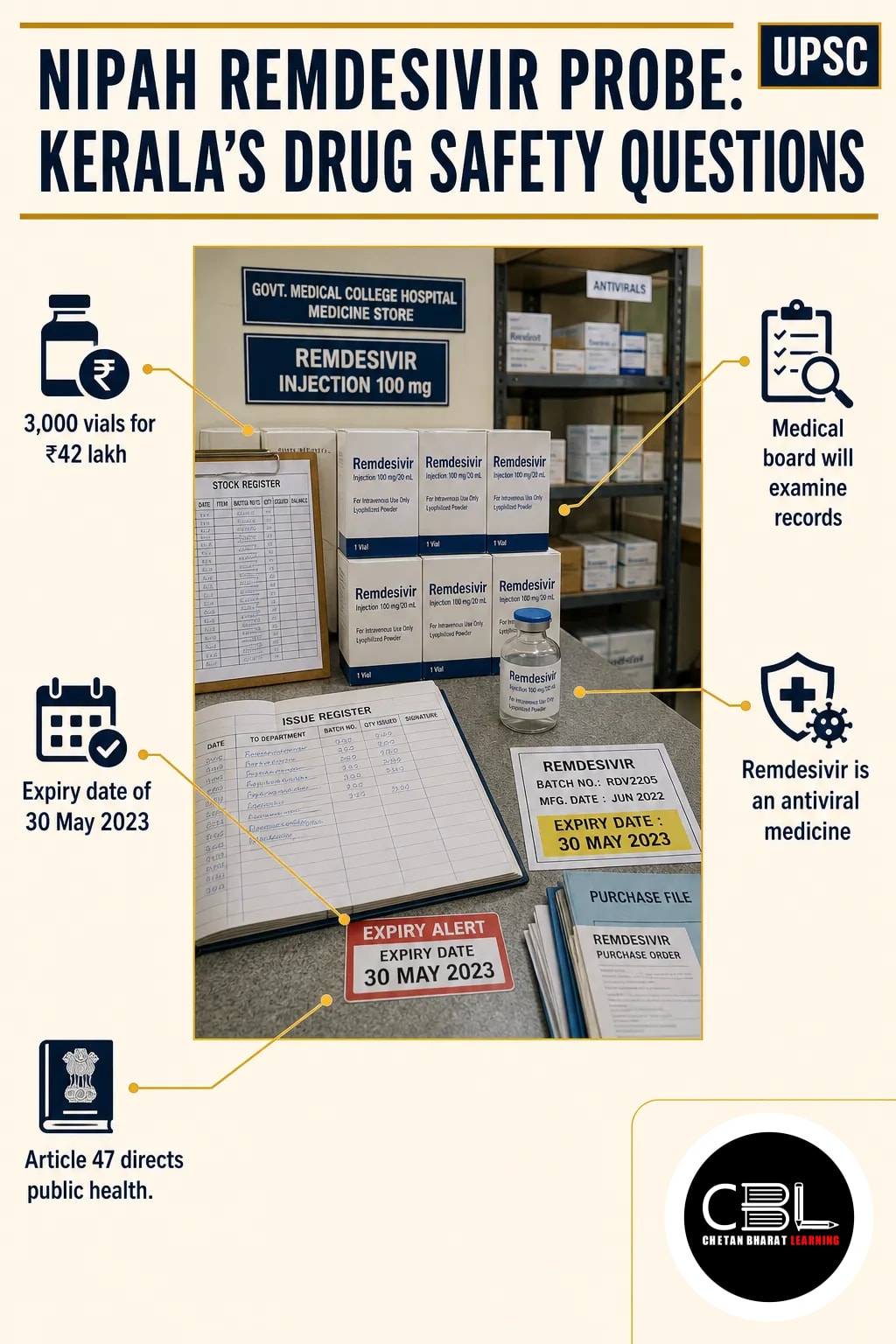

The Nipah remdesivir probe in Kerala has raised questions about medicine safety and outbreak management. For broader context, explore national current affairs.
Quick answer: Kerala has ordered a Nipah remdesivir probe into suspected use of expired vials among patients in 2023–2025. Its last state procurement covered 3,000 vials expiring on 30 May 2023. A medical board will examine whether expired medicine contributed to deaths; neither its use nor a causal link has been established.
What happened in the Nipah remdesivir probe?
Kerala ordered an inquiry into whether expired remdesivir contributed to Nipah patient deaths. Health Minister K Muraleedharan announced a medical board in the Legislative Assembly, responding to legislator Mathew Kuzhalnadan.
The minister said records from Kozhikode Medical College raised suspicion about vials used in 2023, 2024 and 2025. However, suspicion about expiry is distinct from proof of administration or a causal link with death.
The Directorate of Medical Education and the Directorate of Health Services must collect details of all patients given remdesivir. The first oversees medical colleges; the second runs other government hospitals. Therefore, the records exercise extends beyond Nipah patients alone.
What do procurement and hospital records show?
Kerala’s last recorded purchase through its public procurement agency predates the suspected use by more than two years. The Kerala Medical Services Corporation Limited (KMSCL) procures and distributes medicines for government institutions; the minister said it supplied remdesivir to hospitals exclusively.
On 3 June 2021, KMSCL bought 3,000 vials for ₹42 lakh, with an expiry date of 30 May 2023. However, the purchase date alone cannot establish which batch any patient received.
| Financial year | Vials used at Kozhikode Medical College |
|---|---|
| 2023–24 | 102 |
| 2024–25 | 34 |
| 2025–26 | 10 |
| 2026–27 | 50; brought from Bahrain on 12 June 2026 and given to a Nipah patient |
These are hospital-wide reported usage figures, not counts of Nipah patients or confirmed expired vials. Moreover, the 2026–27 vials had a separately stated source; the source report does not specify their expiry date.
Public procurement also matters for access to specialised medicines. For comparison, see CBL’s coverage of Kerala’s procurement of risdiplam.
What do Nipah case numbers establish?
The reported figures establish case outcomes, but not why individual patients died. They also do not establish how many patients received remdesivir.
| Calendar year | Reported Nipah cases and deaths |
|---|---|
| 2023 | 6 cases; 2 deaths |
| 2024 | 2 cases; 2 deaths |
| 2025 | 3 cases; 2 deaths |
| 2026 | 1 case; the patient survived |
The case data follow calendar years, whereas hospital usage follows financial years. Consequently, a year-by-year comparison cannot identify individual treatments or establish causation.
What are remdesivir and Nipah virus?
Remdesivir is an antiviral medicine, while Nipah is a zoonotic virus that can cause severe disease. Zoonotic infections pass between animals and humans; Nipah can also spread between people.
Doctors prescribed remdesivir during India’s COVID-19 pandemic. The drug is patented, and Indian companies manufacture it under voluntary licences from Gilead Life Sciences in the United States. However, the report’s account of its use does not establish its effectiveness against Nipah or make it a proven treatment for the infection.
Why does the issue matter for public health governance?
The inquiry tests whether emergency medicine systems can trace a vial from procurement to patient. It also highlights the difference between maintaining stocks and ensuring that stocks remain safe to use.
- Patient safety: An expiry date signals the period within which the manufacturer supports a product’s quality; therefore, suspected use after expiry requires verification.
- Clinical evidence: Severe infection, treatment timing and other clinical factors may affect outcomes; consequently, death after administration alone cannot prove the drug caused it.
- Accountability: Procurement, storage, dispensing and prescribing involve different actors; hence, the board must establish each actor’s role before assigning responsibility.
- Public confidence: Outbreak decisions often occur under pressure; therefore, clear disclosure of verified findings can support trust without prejudging the inquiry.
Quality and safety are distinct from affordability, although both shape medicine access. In addition, CBL’s explainer on India’s drug pricing mechanisms examines the affordability dimension.
What should the inquiry and response prioritise?
The medical board should establish patient-level facts before assessing responsibility or causation. A credible response also requires safeguards for future outbreaks.
- Trace batches: Match purchase, transfer, stock and dispensing records with batch numbers and expiry dates; then link them to patient files.
- Review clinical histories: Examine illness severity, treatment dates and outcomes independently; moreover, distinguish association from a demonstrated contribution to death.
- Protect stock: Introduce expiry alerts, physical stock checks and separation of expired vials; in addition, document their disposal.
- Communicate findings: Publish the board’s methods and conclusions while protecting patient confidentiality; finally, explain any corrective action and its timeline.
Article 47 of the Constitution directs the State to improve public health. Therefore, reliable medicine supply and accountable treatment systems are relevant to both health administration and governance.
Source: The Indian Express, 29 October 2026
Asked in UPSC: Previous Year Questions
- UPSC CSE Prelims 2025 (GS Paper I): Which statements about monoclonal antibodies are correct: they are human-made proteins, bind specific antigens, and are used to treat viral infections such as Nipah?
UPSC connects Nipah to treatment concepts; therefore, distinguish antibodies from antiviral drugs.
State PCS examinations can test medicine procurement, expiry monitoring and hospital accountability as state governance issues. In addition, revise the respective roles of public health departments and medical colleges in outbreak response.
Prelims Practice Corner
Mains Practice Questions
Frequently Asked Questions
Did expired remdesivir cause Nipah deaths in Kerala?
The link has not been established. Kerala will form a medical board to examine suspected use and whether it contributed to deaths.
When did Kerala’s 2021 remdesivir purchase expire?
The stated expiry date was 30 May 2023. KMSCL had purchased 3,000 vials on 3 June 2021 for ₹42 lakh.
Were the 2026 remdesivir vials from the 2021 purchase?
No: the minister said the 50 vials used in 2026–27 came from Bahrain on 12 June 2026. However, the report does not state their expiry date.
Related Current Affairs
Preparing for UPSC, PCS or HCS?
Talk to a mentor at Chetan Bharat Learning, Chandigarh. Free guidance on choosing the right exam and building a study plan.
Chat on WhatsAppCall 97793 53345UPSC / IAS / PCS coaching in Chandigarh · Trusted by aspirants across Punjab & Haryana
Leave a Reply
You must be logged in to post a comment.