
Kerala salary bills passed by the Assembly raise ministers’ pay and legislators’ allowances, bringing state legislative powers and public expenditure into focus.
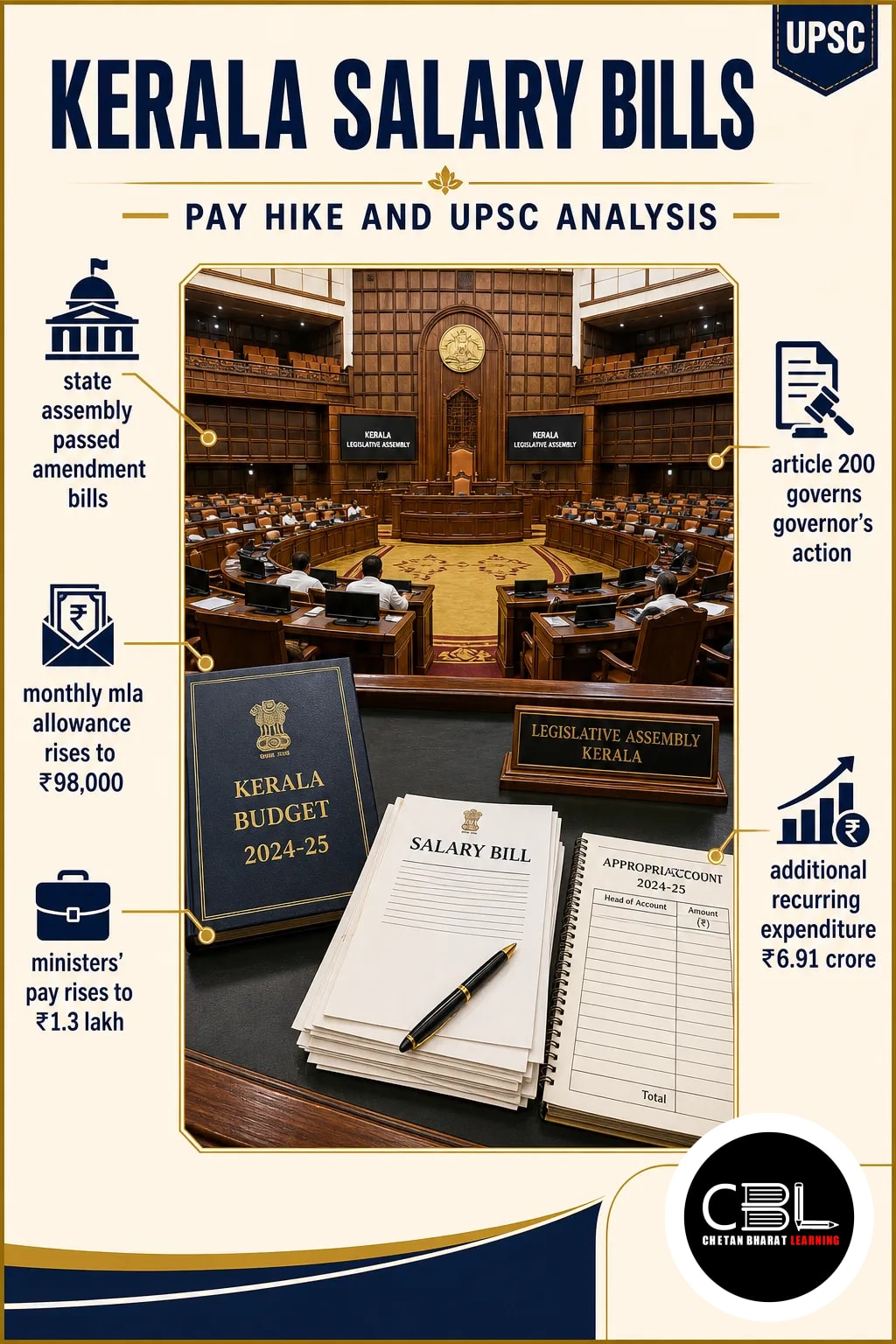
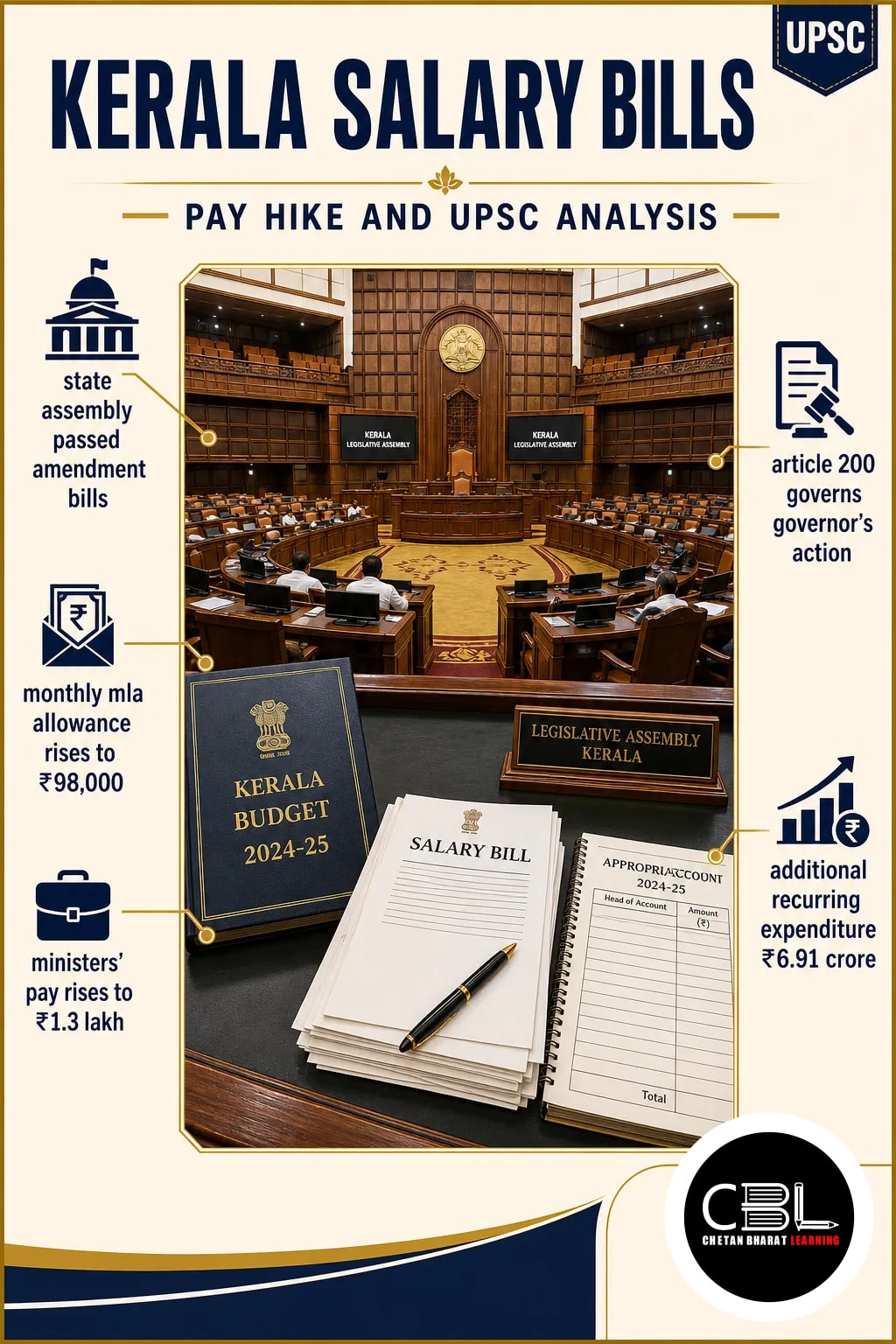
Quick answer: On 29 October 2026, the Kerala Assembly passed two Kerala salary bills revising ministers’ pay, Members of Legislative Assembly (MLAs)’ allowances and former members’ pensions. The revisions are scheduled from 1 November. Ministers’ monthly pay and allowances will rise to approximately ₹1.3 lakh, while MLA allowances will reach ₹98,000.
What did the Assembly pass?
The Assembly passed two amendment Bills covering salaries, allowances and legislative pensions. It did so on the final day of the 16th Assembly’s second session, after the Cabinet cleared both Bills.
The measures are the Payment of Salaries and Allowances (Amendment) Bill, 2026 and the Kerala Payment of Pension to Members of Legislature (Amendment) Bill, 2026. The Assembly also passed Kerala Appropriation Bills and then adjourned sine die, meaning without fixing a date for its next sitting.
The session lasted nine days between 12 and 29 October, with a break in between. The revisions are scheduled from 1 November; however, Assembly passage alone does not complete the process of a Bill becoming law. Article 200 governs the Governor’s action on a Bill presented after passage.
How do the Kerala salary bills change pay and allowances?
Ministers’ monthly salaries and allowances will rise from ₹1.08 lakh to approximately ₹1.3 lakh, while MLA allowances will increase from ₹70,000 to ₹98,000. The allowance components were last revised in 2018.
For ministers, basic salary rises from ₹2,000 to ₹3,000, constituency allowance from ₹40,000 to ₹45,000, and conveyance allowance from ₹17,000 to ₹25,000. For MLAs, the component-wise changes are:
| Monthly MLA allowance | Earlier → revised |
|---|---|
| Fixed allowance | ₹2,000 → ₹4,000 |
| Constituency allowance | ₹25,000 → ₹35,000 |
| Telephone allowance | ₹11,000 → ₹11,000 |
| Information allowance | ₹4,000 → ₹5,000 |
| Sumptuary allowance | ₹8,000 → ₹13,000 |
| Travelling allowance | ₹20,000 → ₹30,000 |
Thus, constituency and travelling allowances each rise by ₹10,000, while the telephone allowance stays unchanged. The salary Bill cites increases in prices, including petrol, diesel and electricity, since the previous revision. For a related inflation context, see the discussion of dearness allowance and inflation; it concerns a separate pay mechanism.
How will former MLAs’ pensions change?
The pension amendment raises the amounts linked to former MLAs’ total years of service. The reported changes cover service periods up to five years:
| Total service | Pension: earlier → revised |
|---|---|
| Less than two years or two years | ₹8,000 → ₹10,000 |
| Three years | ₹12,000 → ₹15,000 |
| Four years | ₹16,000 → ₹20,000 |
| Five years | ₹20,000 → ₹25,000 |
The pension Bill says the additional expenditure will be considerable. However, it does not give a reliable total because qualifying service, age and applicable entitlements vary.
Which constitutional provisions matter?
The Constitution lets state legislatures regulate members’ and ministers’ remuneration by law, subject to the legislative process and public finance rules.
| Provision | What it provides |
|---|---|
| Article 164(5) | Ministers’ salaries and allowances are determined by the state legislature by law. |
| Article 195 | State legislators receive salaries and allowances determined by the legislature by law. |
| Article 200 | After a state legislature passes a Bill, it is presented to the Governor for action under the Article. |
| Article 204 | An appropriation law authorises withdrawal of specified expenditure from the state’s Consolidated Fund. |
| Article 266(3) | Money can be appropriated from the Consolidated Fund only in accordance with law and the Constitution. |
Consequently, an amendment setting entitlements and an appropriation authorising expenditure perform different functions. Aspirants should not treat Assembly passage, assent and withdrawal from the Consolidated Fund as interchangeable steps.
Why does the revision matter for governance?
The revision illustrates how legislatures balance representative work, fiscal responsibility and accountability when determining their own benefits.
- Cost of representation: Constituency and travel allowances can support legislative duties; however, their levels need a clear public rationale.
- Recurring expenditure: The reported allowance increase entails approximately ₹6.91 crore in additional recurring expenditure. The source does not specify the period for this estimate.
- Pension uncertainty: Future costs depend on individual service and entitlement profiles; therefore, the allowance estimate should not be mistaken for the total cost of both Bills.
- Institutional accountability: Legislators decide benefits that affect them directly. Consequently, transparent debate and published cost estimates are important for public scrutiny.
What safeguards could improve future revisions?
Clear criteria and fuller fiscal disclosure can make future remuneration decisions easier to assess.
- Publish a cost breakdown: Present allowance and pension estimates separately, with the period and assumptions stated.
- Explain the benchmarks: Set out how inflation and constituency responsibilities inform each proposed component.
- Enable independent input: Seek an independent assessment before legislative debate; nevertheless, the legislature retains its constitutional law-making role.
- Review implementation: Compare actual expenditure with estimates and explain material differences in public financial documents.
Overall, the Kerala salary bills demonstrate both the legislature’s authority and the need to explain recurring commitments. A sound review should account for adequate representation as well as competing budget priorities.
Source: The Hindu, 29 October 2026
Punjab PCS and Haryana HCS may test the constitutional basis of state legislators’ pay and the state budget process. Therefore, distinguish Articles 164(5), 195 and 204 when revising state governance.
Prelims Practice Corner
Mains Practice Questions
Frequently Asked Questions
What is the revised monthly allowance for Kerala MLAs?
₹98,000, up from ₹70,000. The increase includes higher constituency and travelling allowances, while the telephone allowance remains unchanged.
Which constitutional article covers state legislators’ salaries?
Article 195 covers state legislators’ salaries and allowances. It provides for their determination by the state legislature by law.
Does the ₹6.91 crore estimate include the pension increase?
No; the reported ₹6.91 crore estimate concerns the enhancement of monthly allowances. The pension Bill says its additional cost is difficult to estimate because individual entitlements vary.
When are the Kerala revisions scheduled to take effect?
1 November 2026 is the scheduled date. However, passage by the Assembly is distinct from the Governor’s action under Article 200.
Related Current Affairs
Preparing for UPSC, PCS or HCS?
Talk to a mentor at Chetan Bharat Learning, Chandigarh. Free guidance on choosing the right exam and building a study plan.
Chat on WhatsAppCall 97793 53345UPSC / IAS / PCS coaching in Chandigarh · Trusted by aspirants across Punjab & Haryana
Leave a Reply
You must be logged in to post a comment.