
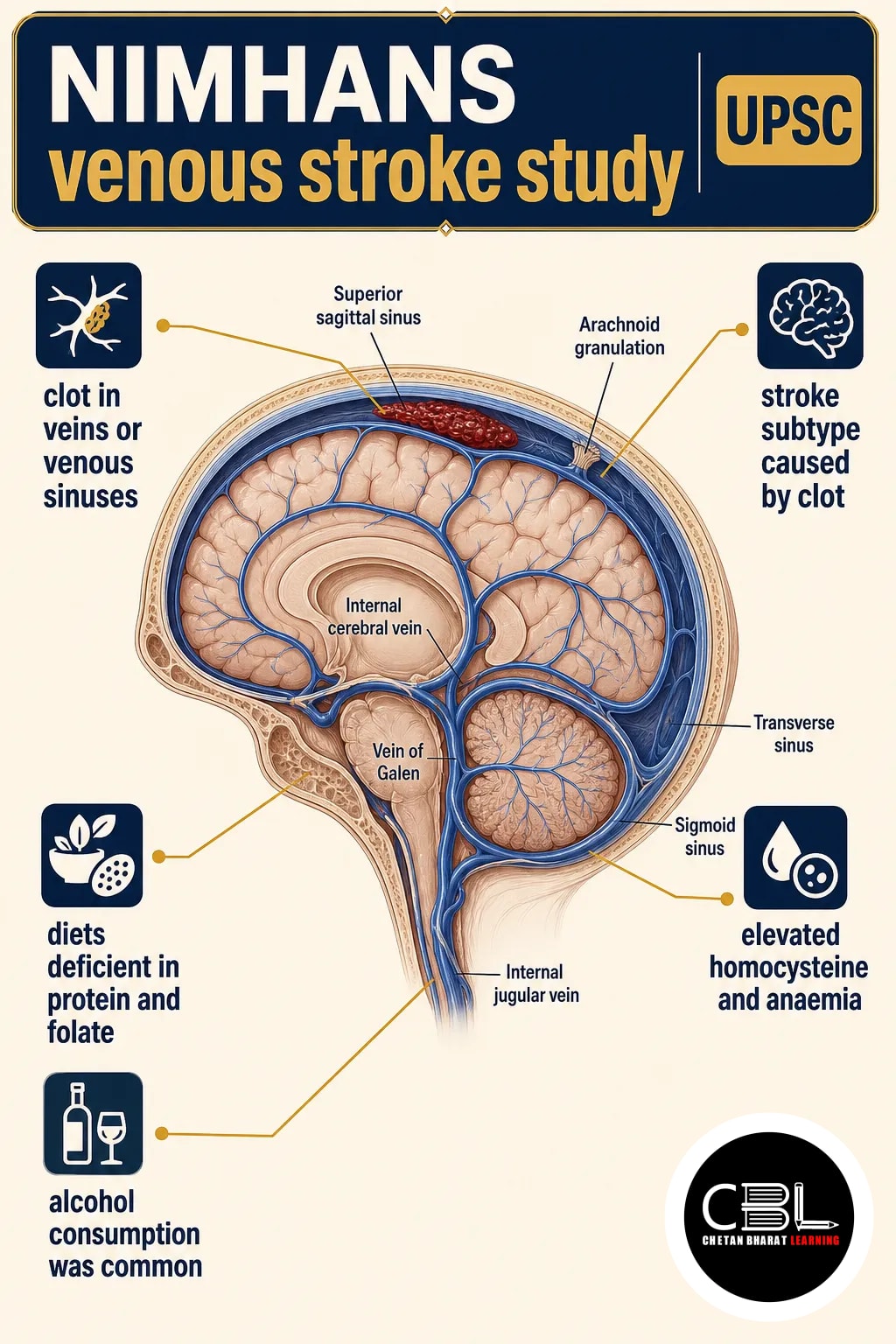

The NIMHANS venous stroke study has highlighted nutritional gaps among patients in Karnataka. For related exam coverage, explore science and technology current affairs.
Quick answer: The NIMHANS venous stroke study examined cerebral venous thrombosis in Karnataka. Researchers found that patients were more likely to have diets deficient in protein and folate. Elevated homocysteine, anaemia and alcohol consumption were also common among diagnosed patients. The findings suggest associations, not proof that these factors caused each case.
What is cerebral venous thrombosis?
Cerebral venous thrombosis (CVT) is a stroke subtype caused by a clot in veins or venous sinuses draining the brain. In contrast, an arterial ischaemic stroke involves a blockage in an artery supplying the brain.
Venous sinuses are channels that collect blood from the brain. Therefore, the location of the clot is the essential distinction for prelims.
What did the NIMHANS venous stroke study find?
Researchers linked CVT in Karnataka with nutritional deficiencies and alcohol consumption. The National Institute of Mental Health and Neurosciences (NIMHANS) team found that nutritional gaps extended beyond vitamin B12.
| Finding | What to remember |
|---|---|
| Dietary intake | Patients were more likely to have diets deficient in protein and folate. |
| Other nutritional gaps | Inadequate pyridoxine and other nutrients were also evident. |
| Patient findings | Elevated homocysteine, anaemia and alcohol consumption were common. |
Pyridoxine is vitamin B6; folate is vitamin B9. Homocysteine, meanwhile, is an amino acid present in the blood.
How should aspirants interpret the findings?
The findings identify factors associated with CVT; they do not establish that any one factor caused an individual case. Moreover, the available source does not specify a sample size or quantify these associations.
The study discusses the potential contribution of these factors to CVT prevalence in Karnataka. However, a common finding among patients should not be treated as a prevalence estimate for the general population.
Why does the study matter?
The study connects a neurological condition with nutrition and public health. Therefore, aspirants should distinguish the condition, the associated dietary gaps and the limits of the evidence.
It also offers a useful reminder that stroke questions can test the site of a clot. In addition, nutrition questions may ask candidates to identify folate and pyridoxine by their vitamin names.
Source: The Hindu, 30 October 2026
State PCS General Studies can test CVT, nutritional deficiencies and their public health relevance. In addition, revise the distinction between an association and a proven cause.
Prelims Practice Corner
Mains Practice Questions
Frequently Asked Questions
What is cerebral venous thrombosis?
CVT is a stroke subtype caused by a clot in veins or venous sinuses that drain the brain. In contrast, an arterial blockage affects a vessel supplying the brain.
Which nutritional gaps did the NIMHANS study identify?
The study identified gaps in protein, folate and pyridoxine intake, among other nutrients. Moreover, the gaps extended beyond vitamin B12.
Did the study prove that alcohol causes every venous stroke?
No, the findings do not prove that alcohol caused every case. Instead, alcohol consumption was common among diagnosed patients.
Related Current Affairs
Preparing for UPSC, PCS or HCS?
Talk to a mentor at Chetan Bharat Learning, Chandigarh. Free guidance on choosing the right exam and building a study plan.
Chat on WhatsAppCall 97793 53345UPSC / IAS / PCS coaching in Chandigarh · Trusted by aspirants across Punjab & Haryana
Leave a Reply
You must be logged in to post a comment.