

UPSC Mapping
| Prelims | Science & Tech |
|---|---|
| Mains | GS Paper 3 |
Article
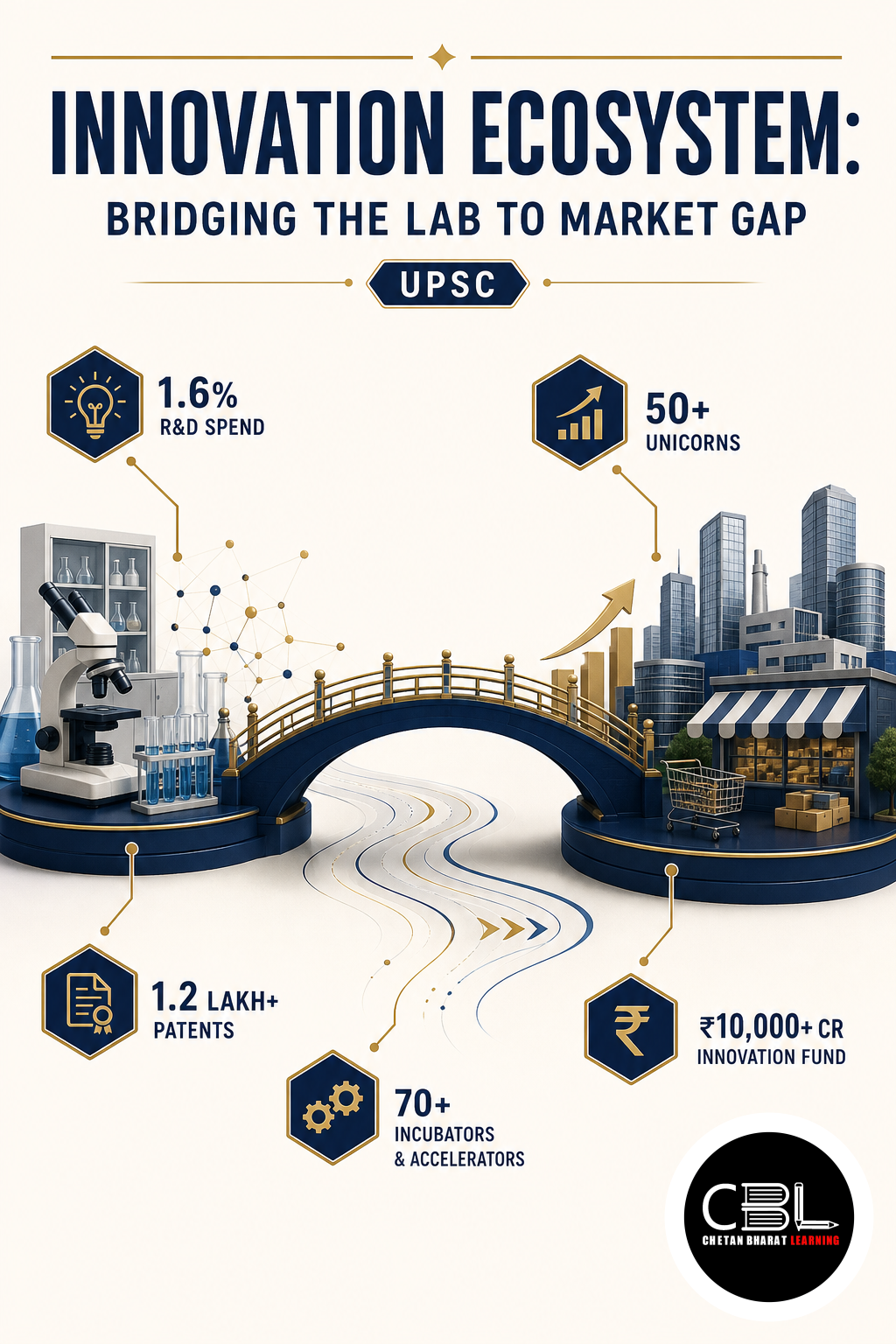
Building a robust innovation ecosystem remains crucial for India’s technological sovereignty and economic growth. Global superpowers are rapidly integrating scientific research with industrial manufacturing to secure future geopolitical dominance. Policymakers continuously monitor these macroeconomic indicators to balance rapid industrialisation with intellectual property creation. Students can track similar updates in our daily current affairs archive regularly. The national administration actively promotes deep-tech ventures to resolve this persistent structural deficit.
| India R&D Spend | 0.64% of GDP |
|---|---|
| China R&D Spend | 2.8% of GDP |
| US R&D Spend | 3.5% of GDP |
| Core Challenge | Lab-Market Gap |
What is innovation ecosystem?
An innovation ecosystem represents the interconnected network of universities, research laboratories, entrepreneurs, and capital markets. This framework ensures that abstract scientific discoveries successfully transition into tangible commercial technologies. The strategic integration of digital intelligence with physical manufacturing defines modern national power.
Leading economies view artificial intelligence not merely as a general-purpose tool but as a crucial accelerator. Fusing discovery with design and manufacturing transforms scientific speed into massive economic capability. This structural evolution fundamentally shifts nations from mere technological adaptation toward original knowledge production.
Why is innovation ecosystem in News?
Global superpowers are currently racing to reintegrate the production of knowledge with industrial manufacturing. Both Washington and Beijing recognize that controlling the underlying intellectual architecture guarantees long-term geopolitical dominance. You can review global technology trends via this WIPO portal for precise intellectual property data.
Meanwhile, domestic experts warn that India’s private capital has largely retreated from funding basic scientific research. The historical tradition of industrial conglomerates funding premier scientific institutes has unfortunately faded in the modern era. Rebuilding this vital pipeline remains essential for achieving genuine technological sovereignty.
Key Features
- Knowledge Integration: Fusing digital intelligence with industrial ecosystems transforms scientific discoveries into massive economic power and global influence.
- Upstream Migration: Leading nations are moving beyond mere technological adaptation to focus heavily on original discovery and patent creation.
- Public-Private Synergy: A functional framework requires massive commitments from private venture capital alongside state-funded university research initiatives.
- Strategic Autonomy: Mastering critical supply chains and intellectual property prevents dangerous reliance on foreign technological architectures and export controls.
- Deep-Tech Financing: Specialized patient capital is essential to sustain long-term research cycles before commercial viability eventually emerges.
Challenges
- Low R&D Intensity: National expenditure remains staggeringly low at 0.64 per cent of GDP compared to aggressive global competitors.
- Lab-Market Gap: A severe disconnect persists between academic researchers and the commercial manufacturers capable of scaling complex prototypes.
- Bureaucratic Hurdles: State-led scientific institutions frequently suffer from rigid administrative structures that actively discourage entrepreneurial risk-taking.
- Capital Retreat: Domestic private industries historically fund very little basic research, relying excessively on limited government grants.
- Talent Drain: The domestic science sector struggles to attract top-tier global talent due to limited institutional autonomy and rigid pay scales.
Way Forward
The administration must accelerate structural reforms to reduce logistical bottlenecks and improve overall industrial competitiveness. Simplifying intellectual property registration processes will help private corporations launch massive manufacturing projects easily. Providing dedicated credit guarantees will drastically improve capital access for ambitious micro-enterprises.
Check the latest Department of Science and Technology guidelines for strategic research funding frameworks. The government must periodically review the baseline methodologies to ensure they reflect current global trade realities. Continuous refinement of the innovation ecosystem will guarantee that the initiative delivers genuine prosperity.
State governments must actively align their local industrial policies with central guidelines to maximize regional synergies. Coordinated efforts between different administrative tiers will eliminate redundant paperwork for aspiring domestic manufacturers. This unified approach will significantly accelerate the national transition towards a self-reliant economic powerhouse.
Prelims Practice Corner
Q1. What percentage of GDP does India currently spend on research and development?
- (a) 0.64 per cent
- (b) 1.5 per cent
- (c) 2.8 per cent
- (d) 3.5 per cent
Answer: (a) National expenditure remains staggeringly low at 0.64 per cent of GDP compared to global competitors.
Q2. Which country spends approximately 2.8 per cent of its GDP on research and development?
- (a) USA
- (b) China
- (c) India
- (d) Germany
Answer: (b) China spends about 2.8 per cent of its GDP on R&D, focusing heavily on original discovery.
Q3. What is the primary objective of the US and China in the current technological race?
- (a) Isolating global trade
- (b) Reintegrating knowledge production with manufacturing
- (c) Banning AI
- (d) Reducing university funding
Answer: (b) Both nations seek to close the gap between knowledge creation and physical industrial manufacturing.
Q4. What historical Indian precedent is cited regarding private funding for scientific research?
- (a) Tata Institute of Fundamental Research
- (b) IIT Kanpur
- (c) ISRO
- (d) DRDO
Answer: (a) The Sir Dorabji Tata Trust supported Homi Bhabha in establishing this premier nuclear research institute.
Q5. What does the lab-market gap primarily refer to in this context?
- (a) Lack of raw materials
- (b) Disconnect between academic research and commercial manufacturing
- (c) High import tariffs
- (d) Poor internet connectivity
Answer: (b) It refers to the severe disconnect between academic researchers and manufacturers capable of scaling prototypes.
Mains Practice Questions
Q1. Discuss the structural challenges hindering the transition of scientific research into commercial technology in India. (10 marks)
Answer Structure:
- Intro: Define the concept of the innovation ecosystem and highlight India’s low R&D intensity compared to global peers.
- Body: Explain the lab-market gap, bureaucratic hurdles in state-led institutions, and the retreat of private capital from basic research.
- Conclusion: Conclude that fostering deep-tech financing and university-industry linkages is essential for achieving technological sovereignty.
Q2. “Technological sovereignty requires building an effective ecosystem that connects universities, laboratories, and factories.” Analyze. (15 marks)
Answer Structure:
- Intro: Introduce the global race between the US and China to reintegrate knowledge production with physical manufacturing using AI.
- Body: Analyze the strategic necessity of moving upstream from adaptation to original discovery, while addressing the vulnerabilities of fragmented domestic supply chains.
- Conclusion: Suggest that India must walk on two legs by deepening global scientific cooperation while massively expanding domestic institutional capacity.
FAQs on innovation ecosystem
Why is private sector participation crucial for this ecosystem?
Private venture capital provides the patient funding necessary to sustain long-term research cycles before commercial viability emerges. Historically, industrial conglomerates played a vital role in establishing premier scientific institutes, a tradition that must be revived today.
How do global powers view artificial intelligence in this context?
Leading economies view artificial intelligence not merely as a software tool but as a crucial accelerator for transforming scientific speed into geopolitical capability. Fusing digital intelligence with physical manufacturing fundamentally shifts nations toward original knowledge production.
What historical legacy of scientific funding does India possess?
Visionary industrialists like Jamsetji Tata and the Kirloskar family recognized early on that independent India’s future lay in mastering modern science. They heavily funded institutions like the Indian Institute of Science and the Tata Institute of Fundamental Research.
Related Current Affairs
Preparing for UPSC, PCS or HCS?
Talk to a mentor at Chetan Bharat Learning, Chandigarh. Free guidance on choosing the right exam and building a study plan.
Chat on WhatsAppCall 97793 53345UPSC / IAS / PCS coaching in Chandigarh · Trusted by aspirants across Punjab & Haryana
Leave a Reply
You must be logged in to post a comment.