
UPSC Mapping
- Prelims: BIS Act, 2016, ISI Mark and Quality Control Orders
- Mains: GS Paper II and III – Consumer Protection and Industrial Standards
Quick Facts
| National Body | Bureau of Indian Standards |
|---|---|
| Governing Law | BIS Act, 2016 |
| Administrative Ministry | Consumer Affairs, Food and Public Distribution |
| Headquarters | New Delhi |
What is BIS Certification?
BIS Certification is a conformity-assessment mechanism administered by the Bureau of Indian Standards, India’s national standards body. It confirms that a product meets the requirements prescribed under an applicable Indian Standard. The process may involve product testing, factory assessment, licensing and continuing surveillance.
Manufacturers holding a valid licence may display the ISI Mark on products covered by the certification scheme. The mark helps consumers identify regulated goods and connects each product with an accountable licence holder. Certification remains voluntary for many goods, but the Union Government can make it compulsory for specified products through quality-control measures.
Why is BIS Certification in News?
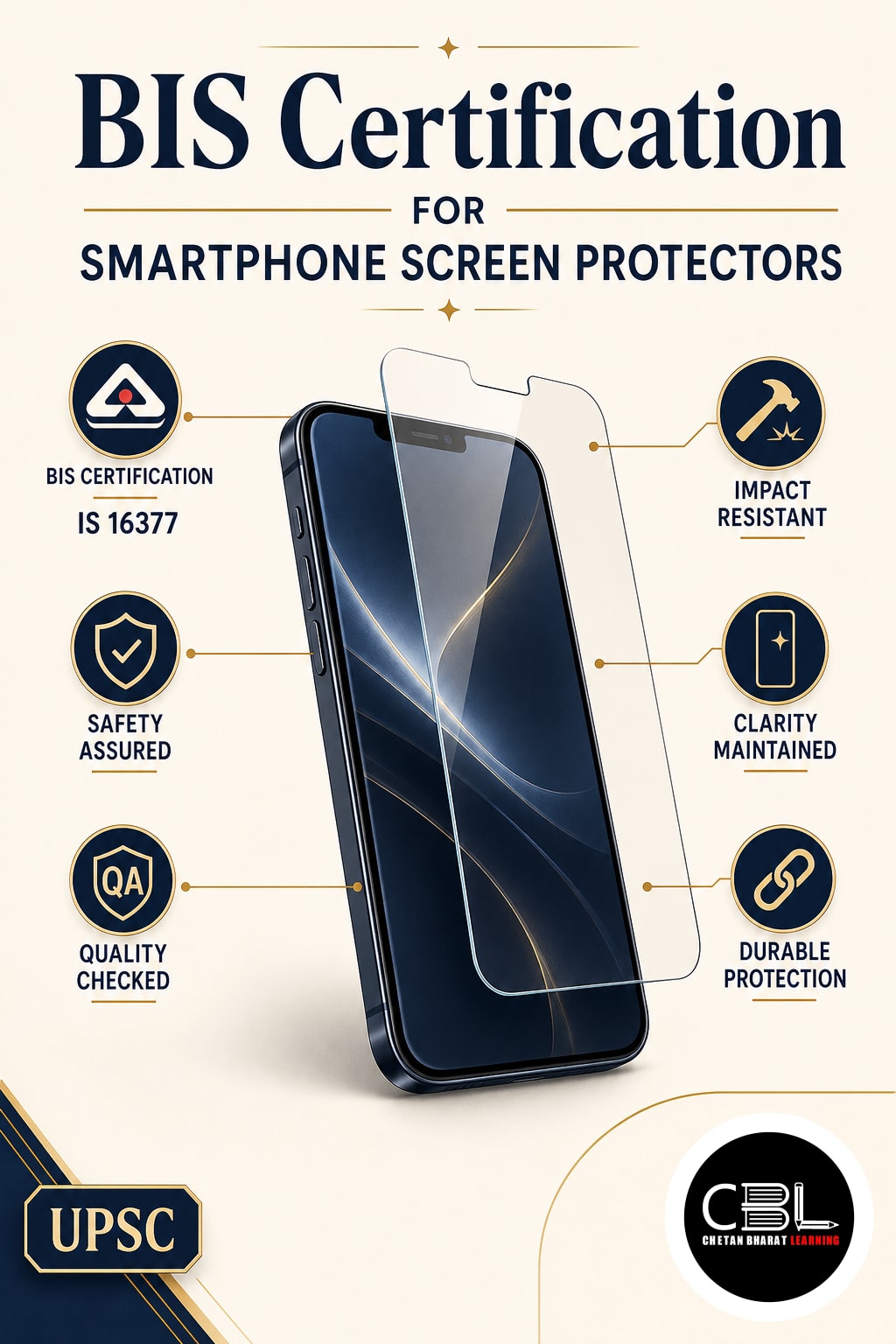
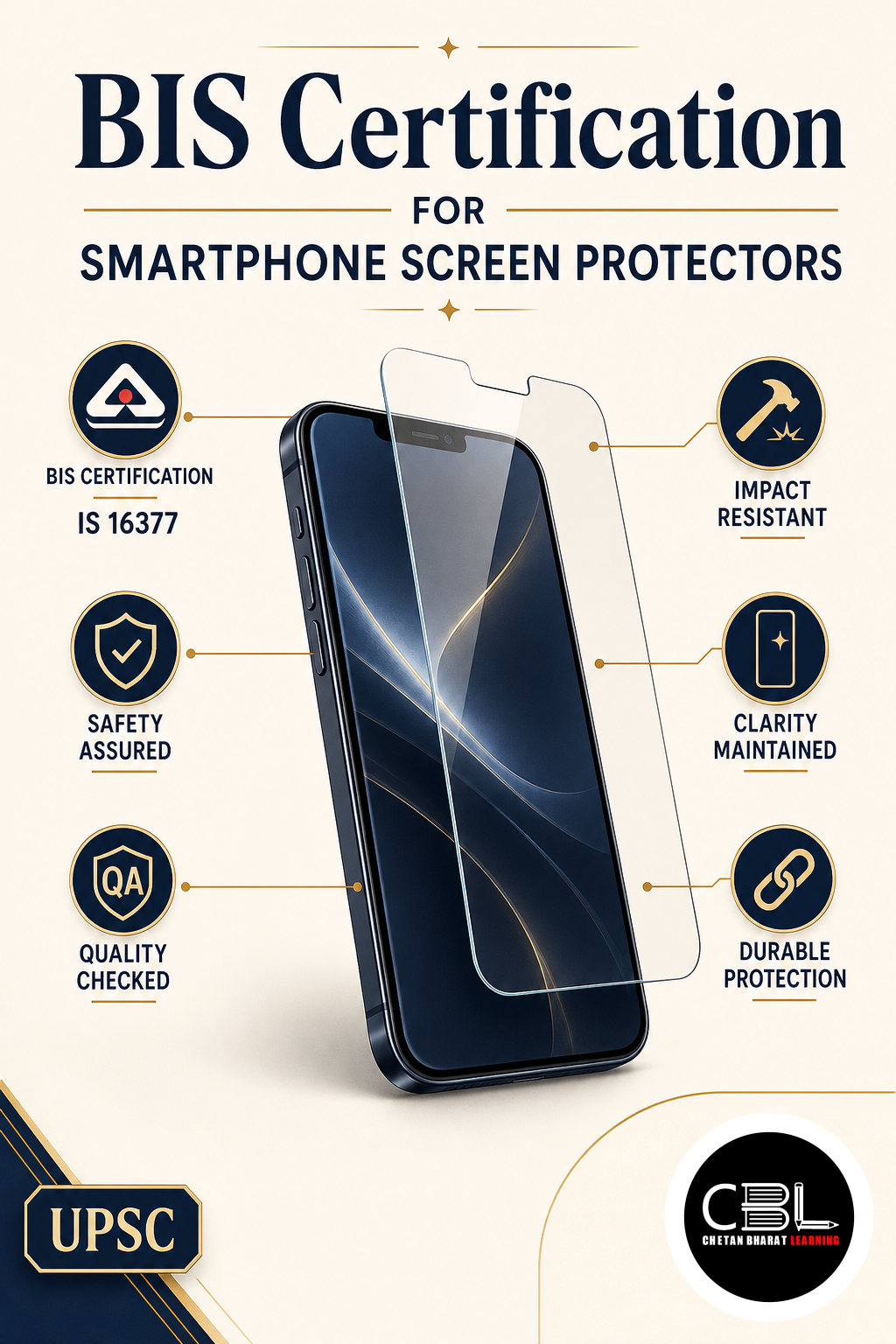
The Government has mandated BIS Certification for smartphone screen protectors to improve quality and consumer safety. These accessories form a large aftermarket serving users across physical shops, repair centres and digital marketplaces. Uneven manufacturing practices can produce protectors with poor clarity, unreliable fit, weak adhesion or misleading performance claims.
Compulsory standards create a common technical baseline for domestic manufacturers, importers and sellers. They also give regulators measurable criteria for testing products and acting against non-compliant supplies. Details about Indian standards and product-conformity systems are available through the Bureau of Indian Standards portal.
Key Features
- Compulsory conformity: Covered screen protectors must satisfy the applicable standard before manufacturers or importers place them in the Indian market.
- Standard-based evaluation: Testing assesses prescribed quality and performance requirements through defined methods instead of depending solely on advertising claims.
- Licensed quality mark: BIS Certification allows eligible manufacturers to use the ISI Mark with licence details that support identification and regulatory traceability.
- Supply-chain responsibility: Manufacturers and importers must maintain conformity, while distributors and marketplaces should avoid listing products that lack required approval.
- Continuing oversight: Market sampling, laboratory testing and licence surveillance help regulators detect quality failures that appear after initial approval.
Challenges
- Fragmented retail market: Numerous small shops, repair outlets and online sellers make inspection difficult across India’s extensive consumer-electronics market.
- Compliance burden: Product testing, documentation and production adjustments may impose transitional costs on smaller manufacturers with limited technical resources.
- Counterfeit markings: Unscrupulous sellers may misuse the ISI Mark or display invalid licence information, weakening consumer confidence and disadvantaging compliant firms.
- E-commerce enforcement: Regulators need cooperation from online marketplaces to verify sellers, remove unlawful listings and preserve transaction records for enforcement.
- Rapid technological change: Authorities must update standards as display materials, phone designs and protective technologies evolve, an issue linked with wider science and technology developments.
Way Forward
Successful BIS Certification requires adequate laboratory capacity, clear implementation timelines and simple digital verification of licences. Regulators should provide technical guidance to smaller enterprises without weakening the prescribed quality benchmark. Risk-based inspections can focus enforcement on suspicious imports, repeated violations and high-volume sellers.
Digital marketplaces should verify certification information before approving product listings and respond quickly to official notices. Consumer-awareness campaigns must explain how to identify a genuine ISI Mark and report doubtful products. The Department of Consumer Affairs can coordinate enforcement, grievance redress and public communication with standards authorities and state agencies.
Prelims Practice Corner
-
Q1. The Bureau of Indian Standards functions under which Union Ministry?
Answer: (c) Ministry of Consumer Affairs, Food and Public Distribution
-
Q2. Which legislation presently provides the statutory framework for the Bureau of Indian Standards?
Answer: (b) The BIS Act, 2016 provides the current statutory framework for the organisation.
-
Q3. What does the ISI Mark generally indicate on a covered product?
Answer: (c) The mark indicates licensed conformity with the applicable Indian Standard.
-
Q4. Consider the following statements: 1. Every product sold in India requires mandatory certification from BIS. 2. The Government may require specified products to follow compulsory Indian Standards. Which statement is correct?
Answer: (b) Certification is not compulsory for every product, but specified goods may face mandatory requirements.
-
Q5. Which of the following best describes the primary role of BIS?
Answer: (b) BIS develops Indian Standards and administers certification and conformity-assessment mechanisms.
Mains Practice Questions
-
Q1. Examine how compulsory product standards can strengthen consumer protection while creating compliance challenges for smaller enterprises. (250 words, 15 marks)
Answer Structure:
- Intro: Explain compulsory standards as a regulatory tool for quality and safety.
- Body: Discuss consumer trust, testing, traceability, compliance costs, laboratory access and informal-market enforcement.
- Conclusion: Recommend phased, technology-enabled enforcement supported by assistance for smaller manufacturers.
-
Q2. Suggest measures for enforcing quality standards across India’s fragmented consumer-accessories market. (150 words, 10 marks)
Answer Structure:
- Intro: Link market fragmentation with weak traceability and uneven product quality.
- Body: Cover digital licence verification, marketplace responsibility, laboratory capacity, risk-based inspections and consumer awareness.
- Conclusion: Emphasise coordinated enforcement that protects buyers and rewards compliant businesses.
FAQs on BIS Certification
- Is certification mandatory for every product sold in India?
- No. Certification remains voluntary for many products, while the Government can make compliance compulsory for specified goods based on public interest, safety or consumer-protection needs.
- What does the ISI Mark signify?
- The ISI Mark indicates that a licensed product conforms to the applicable Indian Standard. Consumers should also examine the accompanying licence details and product labelling.
- Why are smartphone screen protectors being regulated?
- Compulsory standards establish a consistent quality baseline in a large and fragmented accessories market. They also support product testing, seller accountability and action against misleading quality claims.
Related Current Affairs
Preparing for UPSC, PCS or HCS?
Talk to a mentor at Chetan Bharat Learning, Chandigarh. Free guidance on choosing the right exam and building a study plan.
Chat on WhatsAppCall 97793 53345UPSC / IAS / PCS coaching in Chandigarh · Trusted by aspirants across Punjab & Haryana
Leave a Reply
You must be logged in to post a comment.