
UPSC Mapping
- Prelims: R&D, ISRO, Research Ecosystem
- Mains: GS Paper III 6 Science & Technology, Innovation and Research
Quick Facts
| R&D Spending | 0.64% of GDP |
|---|---|
| Researchers Abroad | 73% Do Not Return |
| Annual Cost | US$35 650 Billion |
| AI Talent Index | -16.9 |
What is Research Brain Drain?
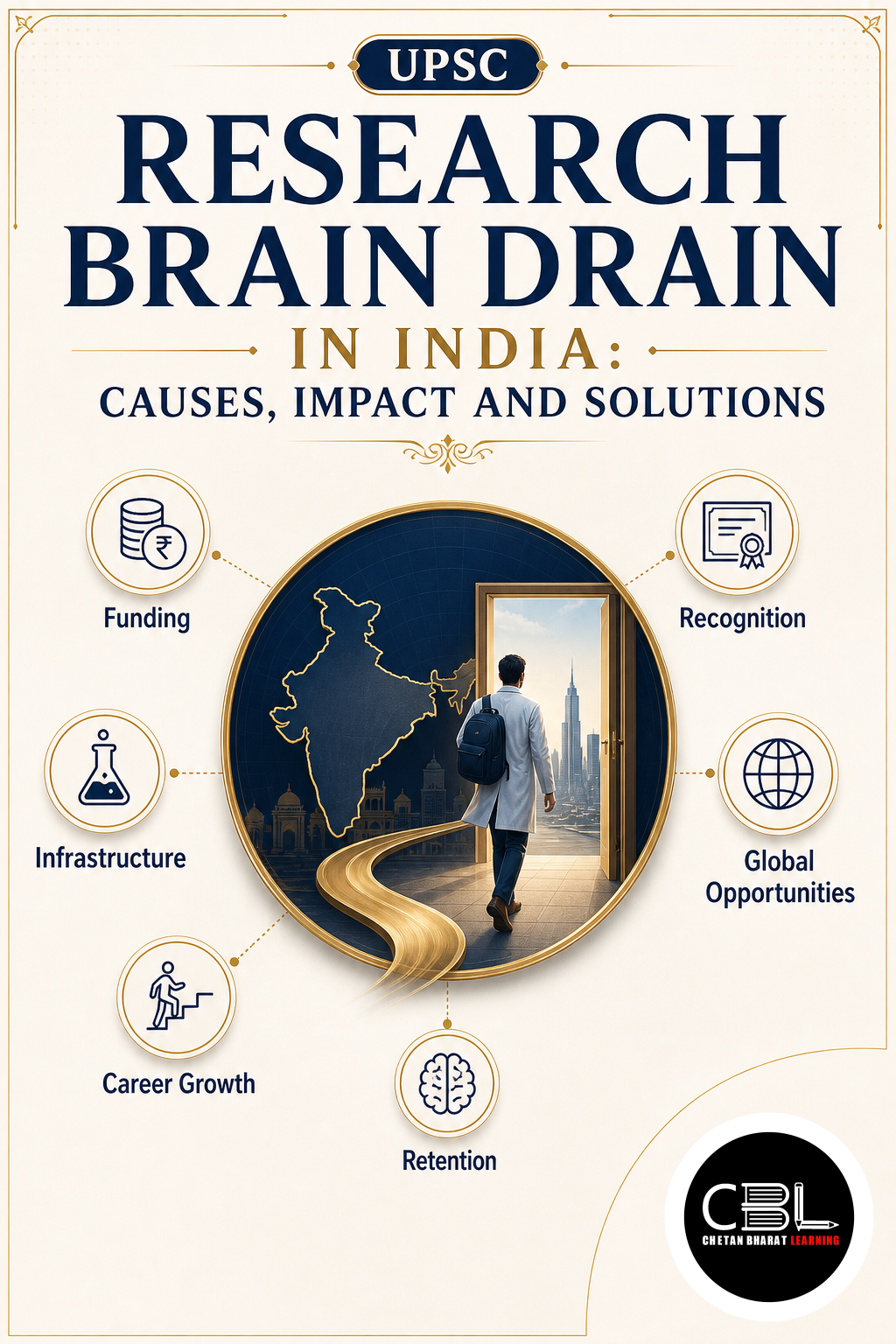
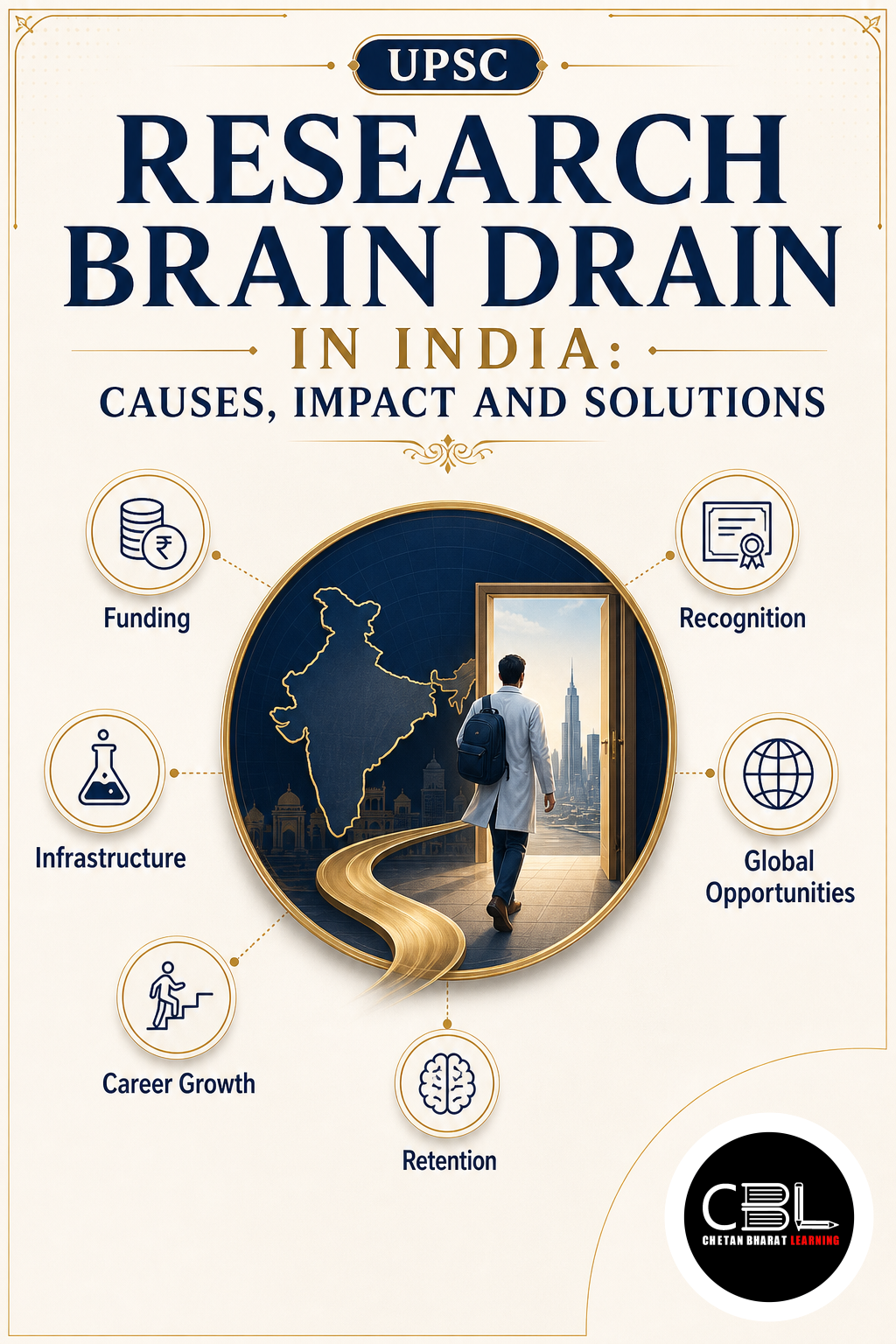
Research Brain Drain refers to the migration of highly skilled scientists, researchers, engineers and innovators from one country to another in search of better research infrastructure, funding, career opportunities and professional autonomy. Persistent outward migration weakens the domestic innovation ecosystem and reduces a country’s scientific competitiveness.
In India, the issue has gained renewed attention following reports of resignations from ISRO and the continued migration of researchers from premier educational and scientific institutions.
Why is Research Brain Drain in News?
Recent reports indicating that nearly 120 scientists resigned from ISRO have reignited concerns regarding India’s ability to retain highly skilled research talent. The debate has also highlighted structural challenges affecting research institutions and innovation ecosystems.
Additional information on India’s science ecosystem is available through the Department of Science and Technology.
Scale of Research Brain Drain
- Scholar migration: Around 60 60% of PhD scholars and nearly 30% of engineering graduates from premier Indian institutions move abroad for better research opportunities.
- Permanent relocation: More than 73% of internationally mobile Indian researchers settle abroad permanently without returning.
- Economic impact: The migration of scientists, engineers and researchers is estimated to cost the Indian economy around US$35 650 billion annually.
- Deep-tech challenge: Artificial intelligence and deep technology record the highest researcher flight with a talent outflow index of -16.9.
- Future migration intent: According to an Elsevier survey, 52% of India-based researchers intend to move abroad, the highest among countries surveyed.
Challenges Driving Research Brain Drain
- Low R&D expenditure: India’s R&D spending remains around 0.64% of GDP, limiting access to advanced laboratories, computational facilities and specialised equipment.
- Procurement delays: Administrative procedures often delay procurement of laboratory consumables by 3 6 months, affecting research productivity.
- Limited institutional autonomy: Seniority-based administrative structures reduce opportunities for early-career researchers to pursue independent scientific ideas.
- Compensation gap: Government pay structures remain significantly lower than international research institutions when adjusted for purchasing power.
- Heavy teaching responsibilities: Faculty members often devote substantial time to teaching under UGC norms, reducing time available for research.
- Patent processing delays: Patent examination timelines of 2 6 years slow intellectual property protection and technology commercialisation.
Consequences of Research Brain Drain
- Academic decline: India’s higher education system faces a student-to-faculty ratio of around 27:1, compared to the benchmark of 20:1.
- Clinical research gap: Despite accounting for nearly 20% of the global disease burden, India contributes only around 4% of global clinical trials.
- Startup ecosystem challenges: Loss of experienced researchers deprives technology startups of technical mentorship, contributing to high startup failure rates.
- Innovation transfer: Around 85 87% of Indian STEM doctorates in the United States remain there long term, strengthening foreign innovation ecosystems.
- Patent deficit: Indian-origin innovations are increasingly patented abroad instead of within India.
- Technological dependence: Reduced domestic research capacity increases reliance on expensive proprietary foreign technologies in strategic sectors.
Way Forward
Addressing research brain drain requires sustained investment in research infrastructure, simplified procurement systems, competitive research funding, greater institutional autonomy and improved opportunities for young scientists. Faster patent processing and stronger academia-industry collaboration can further strengthen India’s innovation ecosystem.
For UPSC, candidates should remember the low R&D expenditure, high researcher migration, institutional challenges and the long-term implications for innovation, higher education and technological self-reliance. Additional information is available through the Indian Space Research Organisation.
Prelims Practice Corner
-
Q1. India’s research and development expenditure is approximately:
(a) 0.64% of GDP (b) 1.5% of GDP (c) 2.5% of GDP (d) 3% of GDP
Answer: (a) -
Q2. According to recent estimates, what proportion of internationally mobile Indian researchers do not return?
(a) 40% (b) 55% (c) 73% (d) 90%
Answer: (c) -
Q3. Which organisation was recently in the news regarding resignations of scientists?
(a) DRDO (b) ISRO (c) BARC (d) CSIR
Answer: (b) -
Q4. Which field records the highest researcher flight according to the talent outflow index?
(a) Biotechnology (b) Artificial Intelligence and Deep Tech (c) Agriculture (d) Civil Engineering
Answer: (b) -
Q5. A major consequence of research brain drain is:
(a) Increased domestic patent filings (b) Reduced dependence on imports (c) Loss of innovation capacity and skilled researchers (d) Higher public R&D expenditure
Answer: (c)
Mains Practice Questions
-
Q1. Examine the major causes of research brain drain in India and discuss its implications for scientific innovation and economic development. (10 Marks)
Answer Structure:
- Intro: Define research brain drain and its significance.
- Body: Explain structural causes, institutional constraints and economic consequences.
- Conclusion: Suggest measures to strengthen India’s research ecosystem.
-
Q2. “Investment in research and innovation is essential for achieving technological self-reliance.” Discuss in the context of India’s science and technology ecosystem. (15 Marks)
Answer Structure:
- Intro: Explain the role of research in national development.
- Body: Discuss R&D funding, innovation, academia-industry collaboration, patents and talent retention.
- Conclusion: Emphasise research-led growth for an Atmanirbhar India.
FAQs on Research Brain Drain
What is research brain drain?
Research brain drain refers to the migration of highly skilled scientists, researchers and innovators to other countries for better research opportunities, infrastructure and career prospects.
Why is research brain drain a concern for India?
It weakens domestic innovation, reduces patent creation, affects higher education quality and increases dependence on foreign technologies.
How can India reduce research brain drain?
Increasing R&D investment, improving research infrastructure, simplifying procurement, accelerating patent approvals, promoting institutional autonomy and creating attractive research careers can help retain scientific talent.
Related Current Affairs
Preparing for UPSC, PCS or HCS?
Talk to a mentor at Chetan Bharat Learning, Chandigarh. Free guidance on choosing the right exam and building a study plan.
Chat on WhatsAppCall 97793 53345UPSC / IAS / PCS coaching in Chandigarh · Trusted by aspirants across Punjab & Haryana
Leave a Reply
You must be logged in to post a comment.