

UPSC Mapping
Important For
| Exam | Details |
|---|---|
| Prelims | Articles 19, 105 and 194 |
| Mains | GS Paper II: Parliament and Fundamental Rights |
Quick Facts
| Topic | Provision |
|---|---|
| Parliament | Article 105 |
| State Legislatures | Article 194 |
| Citizen Speech | Article 19(1)(a) |
| Reference Closed | 6 October 2026 |
Legislative Privileges protect the autonomy and effective functioning of elected Houses. Their exercise can still conflict with freedom of speech, press scrutiny and individual liberty when legislatures act against people outside the House.
What are Legislative Privileges?
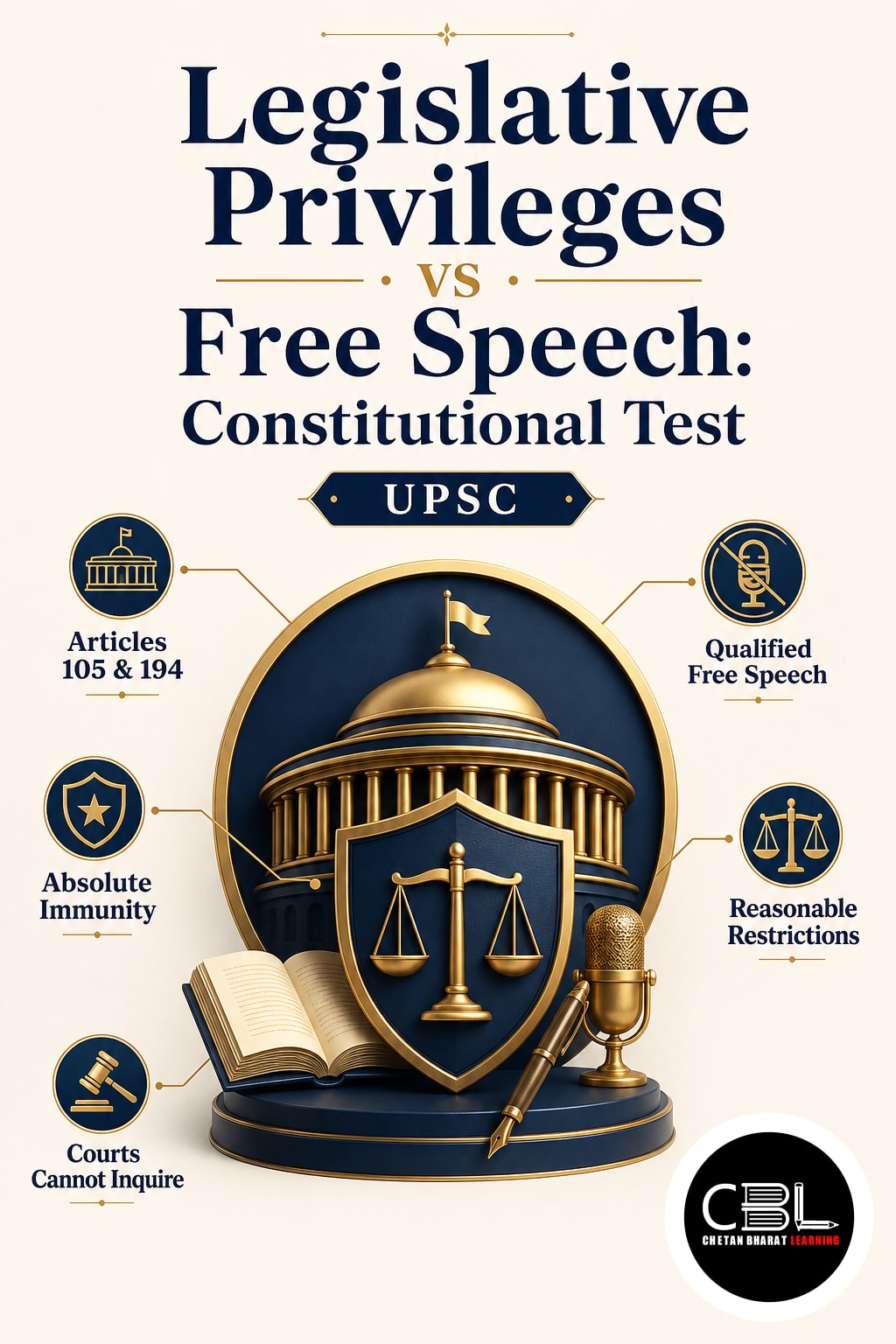
Legislative Privileges are special rights, immunities and powers necessary for Parliament and State Legislatures to perform their constitutional work without obstruction. Article 105 governs Parliament, while Article 194 contains corresponding provisions for State Legislatures. These protections belong partly to individual members and partly to each House as a collective institution.
Members enjoy freedom of speech inside the House under the Constitution and its procedural rules. They also receive immunity from court proceedings for anything said or any vote given in the House or its committees, along with protection for authorised legislative publications. These safeguards support fearless debate but do not create an unrestricted licence for conduct unrelated to legislative functions.
Why are Legislative Privileges in News?
On 6 October 2026, a seven-judge Supreme Court Bench closed the long-pending N. Ravi reference concerning privilege powers and citizens’ speech. The dispute arose from a 2003 Tamil Nadu Legislative Assembly resolution against journalists associated with The Hindu after critical reporting on Assembly proceedings. The Assembly had withdrawn the resolution in 2004, making the original dispute infructuous.
The Court therefore left the larger constitutional questions open for a future case involving a live controversy. Those questions include whether a House can punish non-members for external speech and how privilege must be reconciled with Articles 19(1)(a) and 21. The official Supreme Court portal provides access to orders and judgments governing this evolving area of constitutional accountability.
Key Features
The constitutional scheme combines institutional independence, member immunity and the continuing authority of judicial review.
- Speech inside the House: Articles 105(1) and 194(1) protect legislative speech subject to constitutional provisions, procedural rules and standing orders governing each House.
- Immunity from proceedings: Articles 105(2) and 194(2) prevent court action for speeches or votes given by members during legislative business and committee work.
- Collective powers: A House may regulate its proceedings, address obstruction, discipline members and protect the integrity required for effective legislative functioning.
- Uncodified scope: Parliament has not enacted a comprehensive statute defining every privilege, leaving their boundaries dependent on constitutional text, precedent and functional necessity.
- Constitutional limits: India follows constitutional supremacy rather than absolute parliamentary sovereignty, allowing courts to examine serious illegality, fundamental-rights violations and procedural unfairness.
The freedom available to legislators inside a House differs from the freedom guaranteed to citizens under Article 19(1)(a). Legislative speech serves institutional deliberation and carries specific immunity, whereas citizen speech remains subject to reasonable restrictions under Article 19(2). A conflict emerges when a House uses privilege jurisdiction against journalists, researchers, satirists or other non-members for statements made outside legislative proceedings.
In the Searchlight case of 1959, the Supreme Court gave priority to Article 194 privilege over an Article 19(1)(a) claim in the circumstances before it. The Keshav Singh reference later affirmed that constitutional courts could examine the legality of detention ordered through privilege proceedings. These decisions created the doctrinal tension that the N. Ravi reference was expected to clarify.
Raja Ram Pal in 2007 recognised the Houses’ authority over their internal affairs but rejected complete immunity from judicial review. Courts may intervene when legislative action displays substantive illegality, unconstitutionality or gross procedural irregularity. They do not ordinarily reassess the merits of internal proceedings merely because another view appears preferable.
In Sita Soren v. Union of India, the Supreme Court held in 2024 that lawmakers cannot claim constitutional immunity from ordinary criminal prosecution for bribery connected with a speech or vote. The judgment linked privilege to the collective functioning of the legislature and the necessity of the claimed protection. This functional approach restricts immunity from expanding into a personal exemption from the rule of law.
Challenges
The unresolved boundary creates risks for democratic scrutiny, institutional dignity and predictable enforcement of fundamental rights.
- Legal uncertainty: Non-codification makes it difficult for members, citizens and courts to identify the precise content and permissible reach of particular privileges.
- Chilling effect: Broad privilege notices or punitive action may discourage legitimate reporting, criticism, academic analysis and satire concerning legislative conduct.
- Institutional conflict: Legislative autonomy and judicial protection of rights can appear competitive when neither institution accepts workable boundaries or transparent procedures.
- Procedural vulnerability: Accused non-members may lack clear notice, legal representation, impartial fact-finding or a meaningful opportunity to respond before punishment.
- Disproportionate sanctions: Arrest or imprisonment may be excessive where clarification, correction, reprimand or another less restrictive response could protect institutional functioning.
Legislative Privileges protect the House from obstruction; it should not become a general power to shield legislators from embarrassment or criticism. Democratic institutions gain legitimacy when the press and public can examine their conduct using verified facts.
Judicial review must also avoid turning courts into appellate forums for every internal legislative disagreement. Excessive intervention could weaken separation of powers and disrupt parliamentary work. The challenge is to preserve institutional space while ensuring that privilege action remains connected to necessity, legality and fair procedure.
Way Forward
Parliament should consider a carefully framed law identifying core privileges, procedures and safeguards without freezing legitimate legislative evolution. The law should define breach and contempt, distinguish members from non-members, guarantee notice and hearing, and require reasoned decisions. A functional necessity test should ask whether the claimed power directly protects legislative work and whether a less restrictive measure can achieve that purpose.
Houses should adopt graded sanctions, independent fact verification and published reasons while protecting confidential proceedings where genuinely necessary. Courts should retain review for jurisdictional error, mala fides, gross procedural unfairness and fundamental-rights violations, without reviewing ordinary legislative merits. The official Constitution portal reflects the governing framework of constitutional supremacy, responsible speech and institutional balance.
Prelims Practice Corner
Q1. Which Article deals with the privileges of Parliament?
(a) Article 19 (b) Article 105 (c) Article 194 (d) Article 368
Answer: (b) Article 105 governs the powers and privileges of Parliament and its members.
Q2. Article 194 primarily concerns:
(a) State Legislatures (b) High Courts (c) Finance Commission (d) Election Commission
Answer: (a) Article 194 provides corresponding privileges for State Legislatures.
Q3. Freedom of speech and expression for citizens is guaranteed by:
(a) Article 14 (b) Article 19(1)(a) (c) Article 21A (d) Article 32
Answer: (b) Article 19(1)(a) guarantees freedom of speech and expression to citizens.
Q4. Which case held that legislative proceedings are not completely beyond judicial review?
(a) Raja Ram Pal case (b) Kesavananda Bharati case (c) Bommai case (d) Puttaswamy case
Answer: (a) Raja Ram Pal recognised privilege while preserving limited judicial review.
Q5. What did the Sita Soren judgment clarify?
(a) Bribery receives absolute immunity (b) Privilege bars all investigation (c) Lawmakers lack immunity for bribery (d) Courts cannot review privilege
Answer: (c) Constitutional privilege does not shield lawmakers from ordinary prosecution for bribery.
Mains Practice Questions
Q1. Examine the constitutional relationship between legislative privilege and citizens’ freedom of speech. (250 words, 15 marks)
Answer Structure:
- Intro: State the constitutional basis of privilege and free speech.
- Body: Discuss functional necessity, press freedom, non-codification, judicial precedents and proportionality.
- Conclusion: Support institutional autonomy within constitutional and rights-based limits.
Q2. Should India codify parliamentary and legislative privileges? Give reasons. (150 words, 10 marks)
Answer Structure:
- Intro: Explain the present absence of comprehensive codification.
- Body: Compare certainty and safeguards with concerns about rigidity and judicialisation.
- Conclusion: Recommend principled codification with procedural flexibility.
FAQs on Legislative Privileges
Why did the Supreme Court close the 2026 reference?
The Tamil Nadu Assembly had withdrawn the disputed resolution in 2004. With no surviving controversy between the original parties, the Court treated the reference as infructuous.
Are legislative proceedings completely immune from courts?
No. Courts generally respect internal autonomy but may examine substantive illegality, unconstitutionality or gross procedural irregularity.
Is freedom of the press separately mentioned in the Constitution?
The Constitution does not list it separately. The Supreme Court treats press freedom as part of Article 19(1)(a).
Related Current Affairs
Preparing for UPSC, PCS or HCS?
Talk to a mentor at Chetan Bharat Learning, Chandigarh. Free guidance on choosing the right exam and building a study plan.
Chat on WhatsAppCall 97793 53345UPSC / IAS / PCS coaching in Chandigarh · Trusted by aspirants across Punjab & Haryana
Leave a Reply
You must be logged in to post a comment.