
UPSC Syllabus Mapping
| GS Paper: | GS-I & GS-III |
|---|---|
| Subject: | Indian Geography, Climatology and Disaster Management |
| Syllabus Pointers: | Prep with our comprehensive UPSC Current Affairs Hub analysis guidelines. |
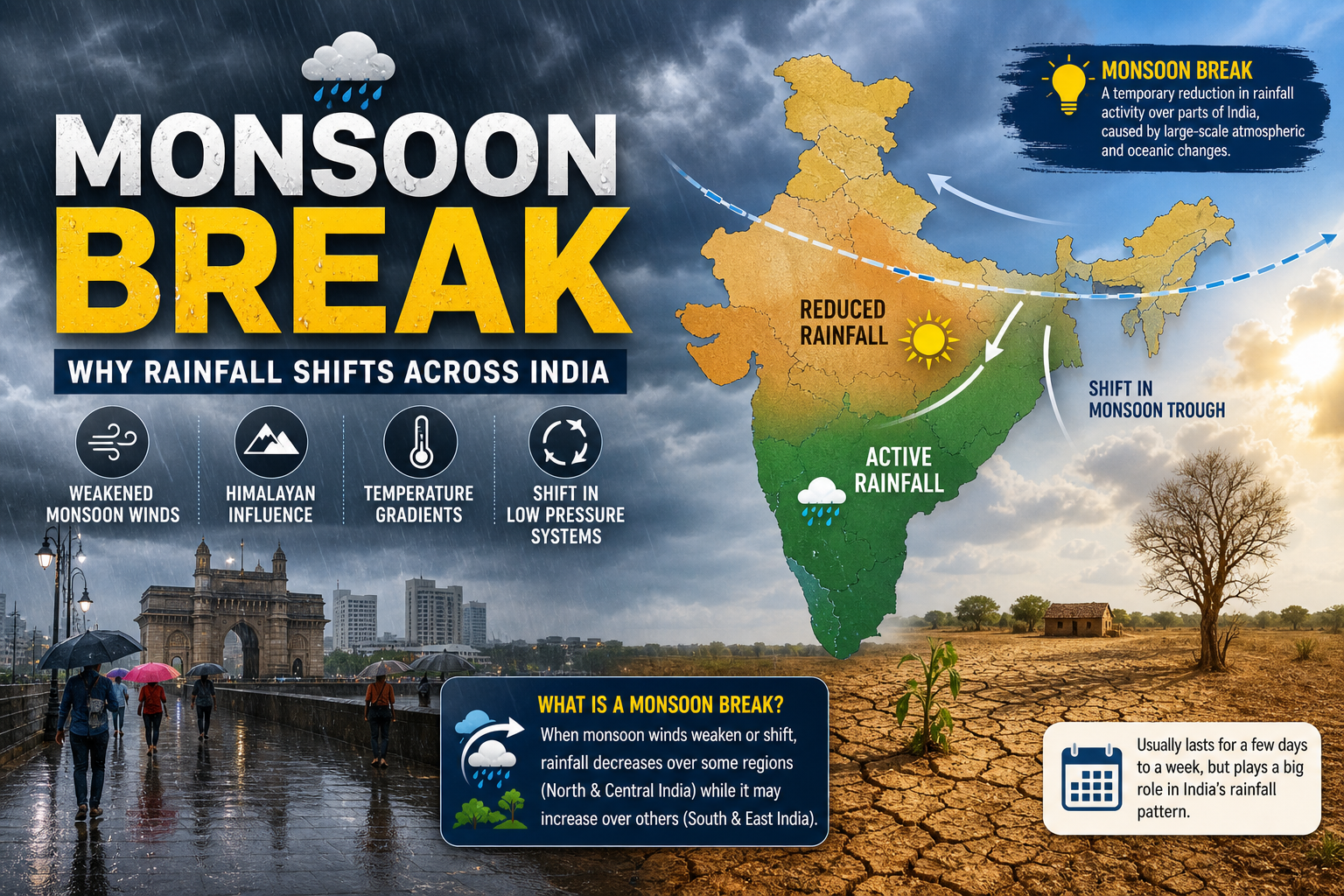
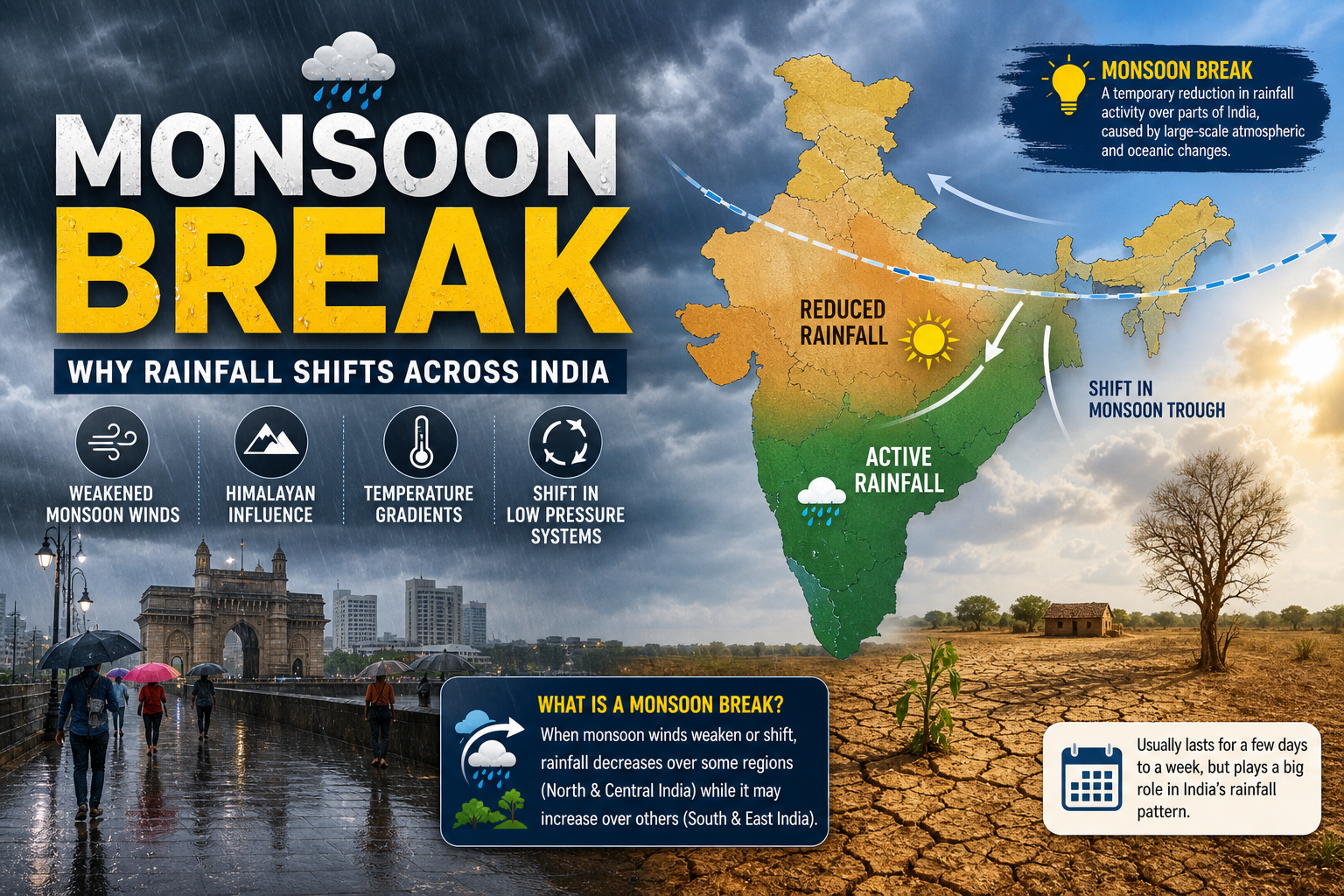
Recent updates regarding Monsoon Break indicate that the India Meteorological Department (IMD) has forecast a week-long reduction in rainfall over central, northwest and peninsular India, while eastern and northeastern states are expected to receive above-normal rainfall due to a fresh cyclonic circulation over the Bay of Bengal. This is not the absence of the monsoon but a temporary shift in rainfall distribution.
Key Dimensions of Monsoon Break
A Monsoon Break is a temporary period during the southwest monsoon season when rainfall decreases significantly over central and parts of northwest India, even though the monsoon remains active elsewhere.
The phenomenon occurs mainly because the Monsoon Trough, an elongated low-pressure zone extending from northwest India to the Bay of Bengal, shifts northwards towards the Himalayan foothills. As a result, rainfall concentrates over the foothills and Northeast India instead of central India.
Why Does a Monsoon Break Occur?
The northward displacement of the monsoon trough causes the main rain-bearing systems to move closer to the Himalayan region. Central India experiences relatively dry conditions, while moisture-laden winds from the Bay of Bengal deliver heavy rainfall over states such as Assam, Meghalaya, Arunachal Pradesh, Nagaland, Manipur, Mizoram and Tripura.
A fresh cyclonic circulation over the Bay of Bengal can further strengthen moisture transport into eastern and northeastern India. Such circulations enhance rainfall but do not necessarily develop into tropical cyclones.
Impact of a Monsoon Break
- Agriculture: Reduced rainfall can delay sowing, irrigation and field operations in rain-fed regions. However, the dry spell may support weeding, fertiliser application and crop management in some areas.
- Water Resources: Lower rainfall reduces reservoir inflows and groundwater recharge, affecting water availability if the break persists.
- Disaster Management: While central India receives less rainfall, northeastern states may experience floods, landslides and river swelling because rainfall becomes concentrated over a shorter period.
- Climate Perspective: Climate change is increasing rainfall variability, making rainfall distribution more uneven. The concern is often not only the total seasonal rainfall but also its timing and spatial distribution.
Monsoon Break and El Niño
El Niño can increase the frequency and intensity of monsoon breaks by altering atmospheric circulation over the tropical Pacific. However, a single monsoon break does not automatically indicate an El Niño year, as intra-seasonal variability is a normal feature of the southwest monsoon.
Way Forward
India should strengthen weather forecasting through improved satellite observations, Doppler weather radars and numerical weather prediction models. Better reservoir management, climate-resilient agriculture, flood preparedness and community-based disaster risk reduction are essential to minimise the impacts of increasingly variable monsoon behaviour.
Prelims Practice Corner
Q1. A Monsoon Break refers to:
- (a) Complete withdrawal of the southwest monsoon
- (b) Temporary reduction in rainfall over central India while the monsoon remains active elsewhere
- (c) Formation of a tropical cyclone
- (d) Failure of the southwest monsoon
Answer: (b) A monsoon break is characterised by a temporary shift in rainfall distribution rather than the end of the monsoon season.
Q2. The Monsoon Trough is:
- (a) A high-pressure belt over the Himalayas
- (b) An elongated low-pressure zone extending from northwest India to the Bay of Bengal
- (c) A cold ocean current
- (d) A tropical cyclone
Answer: (b) The Monsoon Trough is the principal low-pressure zone controlling rainfall distribution during the southwest monsoon.
Mains Practice Question
“A monsoon break is a shift in rainfall distribution rather than a failure of the southwest monsoon.” Explain the causes of monsoon breaks and analyse their implications for agriculture, water resources and disaster management in India. (150 Words, 10 Marks)
FAQs
Why does Northeast India receive heavy rainfall during a monsoon break?
When the monsoon trough shifts northwards, moisture-laden winds from the Bay of Bengal are forced to rise over the hills of Northeast India, producing intense orographic rainfall.
Related Current Affairs
Preparing for UPSC, PCS or HCS?
Talk to a mentor at Chetan Bharat Learning, Chandigarh. Free guidance on choosing the right exam and building a study plan.
Chat on WhatsAppCall 97793 53345UPSC / IAS / PCS coaching in Chandigarh · Trusted by aspirants across Punjab & Haryana
Leave a Reply
You must be logged in to post a comment.