

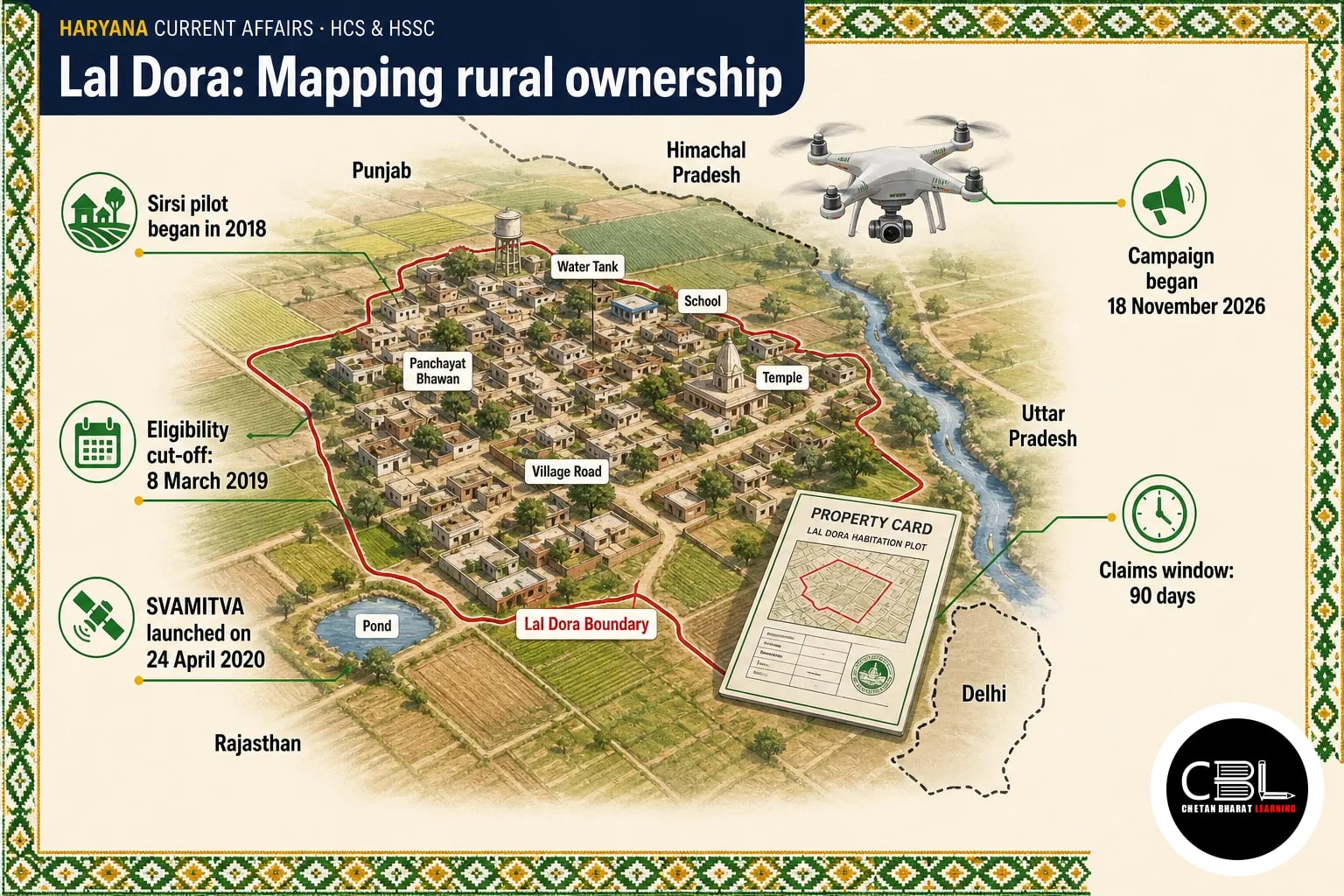
Haryana announced a special campaign from 18 November 2026 to grant ownership rights in rural Lal Dora areas. It operates under the Haryana Abadi Deh Act, 2025. Residents and aggrieved persons have 90 days to file claims and objections. Haryana reports that drone surveys covered all 6,248 Lal Dora villages under SVAMITVA. An online portal lets people check maps and ownership details, give consent and submit grievances.
Timeline: from pilot to campaign
- 2018PilotPilot
Haryana began its Lal Dora-free pilot at Sirsi village in Karnal.
- 8 Mar2019Agreement
Haryana signed a survey agreement with the Survey of India; this date became the eligibility cut-off.
- 24 Apr2020Launch
SVAMITVA launched nationally on National Panchayati Raj Day.
- 2025State lawLaw
The Haryana Abadi Deh Act, 2025 provided the campaign’s legal framework.
- July2026Rules
The Haryana cabinet approved the Abadi Deh ownership rules in July 2026.
- 18 Nov2026Campaign
The campaign and portal opened, with a 90-day window for claims and objections.
- The Haryana pilot began at Sirsi village in Karnal.
- The eligibility cut-off is 8 March 2019.
- The national SVAMITVA scheme launched on 24 April 2020.
- Drone surveys covered 6,248 Lal Dora villages in Haryana.
- Claims and objections have a 90-day window.
What is Lal Dora?
Lal Dora refers to the red line drawn around village habitation in British-era settlement maps in 1908. Land inside it was exempt from revenue records, leaving owners without formal title deeds.
The Survey of Villages and Mapping with Improvised Technology in Village Areas (SVAMITVA) uses surveys to support rural property records. Haryana’s campaign covers abadi deh outside municipal limits. Tenants, lessees, mortgage holders and people without ownership claims do not receive ownership rights under it.
Why it matters
The campaign gives eligible residents a route to ownership certificates. Aggrieved persons can object to property ownership entries.
Clearer ownership records can help residents establish their claims when dealing with property.
Districts must process objections promptly, with reviews every 10–15 days. The portal provides a channel for checking records and filing grievances.
- District: Karnal is a district of Haryana; Sirsi village was the site of the Lal Dora-free pilot.
- Institution: The Survey of India is India’s national mapping agency.
- Local government: Gram panchayats are institutions of rural local self-government.
Key data
| Point | Details |
|---|---|
| State law | Haryana Abadi Deh Act, 2025; ownership rules approved in July 2026. |
| Campaign | Announced from 18 November 2026 for abadi deh outside municipal limits. |
| Eligibility cut-off | 8 March 2019, the date of the survey agreement with the Survey of India. |
| Claims and objections | 90-day window; district reviews every 10–15 days. |
| Survey coverage | All 6,248 Lal Dora villages covered by drone surveys; about 25 lakh rural properties surveyed and verified. |
| Property cards | 25,16,190 beneficiaries covered; 25,16,109 cards distributed and linked with Parivar Pehchan Patra. |
| National scheme | SVAMITVA launched on 24 April 2020. |
Way forward
- Public awareness: Explain eligibility, the cut-off and objection procedures through accessible village-level communication.
- Assisted access: Help residents inspect maps and submit claims, including those who need digital assistance.
- Fair verification: Examine competing claims and give affected persons an opportunity to present their case.
- Timely reviews: Track pending objections in district reviews and communicate decisions to applicants.
- Record accuracy: Correct verified errors in ownership entries and maintain a clear audit trail.
HCS Mains practice questions
Explain the purpose and main features of Haryana’s Lal Dora ownership campaign. (150 words)
Answer pointers:
- Introduce Lal Dora and the title-record problem.
- Identify the 2025 Act and rural coverage.
- Explain the cut-off, claims window and portal.
- Conclude with the importance of accurate records.
Critically examine the potential and challenges of Haryana’s Abadi Deh ownership campaign. (250 words)
Answer pointers:
- Introduce the campaign and survey-based records.
- Discuss clearer ownership documentation and accessible maps.
- Examine disputed claims, exclusions and digital access concerns.
- Conclude with fair verification and timely grievance handling.
As Sub-Divisional Magistrate (SDM) of Jind, how would you manage competing Lal Dora ownership claims? (150 words)
Answer pointers:
- Begin with the claim window and applicable eligibility rules.
- Publicise maps and provide assistance to applicants.
- Verify records and hear affected parties impartially.
- Track objections and communicate reasoned decisions.
Discuss how Haryana’s Abadi Deh campaign connects with SVAMITVA and rural local governance. (150 words)
Answer pointers:
- Introduce SVAMITVA and its village survey role.
- Link mapped property information to Haryana’s ownership campaign.
- Discuss panchayats’ role in local awareness and participation.
- Conclude with coordination and reliable records.
For Haryana Civil Services (HCS) prelims and the Haryana Staff Selection Commission (HSSC) Common Eligibility Test (CET), memorise the cut-off, claim window and Sirsi pilot. For HCS mains, connect ownership documentation with fair grievance redressal.
MCQ Practice Corner
Q1. Consider the following statements about Haryana’s Abadi Deh campaign:
1. It applies to abadi deh outside municipal limits.
2. Its eligibility cut-off is 8 March 2019.
3. Tenants receive ownership rights under the campaign.
Which statements are correct?
(a) 1 and 2 only (b) 2 and 3 only (c) 1 and 3 only (d) 1, 2 and 3
Show answer
Answer: (a) because the campaign covers rural abadi deh, uses the 2019 cut-off and excludes tenants from ownership rights.
Q2. Which sequence correctly traces these developments?
(a) SVAMITVA launch, Sirsi pilot, state Act, campaign (b) Sirsi pilot, SVAMITVA launch, state Act, campaign (c) State Act, Sirsi pilot, campaign, SVAMITVA launch (d) Sirsi pilot, state Act, SVAMITVA launch, campaign
Show answer
Answer: (b) because the pilot began in 2018, followed by the 2020 national launch, 2025 Act and 2026 campaign.
Q3. Haryana’s Lal Dora-free pilot began in which village?
(a) Sirsi (b) Rakhigarhi (c) Pinjore (d) Sultanpur
Show answer
Answer: (a) because Sirsi in Karnal was the pilot village.
Q4. How long is the window for filing claims and objections under the campaign?
(a) 15 days (b) 30 days (c) 60 days (d) 90 days
Show answer
Answer: (d) because residents and aggrieved persons have a 90-day window.
Frequently Asked Questions
What is the Lal Dora ownership campaign in Haryana?
It is a campaign announced from 18 November 2026 to grant ownership rights in eligible rural abadi deh areas. It operates under the Haryana Abadi Deh Act, 2025.
What is the cut-off date for Lal Dora ownership claims?
The eligibility cut-off is 8 March 2019. It is the date Haryana signed its village survey agreement with the Survey of India.
How can residents check Lal Dora ownership details?
Residents can use the online portal launched from 18 November 2026 to view maps and ownership details. They can also give consent and file grievances through it.
Sources: The Tribune: campaign, The Tribune: Abadi Deh bill, Millennium Post: campaign details
Related Current Affairs
More Haryana topics for HCS & HSSC
Preparing for UPSC, PCS or HCS?
Talk to a mentor at Chetan Bharat Learning, Chandigarh. Free guidance on choosing the right exam and building a study plan.
Chat on WhatsAppCall 97793 53345UPSC / IAS / PCS coaching in Chandigarh · Trusted by aspirants across Punjab & Haryana


Leave a Reply
You must be logged in to post a comment.