
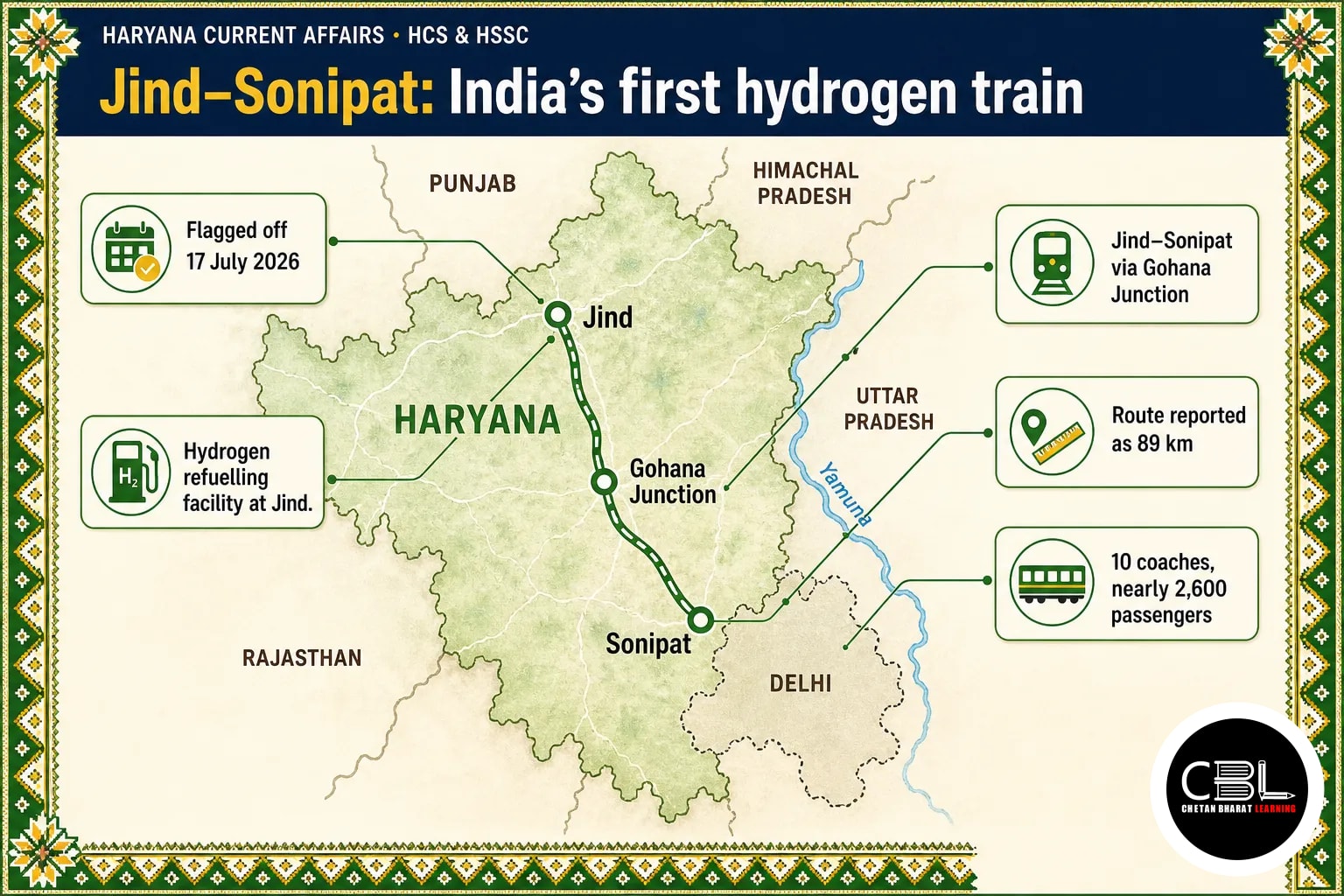
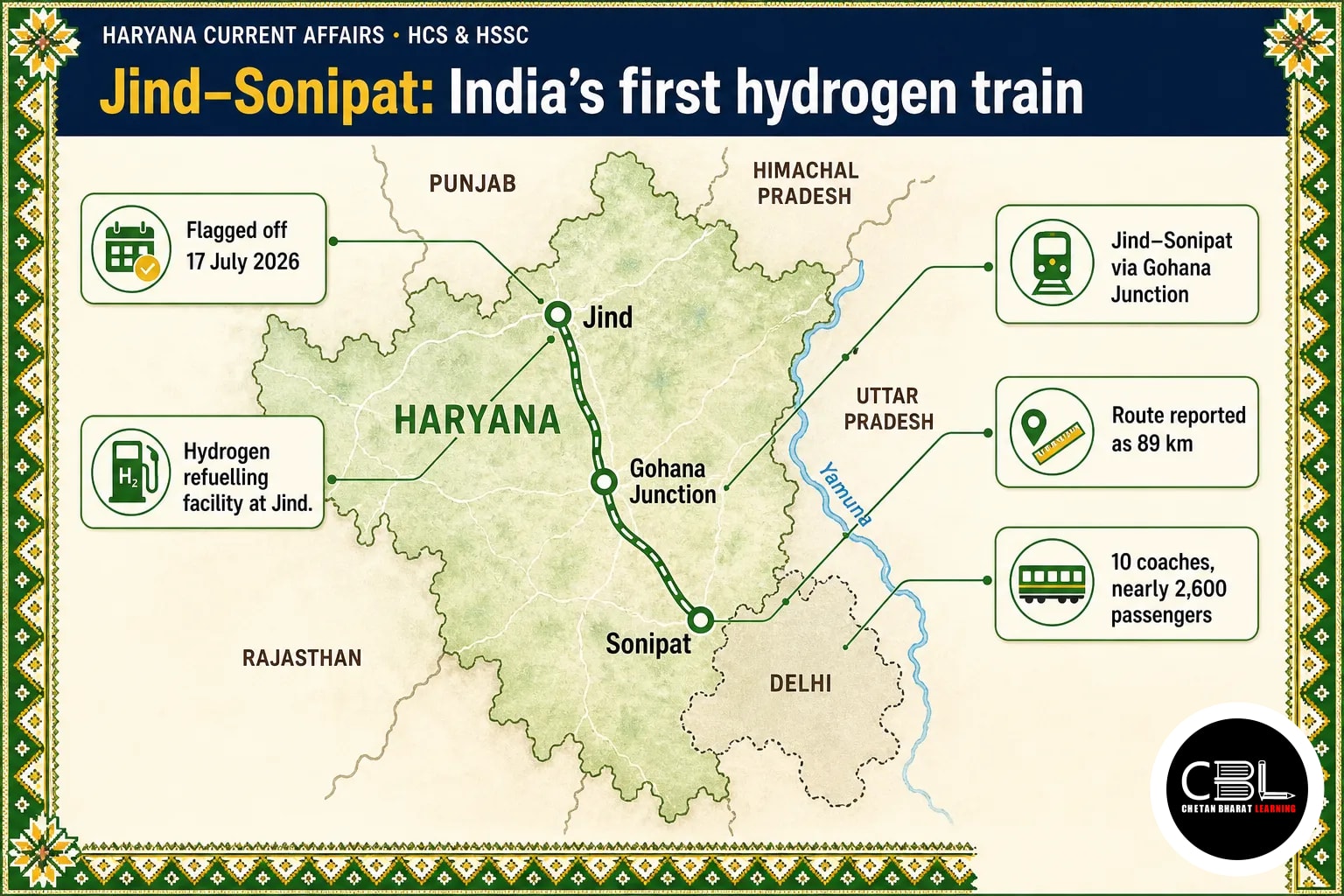
On 17 July 2026, Prime Minister Narendra Modi flagged off India’s first hydrogen-powered passenger train at Jind railway station. It runs from Jind to Sonipat via Gohana Junction, a route reported as about 89 km. The 10-coach train carries nearly 2,600 passengers and uses onboard fuel cells. Jind has an indigenous hydrogen storage and refuelling facility. A glimpse of the train was displayed at the Haryana pavilion in November 2026.
Timeline: launch to pavilion
- 17 July2026Flag-off
India’s first hydrogen passenger train was flagged off at Jind railway station.
- 17 July2026 launchRoute
The Jind–Sonipat service runs via Gohana Junction, over a reported 89 km.
- 17 July2026 launchCapacity
The train has 10 coaches and capacity for nearly 2,600 passengers.
- November2026Display
A glimpse of the train was displayed at the Haryana pavilion of the India International Trade Fair.
- India’s first hydrogen passenger train was flagged off at Jind.
- The train connects Jind and Sonipat via Gohana Junction.
- The flag-off took place on 17 July 2026.
- The train has 10 coaches and capacity for nearly 2,600 passengers.
- The indigenous hydrogen storage and refuelling facility is at Jind.
What is a hydrogen-powered train?
A hydrogen-powered train uses fuel cells to convert hydrogen into electricity onboard. Its stated operational by-product is water vapour. It does not need overhead electrification and can therefore serve non-electrified routes.
The Jind–Sonipat train was designed and made in India. Its reported service frequency is two round trips a day. The refuelling facility at Jind has safety approvals from the Petroleum and Explosives Safety Organisation (PESO).
Why it matters
The train connects Jind and Sonipat via Gohana. Its capacity is nearly 2,600 passengers.
Fuel-cell operation produces water vapour. The wider environmental effect also depends on how the hydrogen is produced.
Hydrogen storage and refuelling require safety oversight. The train has detectors for leaks, heat, flames and smoke.
- Jind: Jind is the headquarters of Jind district.
- Gohana: Gohana is in Sonipat district.
- Sonipat: Sonipat is a district of Haryana.
Key data
| Point | Details |
|---|---|
| Flag-off | 17 July 2026, Jind railway station |
| Route | Jind–Sonipat via Gohana Junction; about 89 km, as reported |
| Formation and capacity | 10 coaches; nearly 2,600 passengers |
| Reported frequency | Two round trips a day |
| Propulsion | Hydrogen fuel cells; reported as a 3,200-horsepower system |
| Refuelling and safety | Indigenous facility at Jind; PESO safety approvals |
| National policy context | National Green Hydrogen Mission approved in January 2023; outlay of Rs 19,744 crore |
Way forward
- Safety drills: Coordinate emergency exercises among railway staff, district authorities and responders.
- Reliable service: Monitor punctuality, maintenance and passenger feedback before considering expansion.
- Hydrogen supply: Assess supply reliability and the environmental effects of hydrogen production.
- Cost assessment: Compare lifecycle costs with suitable alternatives for each route.
- Public awareness: Explain safety procedures and service information to passengers and nearby communities.
HCS Mains practice questions
Explain the working and significance of the Jind–Sonipat hydrogen train. (150 words)
Answer pointers:
- Introduce the July 2026 flag-off and route.
- Explain onboard fuel-cell electricity and water vapour.
- Note capacity, refuelling and non-electrified route potential.
- Conclude with safe and reliable operation.
Critically examine hydrogen trains as an option for cleaner railway transport. (250 words)
Answer pointers:
- Introduce the Jind–Sonipat service as an Indian example.
- Discuss water vapour and use without overhead electrification.
- Examine hydrogen production, costs, supply and safety concerns.
- Conclude with route-specific lifecycle assessment and safety oversight.
As SDM of Jind, how would you prepare for a hydrogen-related emergency near the railway station? (150 words)
Answer pointers:
- Identify risks around storage, refuelling and passenger movement.
- Coordinate a response plan with railways, fire services and PESO.
- Plan evacuation, medical support and verified public communication.
- Conclude with regular drills and review.
Discuss how the Jind–Sonipat train relates to the National Green Hydrogen Mission. (150 words)
Answer pointers:
- Introduce the mission approved in January 2023.
- Explain hydrogen use in railway fuel cells.
- Distinguish hydrogen use from the method of hydrogen production.
- Conclude with the need for reliable, cleaner supply and safety.
For Haryana Civil Services (HCS) prelims and the Haryana Staff Selection Commission (HSSC) Common Eligibility Test (CET), memorise the date, route, Gohana Junction and coach count. For HCS mains, connect fuel-cell benefits with supply and safety concerns.
MCQ Practice Corner
Q1. Which station lies on the route of India’s first hydrogen-powered passenger train between Jind and Sonipat?
(a) Gohana Junction (b) Kalka (c) Rewari (d) Ambala Cantonment
Show answer
Answer: (a) because the Jind–Sonipat service runs via Gohana Junction.
Q2. Consider the following statements about the Jind–Sonipat hydrogen train:
1. It uses onboard fuel cells to generate electricity.
2. It has 10 coaches.
3. It requires overhead electrification to operate.
Which statements are correct?
(a) 1 and 2 only (b) 2 and 3 only (c) 1 and 3 only (d) 1, 2 and 3
Show answer
Answer: (a) because the train uses fuel cells and has 10 coaches but does not need overhead electrification.
Q3. On which date was India’s first hydrogen passenger train flagged off?
(a) 17 July 2026 (b) 17 July 2025 (c) 26 January 2026 (d) 15 August 2026
Show answer
Answer: (a) because the flag-off took place on 17 July 2026.
Q4. Where is the train’s indigenous hydrogen storage and refuelling facility?
(a) Jind (b) Hisar (c) Panipat (d) Sirsa
Show answer
Answer: (a) because the facility was set up at Jind.
Frequently Asked Questions
Where does India’s first hydrogen train run?
It runs from Jind to Sonipat via Gohana Junction in Haryana. The route length is reported as about 89 km.
When was the Haryana hydrogen train launched?
It was flagged off on 17 July 2026 at Jind railway station. Prime Minister Narendra Modi performed the flag-off.
How does the Jind–Sonipat hydrogen train work?
Its onboard fuel cells convert hydrogen into electricity. The train does not need overhead electrification.
Sources: Business Today, Zee News
Related Current Affairs
More Haryana topics for HCS & HSSC
Preparing for UPSC, PCS or HCS?
Talk to a mentor at Chetan Bharat Learning, Chandigarh. Free guidance on choosing the right exam and building a study plan.
Chat on WhatsAppCall 97793 53345UPSC / IAS / PCS coaching in Chandigarh · Trusted by aspirants across Punjab & Haryana



Leave a Reply
You must be logged in to post a comment.