
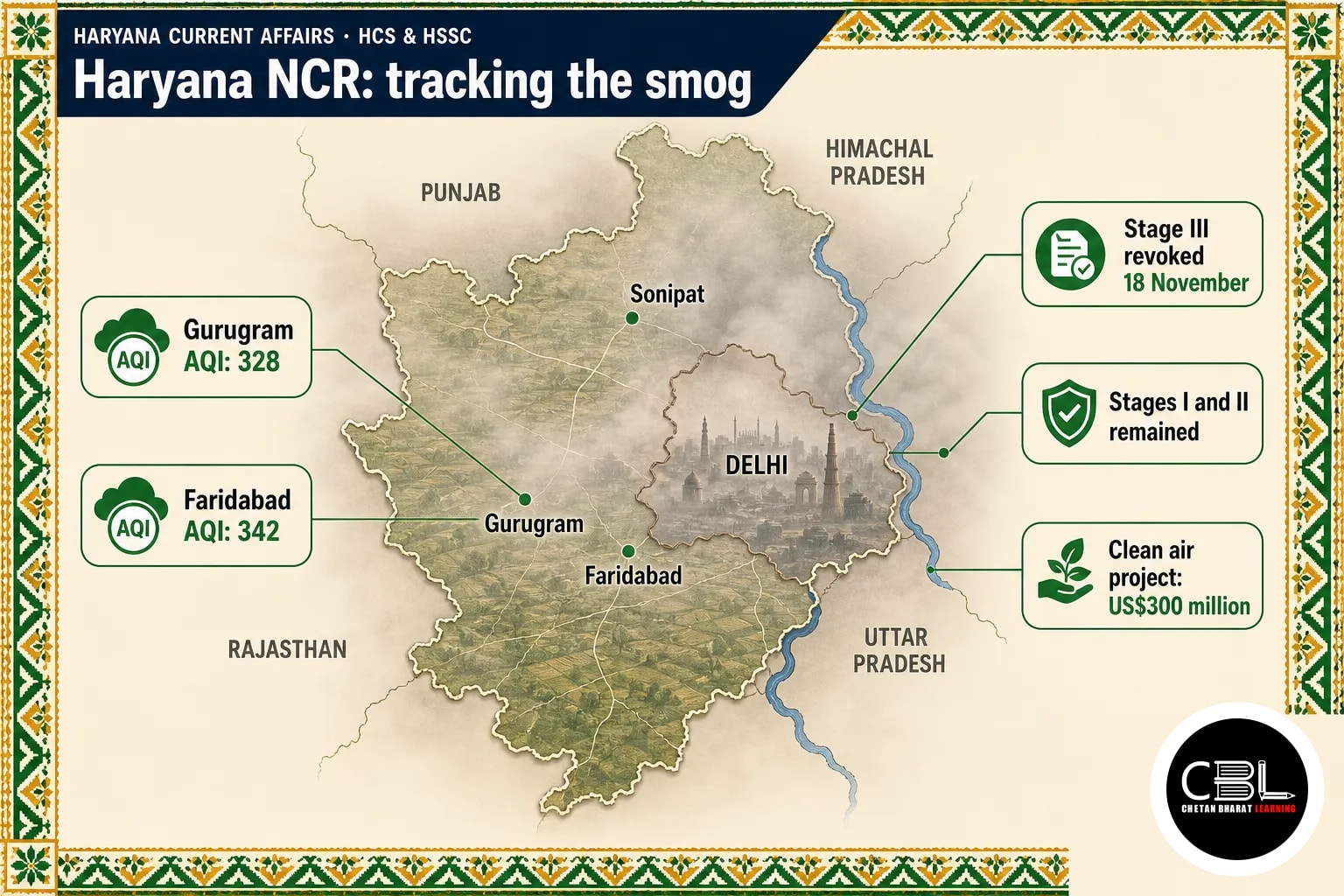
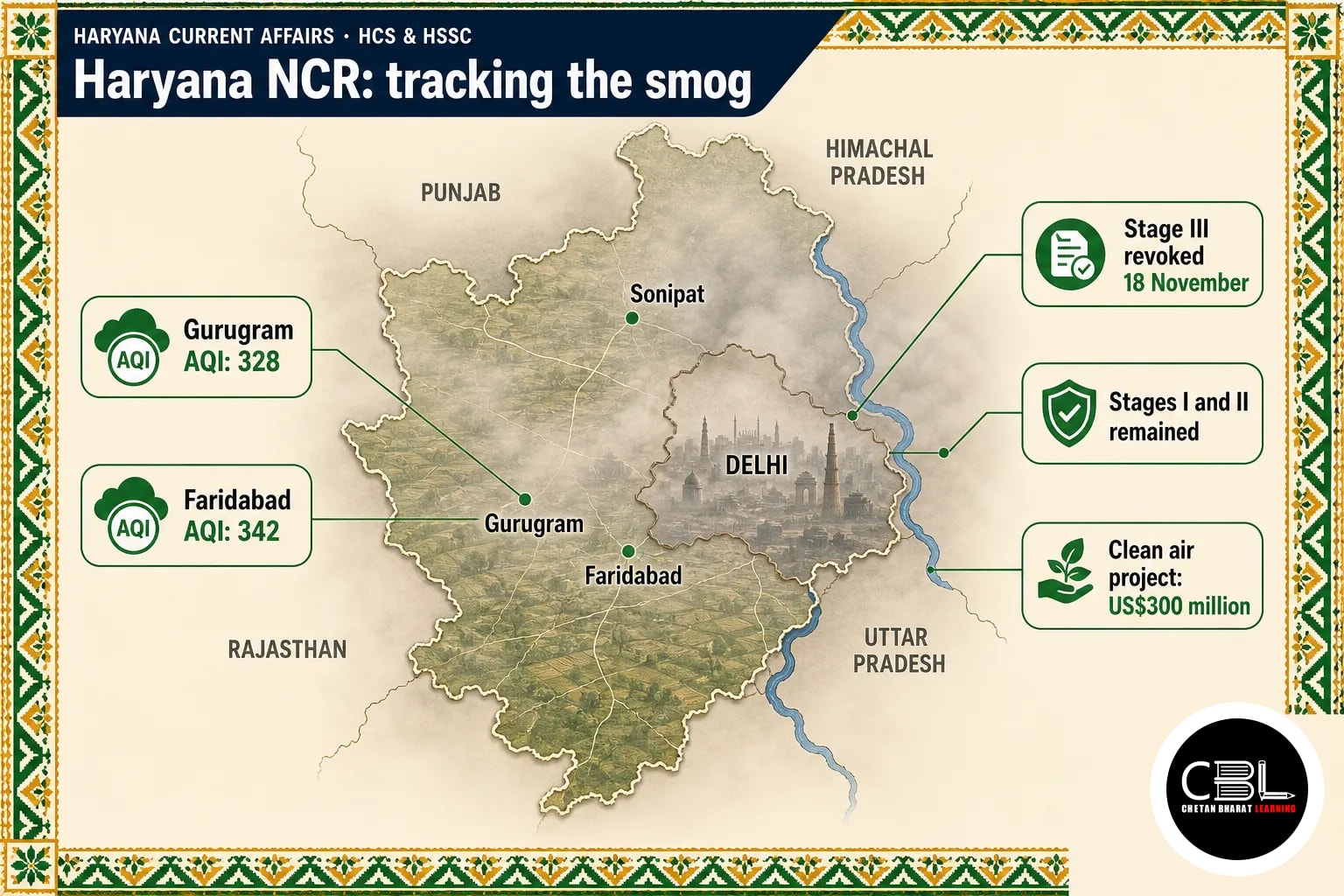
In November 2026, Delhi and the National Capital Region (NCR) faced smog under Stage III of the Graded Response Action Plan (GRAP). The Central Pollution Control Board (CPCB) recorded an Air Quality Index (AQI) of 328 in Gurugram and 342 in Faridabad. On 18 November, the Commission for Air Quality Management (CAQM) revoked Stage III as air quality improved. Stages I and II remained in force, while certain vehicle restrictions were lifted.
Timeline: the clean-air response
- 2019national policyProgramme
The National Clean Air Programme established a national policy context for tackling air pollution.
- 2021legal frameworkCommission
The CAQM Act, 2021 established the statutory framework for regional air quality management.
- March2026Project
Haryana signed a clean air project supported by US$300 million from the World Bank.
- 1 Nov2026Entry rule
Restrictions began on non-BS6 vehicles registered outside Delhi entering Delhi, until 31 January 2027.
- Nov2026Smog
Under regional Stage III, Gurugram recorded 328 AQI and Faridabad 342.
- 18 Nov2026Rollback
CAQM revoked Stage III; Stages I and II remained in force.
- CAQM revoked GRAP Stage III on 18 November 2026.
- Gurugram recorded an AQI of 328 during the November smog.
- Faridabad recorded an AQI of 342 during the November smog.
- GRAP Stage III corresponds to the 401–450 AQI range.
- The World Bank supported Haryana’s clean air project with US$300 million.
What is GRAP?
GRAP is a staged response to air pollution in Delhi-NCR. Its four stages correspond to progressively worse AQI bands: poor, very poor, severe and severe-plus. Regional restrictions can apply even when an individual city’s reading differs from the regional stage band.
The CAQM Act, 2021 provides the regional institutional framework. In March 2026, Haryana signed the Haryana Clean Air Project for Sustainable Development. The Haryana Space Applications Centre (HARSAC) reported about 55% fewer farm fires in the 2026 season: 252 compared with 563.
Why it matters
Smog affects exposure to polluted air. On 18 November, Gurugram’s AQI was reported as 265–278 and Faridabad’s as 222–254, both in the poor band.
Pollution controls can affect transport and other activity. Farm-fire reduction also matters for the region’s air quality.
Air pollution crosses administrative boundaries. CAQM’s regional framework requires coordination across Delhi and adjoining areas.
- Districts: Gurugram, Faridabad and Sonipat are Haryana districts in the National Capital Region.
- Institution: HARSAC is the Haryana Space Applications Centre.
- River: The Yamuna forms much of Haryana’s eastern boundary with Uttar Pradesh.
Key data
| Point | Details |
|---|---|
| GRAP AQI bands | Stage I: 201–300; II: 301–400; III: 401–450; IV: above 450. |
| November smog readings | Gurugram: 328; Faridabad: 342. |
| Stage III revoked | 18 November 2026; Stages I and II remained in force. |
| Vehicle restrictions lifted | Restrictions on BS-III petrol and BS-IV diesel light motor vehicles were lifted in Delhi and specified high-density NCR districts. |
| Delhi entry restriction | Non-BS6 vehicles registered outside Delhi were barred from entering Delhi from 1 November 2026 to 31 January 2027. |
| Haryana clean air project | Signed in March 2026; World Bank support: US$300 million. |
| Farm fires | HARSAC reported 252 in the 2026 season, compared with 563: a fall of about 55%. |
BS means Bharat Stage, the vehicle emission standards used in India.
Way forward
- Monitor locally: Track district-level AQI and communicate changes in restrictions promptly.
- Coordinate regionally: Align district enforcement with CAQM directions and neighbouring administrations.
- Reduce farm fires: Support farmers with practical alternatives to crop-residue burning.
- Control emissions: Inspect transport, construction dust and other local pollution sources.
- Protect residents: Share clear health advisories, especially for people vulnerable to polluted air.
HCS Mains practice questions
Explain GRAP and its relevance to Haryana’s NCR districts. (150 words)
Answer pointers:
- Introduce GRAP as a staged regional response.
- Outline the four AQI bands.
- Use the November 2026 Gurugram and Faridabad readings.
- Conclude with coordinated local implementation.
Critically examine regional air-pollution management in Haryana’s NCR districts. (250 words)
Answer pointers:
- Introduce CAQM and the cross-border nature of pollution.
- Discuss coordinated stages and the clean air project as potential strengths.
- Consider enforcement, local variation and effects on livelihoods.
- Conclude with monitoring and balanced, coordinated action.
As Sub-Divisional Magistrate (SDM) of Gurugram, how would you respond to a smog episode? (150 words)
Answer pointers:
- Begin with current AQI and applicable CAQM directions.
- Coordinate inspections with relevant district agencies.
- Inform residents and support vulnerable groups.
- Review compliance and adjust action when directions change.
Discuss how Haryana’s clean air efforts connect with the National Clean Air Programme. (150 words)
Answer pointers:
- Introduce the national programme launched in 2019.
- Connect it with Haryana’s 2026 clean air project.
- Explain the roles of regional coordination and district monitoring.
- Conclude with measurable implementation and public reporting.
For Haryana Civil Services (HCS) prelims and the Haryana Staff Selection Commission (HSSC) Common Eligibility Test (CET), memorise the GRAP bands and the 18 November rollback. For mains, link regional coordination with district-level enforcement.
MCQ Practice Corner
Q1. Consider the following statements:
1. GRAP Stage III corresponds to an AQI of 401–450.
2. CAQM revoked Stage III on 18 November 2026.
3. Stages I and II also ended on that date.
Which statements are correct?
(a) 1 and 2 only (b) 2 and 3 only (c) 1 and 3 only (d) 1, 2 and 3
Show answer
Answer: (a) because Stage III was revoked, but Stages I and II remained in force.
Q2. Which statement best explains the November 2026 district AQI readings under regional GRAP Stage III?
(a) Every district must have an AQI above 450 (b) Individual district readings can differ from the regional stage band (c) GRAP applies only to Faridabad (d) AQI is unrelated to air quality
Show answer
Answer: (b) because a regional stage does not require every individual city’s reading to fall within that stage’s band.
Q3. Which Haryana city recorded an AQI of 342 during the November 2026 smog?
(a) Sonipat (b) Rohtak (c) Faridabad (d) Karnal
Show answer
Answer: (c) because Faridabad’s recorded AQI was 342.
Q4. Which institution supported Haryana’s clean air project with US$300 million?
(a) World Bank (b) CPCB (c) HARSAC (d) CAQM
Show answer
Answer: (a) because the project signed in March 2026 had World Bank support.
Frequently Asked Questions
When was GRAP Stage III revoked in November 2026?
CAQM revoked it on 18 November 2026. Stages I and II remained in force.
What was the AQI in Gurugram and Faridabad during the November 2026 smog?
Gurugram recorded 328 and Faridabad 342. Both readings fall in the very poor AQI band.
What vehicle restrictions were lifted after GRAP Stage III was revoked?
Restrictions on BS-III petrol and BS-IV diesel light motor vehicles were lifted in Delhi and specified high-density NCR districts. These Haryana districts included Gurugram, Faridabad and Sonipat.
Sources: Business Standard, The Quint, The Tribune
Related Current Affairs
More Haryana topics for HCS & HSSC
Preparing for UPSC, PCS or HCS?
Talk to a mentor at Chetan Bharat Learning, Chandigarh. Free guidance on choosing the right exam and building a study plan.
Chat on WhatsAppCall 97793 53345UPSC / IAS / PCS coaching in Chandigarh · Trusted by aspirants across Punjab & Haryana


Leave a Reply
You must be logged in to post a comment.