

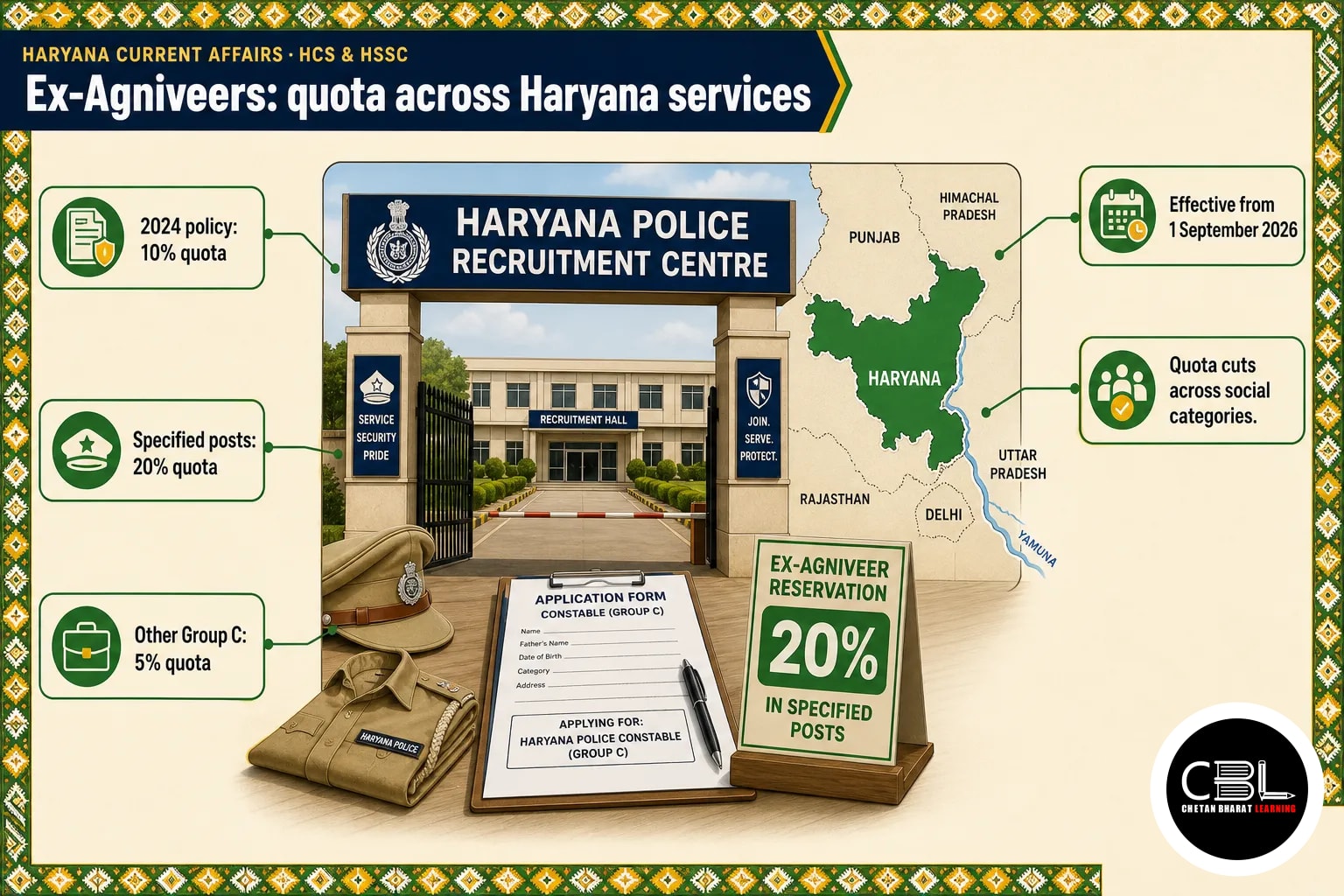
Haryana raised horizontal reservation for domiciled former Agniveers from 10% to 20% in specified government posts. An October 2026 consolidated order covers police constables and several forest, prison, mining and fire-service posts. Other Group C posts carry a 5% reservation. The order also provides recruitment-test exemptions and takes effect retrospectively from 1 September 2026. The quota operates across social categories rather than as a separate vertical category.
Timeline: from Agnipath to Haryana quota
- June2022Agnipath launched
The Union scheme introduced a four-year armed-forces engagement.
- 2024Haryana policyFirst quota
Haryana’s Agniveer policy provided 10% horizontal reservation in certain posts.
- March2026Budget proposal
The state budget proposed 20% of police recruitment for returning Agniveers.
- April2026Quota raised
The Cabinet decided to raise the reservation from 10% to 20%.
- 28 July2026Categories revised
The Cabinet revised the category break-up for 3 types of guard and warder posts.
- October2026Order issued
A consolidated order made the quota effective retrospectively from 1 September 2026.
- The original Haryana Agniveer Policy was introduced in 2024.
- Specified posts carry a 20% horizontal reservation for domiciled former Agniveers.
- Other Group C posts carry a 5% reservation.
- The consolidated order takes effect from 1 September 2026.
- The Home Department police constable post is among those covered by the 20% quota.
What is horizontal reservation for ex-Agniveers?
The Union Government announced the Agnipath scheme in June 2022. It provides a four-year engagement in the armed forces, with up to 25% retained. Former Agniveers are people who have completed their engagement under the scheme.
Horizontal reservation cuts across vertical social categories, following the principle associated with Indra Sawhney (1992). Haryana’s order applies the 20% quota to specified posts and distributes it across listed categories. It also exempts former Agniveers from written examinations for direct recruitment to Group C posts and from physical screening tests; some posts also have physical measurement test exemptions.
Why it matters
The quota creates a route into specified state jobs after armed-forces engagement. Test exemptions also alter their recruitment process.
Government services can draw on the experience of people trained in the armed forces. Recruitment must still match candidates to post requirements.
Recruiting bodies must apply the horizontal quota within the listed categories and observe the order’s retrospective effective date.
- Capital: Chandigarh is the capital of Haryana.
- Recruitment institution: The Haryana Public Service Commission is based in Panchkula.
Key data
| Point | Details |
|---|---|
| Original policy | Haryana Agniveer Policy, 2024: 10% horizontal reservation in certain posts. |
| Specified-post quota | 20% for domiciled former Agniveers in specified police, forest, wildlife, mining, prison and fire-service posts. |
| Other Group C posts | 5% reservation. |
| Category break-up | Deprived Scheduled Castes: 2%; Other Scheduled Castes: 2%; Backward Classes A: 3%; Backward Classes B: 2%; Economically Weaker Sections: 2%; Unreserved: 9%. |
| Other constable posts | Constables in the Indian Reserve Battalion and State Disaster Response Force are covered by the 20% quota. |
| Exemptions | Written examinations for direct Group C recruitment and physical screening tests; physical measurement tests for some posts. |
| Effective date | 1 September 2026, retrospectively. |
Way forward
- Clear notifications: Specify covered posts, eligibility and applicable exemptions in each recruitment notice.
- Accurate implementation: Apply the category break-up and retrospective date consistently.
- Verification: Establish a transparent process for checking domicile and former Agniveer status.
- Grievance handling: Provide applicants with a time-bound route to correct errors and seek clarification.
- Service readiness: Support post-specific induction after selection.
HCS Mains practice questions
Explain Haryana’s reservation framework for former Agniveers. (150 words)
Answer pointers:
- Introduce the 2024 policy and its original 10% quota.
- Identify the 20% quota for specified posts and 5% for other Group C posts.
- Explain horizontal allocation and recruitment-test exemptions.
- Conclude with the need for clear implementation.
Critically examine the merits and concerns of Haryana’s ex-Agniveer reservation policy. (250 words)
Answer pointers:
- Introduce the policy as a transition route after military engagement.
- Discuss employment access and the use of prior training.
- Examine category allocation, test exemptions and post-specific suitability.
- Conclude with transparent recruitment and appropriate induction.
As SDM of Rohtak, how would you address applicant grievances concerning the ex-Agniveer quota? (150 words)
Answer pointers:
- Identify the relevant recruitment notice and applicable order.
- Help applicants understand domicile, post coverage and documentation requirements.
- Refer recruitment decisions to the competent authority and track grievances.
- Promote timely, consistent responses without prejudging claims.
Discuss how Haryana’s ex-Agniveer quota illustrates the distinction between horizontal and vertical reservation. (150 words)
Answer pointers:
- Introduce horizontal reservation as a cross-cutting allocation.
- Explain its operation across the listed vertical categories.
- Link the distinction to the Indra Sawhney principle.
- Conclude with the importance of accurate category-wise implementation.
For Haryana Civil Services (HCS) prelims and the Haryana Staff Selection Commission (HSSC) Common Eligibility Test (CET), memorise 10%, 20%, 5% and the effective date. For mains, explain how horizontal reservation cuts across categories.
MCQ Practice Corner
Q1. Consider the following statements about Haryana’s ex-Agniveer reservation:
1. The 20% quota applies to specified posts.
2. Other Group C posts carry a 5% reservation.
3. The quota is a separate vertical category.
Which statements are correct?
(a) 1 and 2 only (b) 2 and 3 only (c) 1 and 3 only (d) 1, 2 and 3
Show answer
Answer: (a) because the quota is horizontal and cuts across vertical categories.
Q2. Which category has a 9% share within the specified-post ex-Agniveer quota?
(a) Backward Classes A (b) Unreserved (c) Economically Weaker Sections (d) Other Scheduled Castes
Show answer
Answer: (b) because the unreserved share is 9% within the 20% break-up.
Q3. From which date is the consolidated order effective?
(a) 1 January 2024 (b) 28 July 2026 (c) 1 September 2026 (d) 1 January 2027
Show answer
Answer: (c) because the order applies retrospectively from 1 September 2026.
Q4. What was the original horizontal quota under the Haryana Agniveer Policy, 2024?
(a) 5% (b) 10% (c) 15% (d) 25%
Show answer
Answer: (b) because the 2024 policy provided 10% in certain posts.
Frequently Asked Questions
What is the Haryana ex-Agniveer reservation percentage?
It is 20% in specified posts and 5% in other Group C posts. The 20% quota is horizontal and applies to domiciled former Agniveers.
Which Haryana jobs have a 20% ex-Agniveer quota?
They include specified constable, forest guard, wildlife guard, mining guard, prison warder and fire operator-cum-driver posts. Constable posts include those in the Home Department, Indian Reserve Battalion and State Disaster Response Force.
Are former Agniveers exempt from Haryana recruitment tests?
They are exempt from written examinations for direct recruitment to Group C posts and from physical screening tests. Some posts also carry an exemption from the physical measurement test.
Sources: ThePrint, UNI, The Daily Pioneer, Free Press Journal
Related Current Affairs
More Haryana topics for HCS & HSSC
Preparing for UPSC, PCS or HCS?
Talk to a mentor at Chetan Bharat Learning, Chandigarh. Free guidance on choosing the right exam and building a study plan.
Chat on WhatsAppCall 97793 53345UPSC / IAS / PCS coaching in Chandigarh · Trusted by aspirants across Punjab & Haryana


Leave a Reply
You must be logged in to post a comment.