
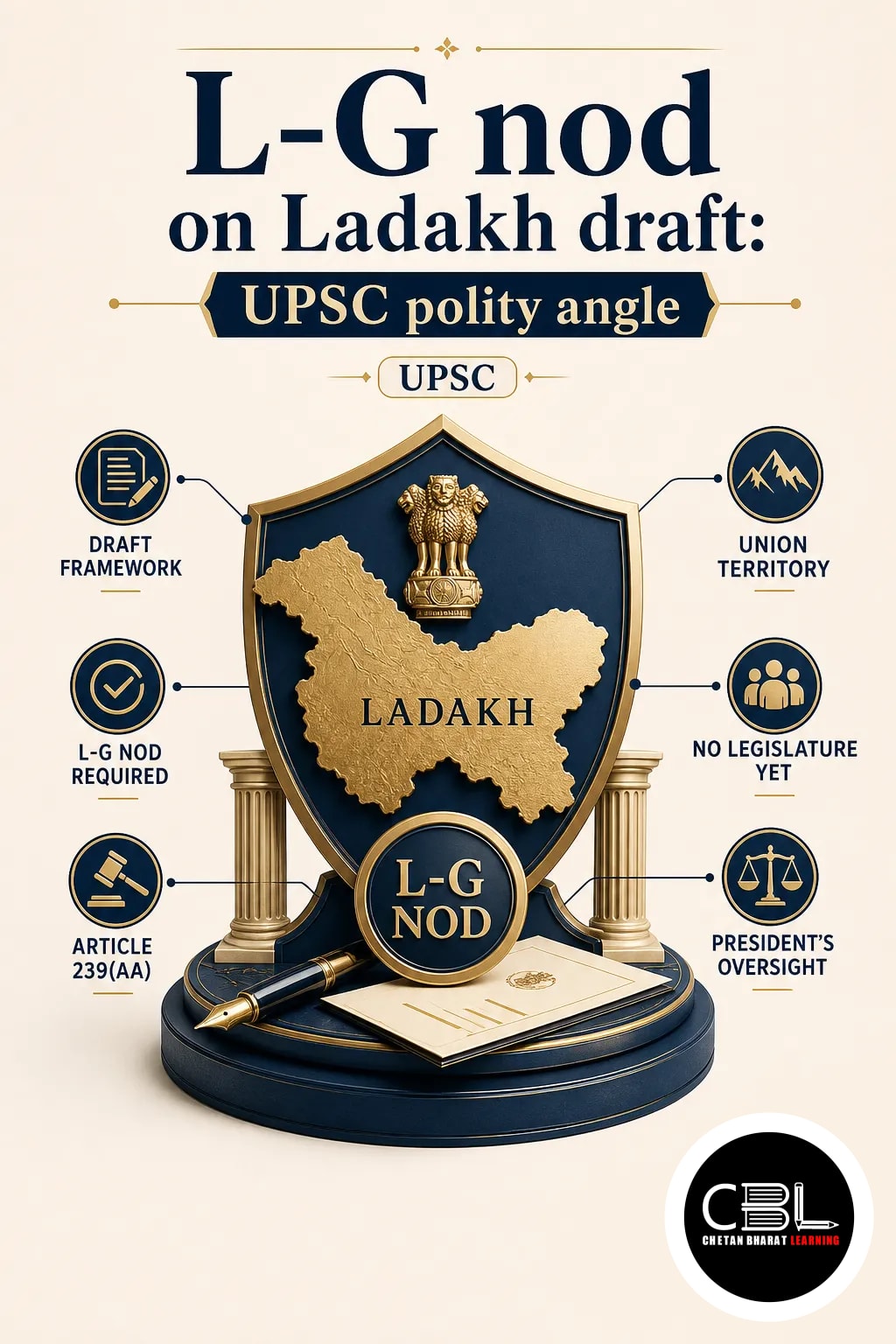

L-G nod has emerged as the key phrase in the draft linked to Ladakh’s autonomy demands. For background on Ladakh’s special constitutional setting, see our explainer on Article 371(K) safeguards for Ladakh.
What is L-G nod?
The draft’s use of L-G nod points to an approval filter before locally made laws can take effect. In Union Territories, the Lieutenant Governor exercises powers under the constitutional and statutory framework, so the balance between local representation and executive control becomes central.
In Ladakh, this question matters because the region seeks greater say in decisions affecting land, culture, and administration. The issue is not only about procedure; it also touches the design of governance in a strategically sensitive Union Territory.
Why in News?
The Indian Express report says the Ministry of Home Affairs has prepared a draft on Ladakh’s demands. The draft reportedly requires laws passed by the elected body to receive the L-G nod, making the approval power the core flashpoint.
This development comes against the wider debate on autonomy, representation, and the extent of elected institutions in Ladakh. It also revives constitutional questions about how far a Union Territory legislature or elected council can act independently.
Key Features
- Prior approval mechanism: The draft reportedly links the validity of local laws to clearance by the L-G.
- Elected body role: A representative body would still frame laws, but its legislative space would be conditioned by executive consent.
- UT governance model: The proposal fits the broader constitutional pattern where Union Territories may have limited legislative autonomy.
- Strategic context: Ladakh’s border location makes administrative control and security considerations especially important.
- Autonomy debate: The move directly affects demands for stronger local control over development and identity-related issues.
Challenges
- Democratic deficit: If every major law needs approval, elected institutions may appear weak in practice.
- Centre-local friction: A strong approval role can deepen tension between local aspirations and central oversight.
- Policy delays: Requiring clearance may slow down urgent decisions on development and regulation.
- Ambiguity in powers: Overlapping authority can produce uncertainty about who finally controls key subjects.
- Trust gap: If local groups see the process as restrictive, confidence in the autonomy framework may erode.
Way Forward
A workable arrangement would need clear rules on which subjects require prior approval and which can move directly through elected institutions. The Lieutenant Governor and the elected body should operate through defined, transparent procedures to avoid repeated conflict.
For Ladakh, the larger need is a structure that protects local participation without weakening constitutional oversight. Any final settlement should reduce ambiguity, preserve administrative efficiency, and respect the region’s distinct concerns.
Source: Indian Express India, 2026-10-24
- Article 371K for Ladakh: Safeguards Explained (23 Sep 2026)
- Ladakh Autonomy: Article 371(K) and Land Rights (21 Sep 2026)
This topic is useful for GS questions on Centre–UT relations, constitutional distribution of powers, and local self-governance. It can also help in comparing how executive approval shapes administration in special regions and Union Territories.
FAQ
Why does L-G approval matter in Ladakh?
It determines how much practical autonomy the elected body can exercise. If approval is mandatory for many laws, the executive can shape or delay local policy.
Is this issue only about Ladakh?
No. It also reflects a wider UPSC theme: how the Constitution manages governance in Union Territories. Similar questions arise wherever elected institutions share space with central oversight.
What should aspirants remember from this development?
Focus on the balance between autonomy, accountability, and administrative control. Also revise the constitutional position of Union Territories and the role of the Lieutenant Governor.
Related Current Affairs
Preparing for UPSC, PCS or HCS?
Talk to a mentor at Chetan Bharat Learning, Chandigarh. Free guidance on choosing the right exam and building a study plan.
Chat on WhatsAppCall 97793 53345UPSC / IAS / PCS coaching in Chandigarh · Trusted by aspirants across Punjab & Haryana
Leave a Reply
You must be logged in to post a comment.