
UPSC Mapping
Important For
| Prelims | Indian Polity and Constitution |
|---|---|
| Mains | GS Paper II — Constitution and Federalism |
Quick Facts
| Status | Proposed Provision |
|---|---|
| Territory | Ladakh |
| Constitutional Part | Part XXI |
| Related Provision | Article 240 |
What is Article 371K?
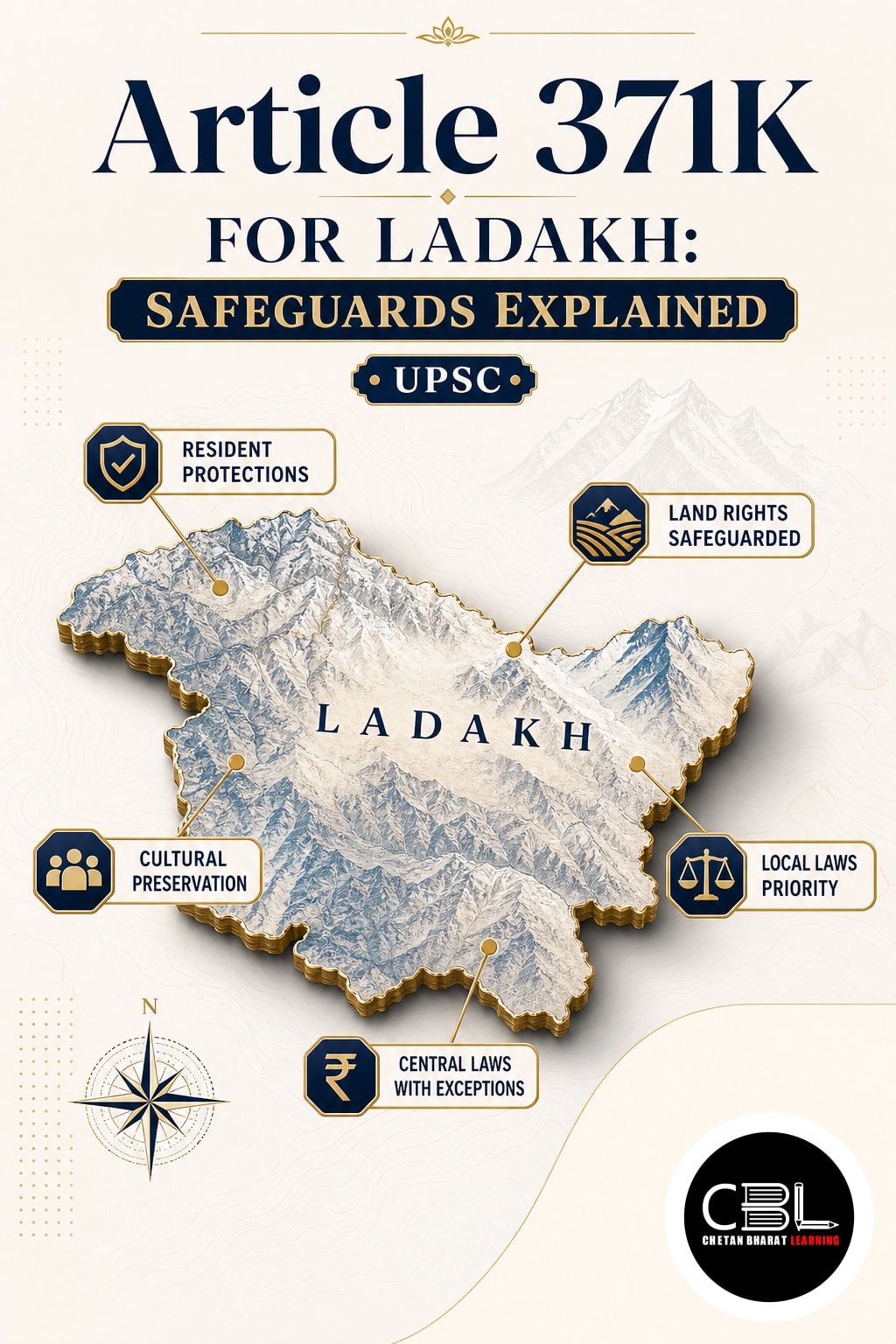
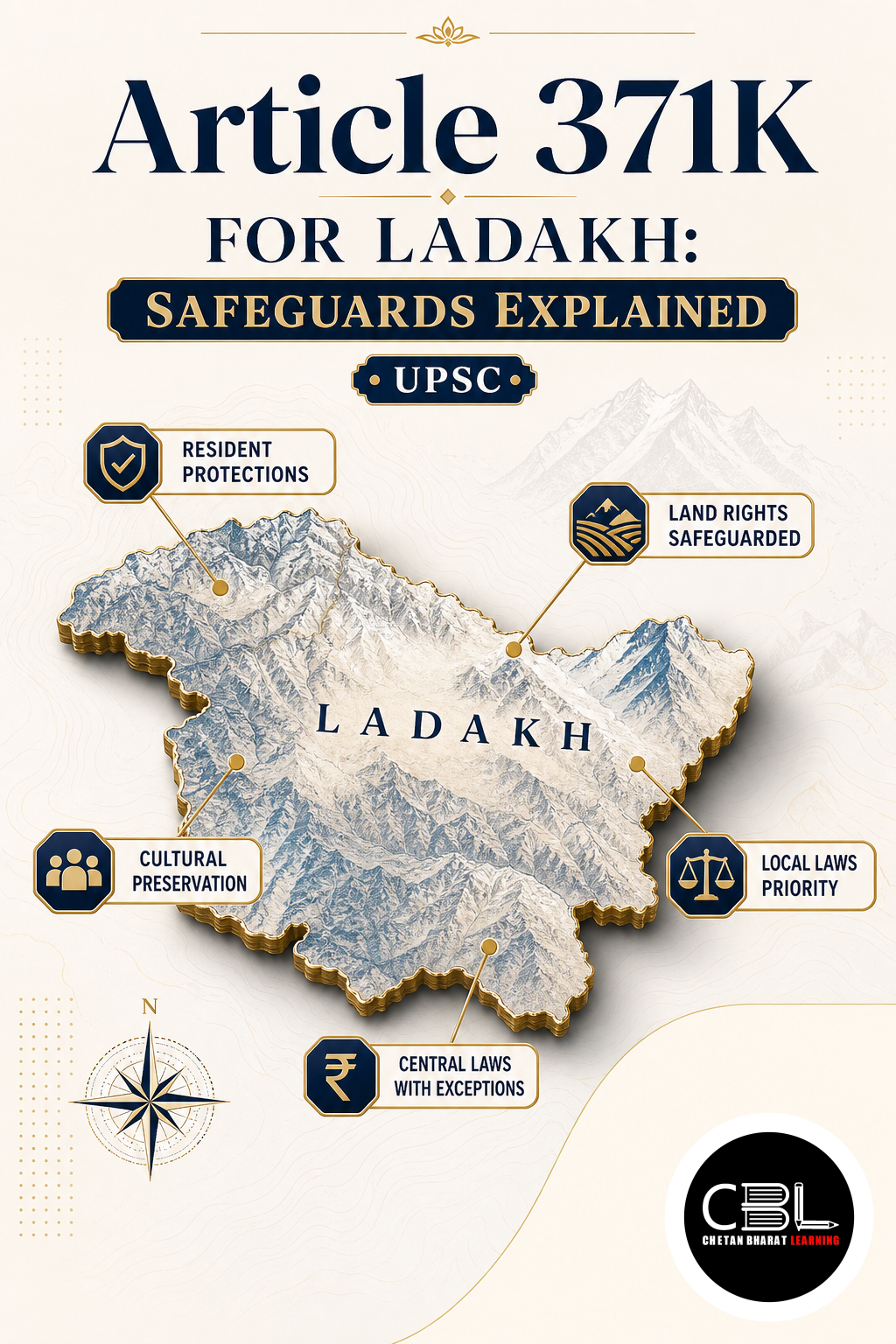
The proposed constitutional provision seeks a customised governance model for Ladakh, which currently remains a Union Territory without a legislature. It may establish a directly elected territory-level body with legislative, executive, planning, budgetary and financial responsibilities. Such an institution would introduce representative decision-making without necessarily converting Ladakh into a state or a conventional legislature-bearing Union Territory.
The proposal belongs to India’s wider practice of asymmetric federalism, under which different regions receive arrangements suited to their historical and social circumstances. Article 371 presently addresses regional development within Maharashtra and Gujarat, while Articles 371A to 371J create varied protections for specified states. The proposed Article 371K would extend this constitutional approach to Ladakh through a model not copied directly from any existing state provision.
This development also reflects the changing history of Article 371 itself. The original provision supervised the administration of former Part B States during their constitutional integration after Independence. The Seventh Constitutional Amendment of 1956 reorganised this framework, after which Article 371 evolved into a source of region-specific institutional arrangements and developmental safeguards.
Why is Article 371K in News?
The Union government discussed the proposal with representatives of the Apex Body Leh and the Kargil Democratic Alliance. These organisations have sought stronger democratic representation, protection of land and employment, and institutional control over decisions affecting Ladakh’s environment and cultural identity. The discussions followed an in-principle understanding on creating safeguards tailored to the territory’s distinctive requirements.
Reports indicate that the proposed elected body could legislate on land, culture, language, forests, environment, natural resources and subjects otherwise administered under Article 240. The arrangement may also address control over officials, planning and expenditure within transferred fields. Readers should consult the Ministry of Home Affairs for any officially released proposal, bill or final constitutional text.
The development matters because Ladakh became a separate Union Territory in 2019 following the reorganisation of the former State of Jammu and Kashmir. Unlike Jammu and Kashmir, Ladakh did not receive a legislative assembly. Local organisations subsequently argued that an administration dominated by unelected officials could not adequately represent regional concerns involving fragile ecology, tribal communities, public employment and scarce land.
Key Features
The emerging framework contains several potentially significant constitutional and institutional elements:
- Directly elected institution: Ladakh may receive a territory-level representative body chosen directly by voters, creating political accountability beyond the existing administrative system and the two Autonomous Hill Development Councils operating in Leh and Kargil.
- Legislative competence: The institution may obtain authority over specified local subjects, allowing representatives to frame rules responsive to Ladakh’s geography, communities, development needs and cultural diversity instead of depending entirely on centrally controlled regulations.
- Land and resource safeguards: Proposed authority over land, forests, environment and natural resources could protect local interests while regulating tourism, infrastructure, urban expansion, extraction and development within a highly sensitive Himalayan ecosystem.
- Executive and financial powers: Budgetary, planning and implementation responsibilities could enable the elected body to translate legislative decisions into programmes, allocate resources transparently and monitor departments handling subjects placed under its jurisdiction.
- Administrative supervision: Local control over relevant civil servants and their performance assessments could make officials answerable to elected representatives, although the final draft must precisely define appointments, transfers, disciplinary control and accountability.
These proposed powers distinguish the model from an advisory council with limited influence. Their practical value will depend on whether the Constitution itself guarantees authority or leaves essential details to ordinary laws, executive orders and future regulations. A constitutionally protected distribution of functions would usually offer greater stability than an arrangement alterable through routine administrative action.
Challenges
The effectiveness of Article 371K will depend on precise drafting, democratic legitimacy and workable relations among Ladakh’s institutions.
- Unsettled constitutional design: Authorities must determine the body’s name, composition, electoral system, tenure and law-making procedure before assessing whether it will function as an effective legislature or a restricted regional council.
- Division of responsibilities: The new institution must coexist with the Leh and Kargil Hill Councils, requiring clear boundaries that prevent duplication, administrative conflict and competition over finances, staff and development planning.
- Central oversight: Ladakh’s strategic location gives the Union government significant security responsibilities, creating difficult questions about public order, police administration and the Lieutenant Governor’s powers relative to an elected executive.
- Environmental pressures: Local authority must balance infrastructure, tourism, connectivity and employment with water scarcity, glacier vulnerability, waste management and the carrying capacity of a fragile cold-desert ecosystem.
- Representative inclusion: The final arrangement must fairly accommodate Leh, Kargil, tribal communities, religious groups, remote settlements, women and young people without allowing territorial or demographic differences to weaken collective governance.
A further question concerns the relationship between this proposal and the Sixth Schedule, which local groups previously demanded for tribal and cultural protection. The Sixth Schedule establishes autonomous councils in specified tribal areas of Assam, Meghalaya, Tripura and Mizoram, whereas the Ladakh proposal appears to envision a distinct Union Territory-level body.
Way Forward
The Union government and Ladakh’s representatives should publish a clear draft for structured public consultation. The text must specify legislative subjects, executive accountability, financial powers, administrative control and the role of the Lieutenant Governor. It should also establish procedures for resolving disputes between the proposed institution, Hill Councils and Union administration.
The design should protect land, culture, employment and ecological security while supporting national integration and strategic coordination. Parliament would need to follow the applicable constitutional amendment procedure before the provision could enter the Constitution. The final requirements would depend on the scope of the amendment and the constitutional provisions it affects.
Any lasting settlement should combine democratic participation, constitutional certainty and administrative practicality. Article 371K should not merely create another institution; it should provide Ladakh’s residents with genuine influence over local decisions and measurable accountability for public services.
Prelims Practice Corner
Q1. The proposed Article 371K is associated with which territory?
- Jammu and Kashmir
- Ladakh
- Lakshadweep
- Puducherry
Answer: (b) The proposed provision seeks special constitutional safeguards for Ladakh.
Q2. Article 371 and Articles 371A to 371J primarily represent which constitutional idea?
- Judicial federalism
- Fiscal emergency
- Asymmetric federalism
- Parliamentary sovereignty
Answer: (c) These provisions create differentiated arrangements for regions with distinct historical and social conditions.
Q3. The President’s power to make regulations for certain Union Territories is principally provided under:
- Article 239AA
- Article 240
- Article 244
- Article 263
Answer: (b) Article 240 empowers the President to make regulations for specified Union Territories.
Q4. Which areas are presently covered by the Sixth Schedule?
- Tribal areas of all northeastern states
- Scheduled Areas throughout India
- Specified tribal areas of four northeastern states
- Every Union Territory with a tribal population
Answer: (c) It applies to specified tribal areas of Assam, Meghalaya, Tripura and Mizoram.
Q5. Consider the following statements:
1. Ladakh currently has a legislative assembly.
2. Leh and Kargil have Autonomous Hill Development Councils.
Which statement is correct?
- 1 only
- 2 only
- Both 1 and 2
- Neither 1 nor 2
Answer: (b) Ladakh lacks a legislative assembly, while autonomous councils operate in Leh and Kargil.
Mains Practice Questions
Q1. Explain how the proposed constitutional safeguards for Ladakh illustrate asymmetric federalism in India. (15 marks)
Answer Structure:
- Intro: Define asymmetric federalism and locate special provisions within Part XXI.
- Body: Discuss Ladakh’s status, proposed elected body, legislative subjects, comparisons with other special provisions and implications for regional autonomy.
- Conclusion: Emphasise a balanced settlement combining national integration with locally accountable governance.
Q2. Constitutional protection alone cannot guarantee meaningful autonomy unless supported by clear institutional powers. Discuss with reference to Ladakh. (10 marks)
Answer Structure:
- Intro: Present the proposal as an attempt to constitutionalise democratic safeguards for the Union Territory.
- Body: Examine legislative competence, finances, bureaucracy, Lieutenant Governor’s powers, Hill Council relations, land rights and environmental governance.
- Conclusion: Recommend precise drafting, consultation and enforceable accountability mechanisms.
FAQs on Article 371K
What does the proposed provision seek to achieve?
It seeks a customised constitutional framework for Ladakh with stronger democratic representation and regional safeguards. A directly elected body may receive legislative, executive, financial and planning responsibilities.
How would the proposal differ from the Sixth Schedule?
The Sixth Schedule creates autonomous councils in specified tribal areas of four northeastern states. Ladakh’s proposed arrangement envisages a distinct territory-level institution designed specifically for a Union Territory without a legislature.
Has the new constitutional arrangement already taken effect?
No. It remains a proposal under discussion, and its final wording, powers and institutional structure have not been officially enacted. Parliament must approve the necessary constitutional amendment before it can take effect.
Related Current Affairs
Preparing for UPSC, PCS or HCS?
Talk to a mentor at Chetan Bharat Learning, Chandigarh. Free guidance on choosing the right exam and building a study plan.
Chat on WhatsAppCall 97793 53345UPSC / IAS / PCS coaching in Chandigarh · Trusted by aspirants across Punjab & Haryana
Leave a Reply
You must be logged in to post a comment.