
What is the issue?
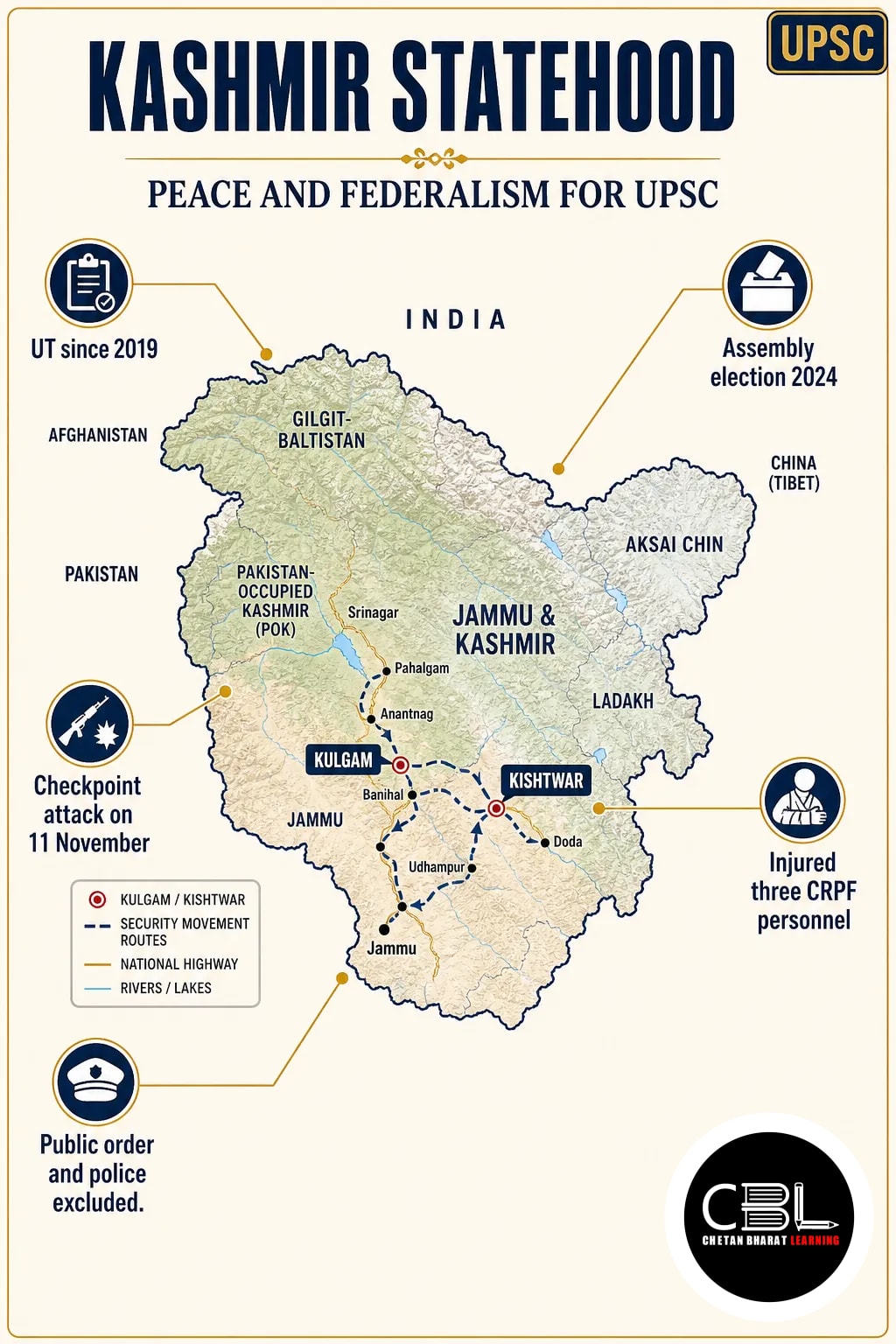
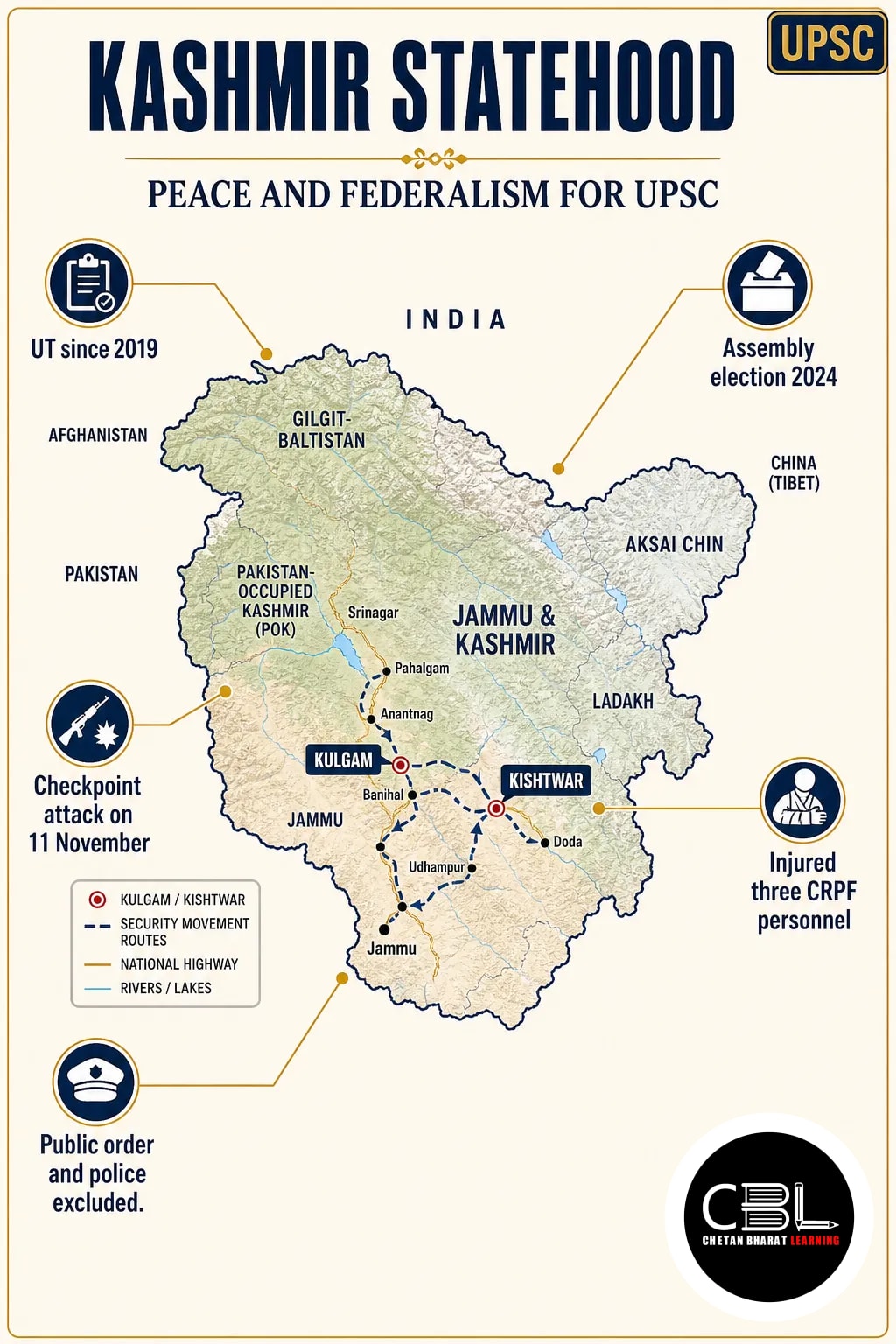
The central issue is how to combine counter-terrorism with accountable elected government in Jammu and Kashmir. The region has been a Union Territory since 2019, and its elected government has no jurisdiction over the police.
The Hindu argues that fewer attacks alone do not establish durable peace. It therefore identifies restoration of statehood and political outreach as necessary complements to security operations, rather than substitutes for them.
Why is the debate in the news?
Violence in November 2026 interrupted a three-month lull and renewed concerns about both security and civilian impacts. The incidents also exposed the uncertainty surrounding some operational circumstances.
| Event | Source detail |
|---|---|
| Kulgam checkpoint, 11 November | A terror attack injured three Central Reserve Police Force (CRPF) personnel. |
| Kishtwar, after 11 November | Two Special Police Officers (SPOs) of the Jammu and Kashmir Police were found dead with bullet wounds after they went missing in a forest range; accounts of their deaths conflicted. |
| Kulgam operation, 16 November | A local man whom police suspected of recently joining terrorist ranks was killed after a six-day operation in residential areas. |
| Local recruitment | Police put the number of local recruits in Kashmir at fewer than 10. |
Former Chief Minister Mehbooba Mufti criticised the Kulgam operation as collective punishment. Meanwhile, National Conference spokesperson Imran Nabi Dar said entire villages faced prolonged restrictions. These are political allegations, not established findings about the operation.
What is the constitutional position?
The Jammu and Kashmir Reorganisation Act, 2019 created a Union Territory of Jammu and Kashmir with a Legislative Assembly. It also created the separate Union Territory of Ladakh.
Under the Act, the Assembly can legislate on applicable State List and Concurrent List subjects, except public order and police. Parliament retains power to legislate for the Union Territory. Consequently, an elected Assembly does not by itself give the regional government the same responsibilities as a state government.
Article 3 of the Constitution empowers Parliament to make laws concerning the formation of states and changes to their areas, boundaries or names. A Bill under Article 3 requires the President’s recommendation. Where it affects a state’s area, boundaries or name, the President must refer it to that state legislature for its views; Parliament is not bound by those views.
Arguments for restoring statehood
Supporters see Kashmir statehood as a means of strengthening democratic responsibility alongside security. Their case rests on institutions as well as public confidence.
- Electoral accountability: Voters participated in the 2024 Assembly elections; greater authority would better connect their mandate with decisions affecting the region.
- Federal representation: Statehood can give elected institutions a stronger role in governance and scrutiny, subject to the law establishing the arrangement.
- Political trust: Dialogue with diverse stakeholders can create channels for grievances that security operations alone cannot address.
- Institutional coordination: Clear responsibilities can help elected leaders and security agencies work towards compatible political and security goals.
Moreover, accountability includes fair legal processes, not merely a change in status. For related context, see the Jammu and Kashmir court case on proof and the Unlawful Activities (Prevention) Act.
Security arguments and concerns
Any settlement must address terrorism while avoiding unnecessary harm to civilian trust. The editorial recognises security gains, but questions whether those gains alone can sustain peace.
- Continuing threat: The Kulgam checkpoint attack shows that violence remains possible despite the lull. Therefore, security agencies need operational capacity.
- Limited evidence of peace: Fewer attacks and reduced local recruitment are important indicators; however, they do not measure political trust or civilian experience.
- Civilian costs: Prolonged restrictions in residential areas can disrupt daily life and deepen resentment. Therefore, necessity and proportionality matter.
- Unclear accountability: When elected leaders lack control over police, citizens may find it harder to identify who answers for security decisions.
- No automatic solution: Statehood alone cannot eliminate terrorism or settle every institutional dispute. Its effects would depend on the legal design and implementation.
What could a balanced way forward include?
A balanced approach would combine a political process with targeted security and safeguards for civilians. Each component should reinforce the others.
- Political engagement: The Centre could consult elected representatives and other stakeholders on a credible route to statehood and institutional responsibilities.
- Operational safeguards: Authorities should minimise disruption during operations and explain restrictions where security permits.
- Accountability: Independent scrutiny and accessible grievance mechanisms can help address allegations of excess, while protecting legitimate operations.
- Security coordination: The Union, regional institutions and security agencies should establish clear channels for sharing information and resolving jurisdictional differences.
- Broader assessment: Policymakers should assess civilian confidence and access to remedies alongside attack and recruitment figures.
Useful for Essay and GS IV: Lasting peace requires institutions that protect people and remain answerable to them.
Source: The Hindu, 18 November 2026
- J&K Court Acquittal: Proof and UAPA for UPSC (10 Nov 2026)
Prelims Practice Corner
Mains Practice Questions
Frequently Asked Questions
Is Jammu and Kashmir currently a state?
No, it is a Union Territory with a Legislative Assembly. The 2019 Reorganisation Act also created Ladakh as a separate Union Territory.
Does the Jammu and Kashmir government control the police?
No, the elected Union Territory government does not have jurisdiction over police. Moreover, public order and police are outside the Assembly’s legislative competence under the Reorganisation Act.
Why is statehood linked to peace in Jammu and Kashmir?
The editorial links it to stronger political accountability and public trust. However, it also recognises the continuing need for counter-terrorism.
Which constitutional provision concerns the formation of states?
Article 3 empowers Parliament to make laws on the formation of states and related changes. A Bill under it also requires the President’s recommendation.
Related Current Affairs
Preparing for UPSC, PCS or HCS?
Talk to a mentor at Chetan Bharat Learning, Chandigarh. Free guidance on choosing the right exam and building a study plan.
Chat on WhatsAppCall 97793 53345UPSC / IAS / PCS coaching in Chandigarh · Trusted by aspirants across Punjab & Haryana









Leave a Reply
You must be logged in to post a comment.