
The Agnipath scheme revamp introduces a second route to regular military service for Agniveers. Since CBL’s earlier coverage of the Supreme Court ruling, the Union Cabinet has cleared a path for those not selected after four years to seek regular service after an extension. The selection criteria remain under discussion. Follow more national current affairs for related developments.
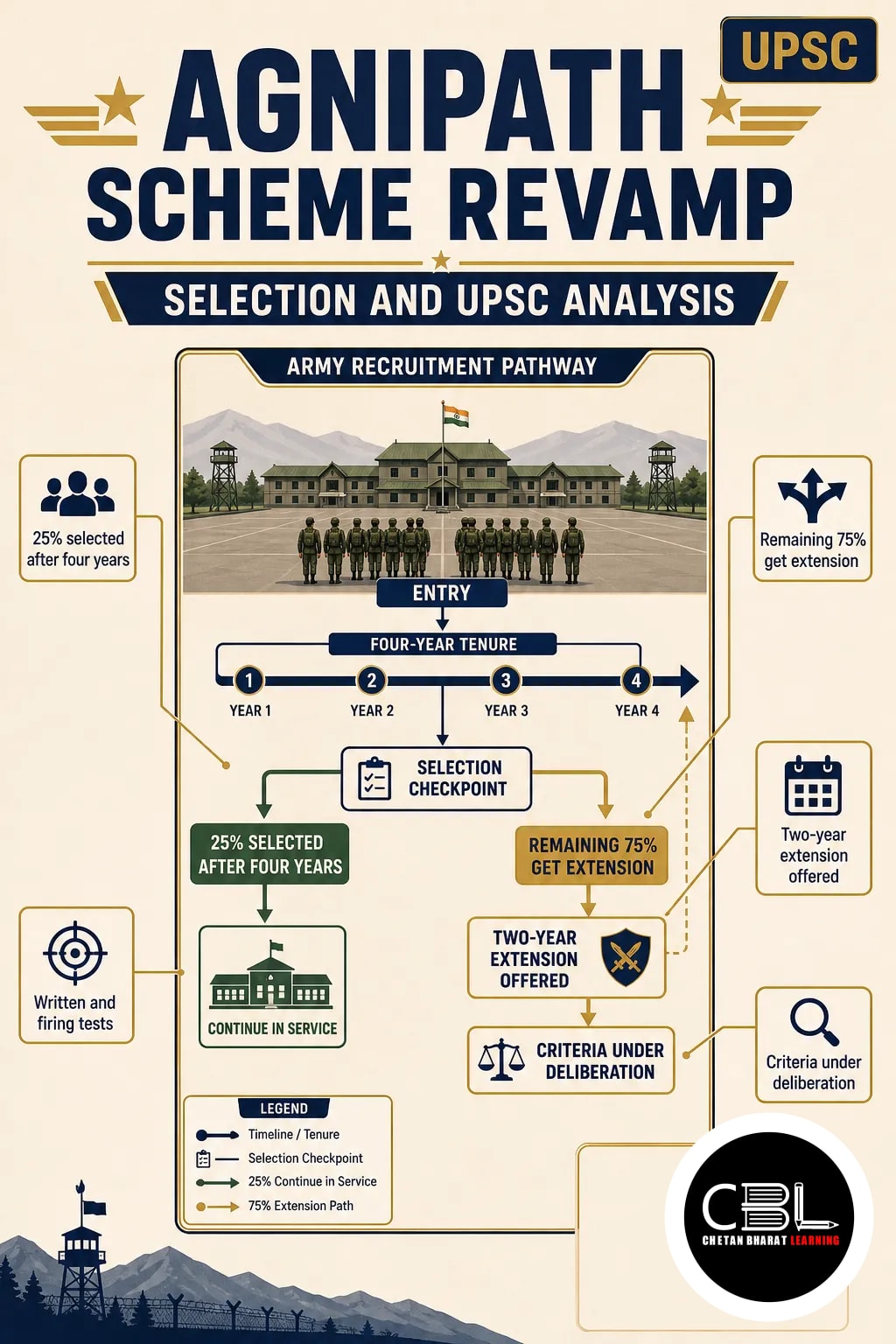
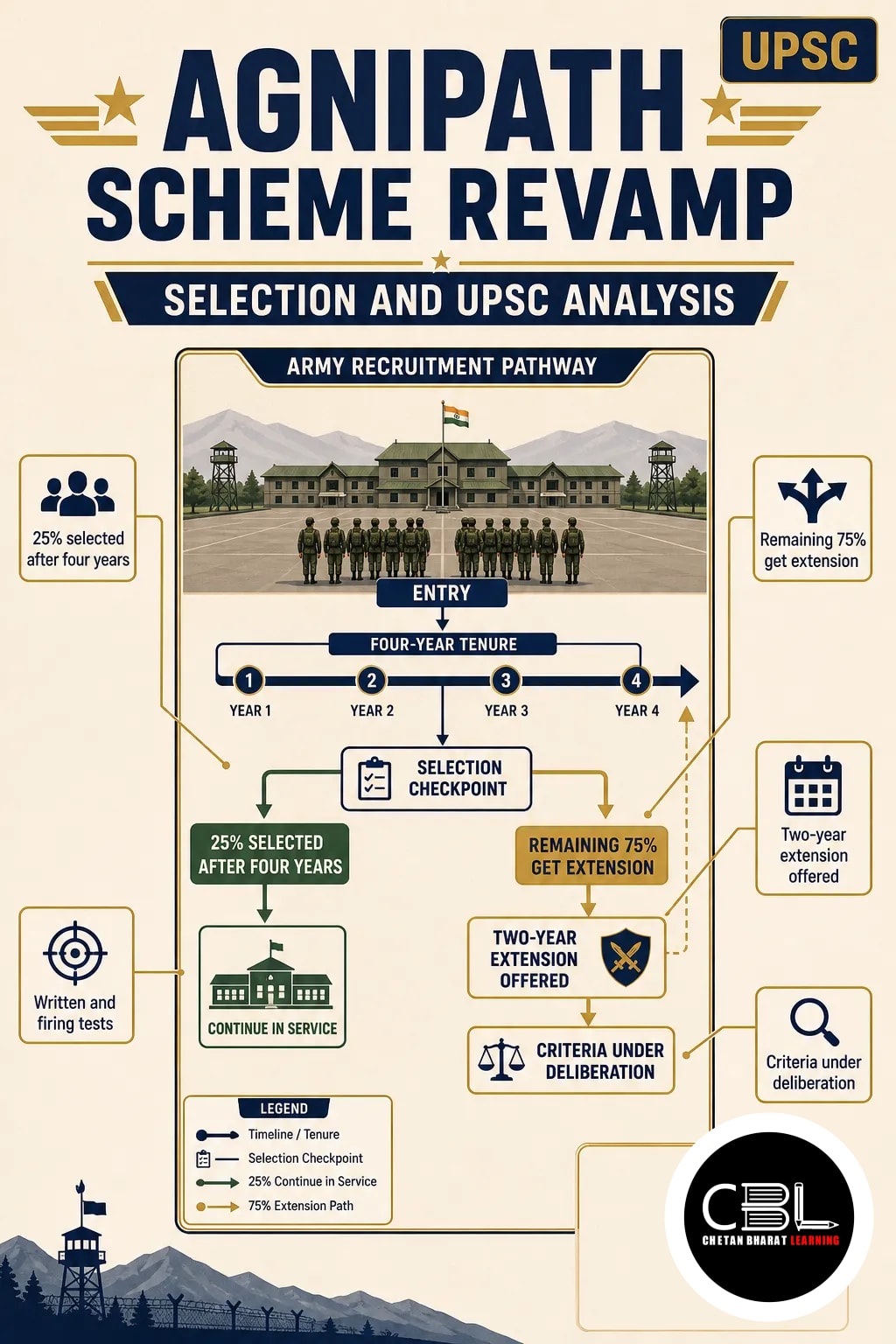
Quick answer: Under the Agnipath scheme revamp, 25% of Agniveers will enter regular service on merit after four years. The remaining 75% will be offered a two-year extension and a subsequent opportunity to qualify for regular service. India’s armed forces are still discussing selection standards, including fitness, discipline and technical proficiency.
What changes under the Agnipath scheme revamp?
The revamp adds a second selection opportunity after an additional two-year engagement. However, regular service after six years depends on willingness and selection; it is not automatic.
| Stage | Path for Agniveers |
|---|---|
| After four years | 25% selected on merit for absorption into regular service. |
| Two-year extension | The remaining 75% are offered additional engagement. |
| After six years | Willing candidates can seek regular service, subject to selection criteria. |
Under the earlier arrangement, the remaining 75% would have exited with a contributory scheme package. The new route therefore extends their opportunity to compete for regular service. The report does not specify how many will eventually qualify at the six-year stage.
Why are selection standards in the news?
The services are discussing how to select Agniveers seeking regular service after the extension. Headquarters Integrated Defence Staff (HQ IDS), the apex tri-service organisation, told The Indian Express that the criteria were under deliberation.
Technology and weapons proficiency are being considered for preference as the forces induct new systems. In addition, multi-skilled personnel could meet more than one operational requirement. These are discussion points, not a final selection notification.
What criteria are being considered?
The reported discussions cover physical fitness, firing ability, medical status and discipline. Moreover, the services are considering a unit-level assessment to inform the final merit list.
| Area | Standard or process under discussion |
|---|---|
| Physical fitness | An excellent grade in Combined Physical Tests. |
| Firing | At least a first-class shot; the report lists marksman, first-shot and standard shot as firing grades. |
| Medical status | Non-retention of Low Medical Category (LMC) candidates is being discussed, with possible exceptions still at a preliminary stage. |
| Discipline | The effect of disciplinary cases, including a single minor infringement, remains under discussion. |
| Unit assessment | A written examination and physical and firing tests are being considered for the final merit list. |
The report distinguishes three LMC categories: battle casualty; injury or disability attributable to or aggravated by military service; and conditions neither attributable to nor aggravated by service. Meanwhile, possible dispensation for battle casualties or service-attributable cases remains preliminary.
What choices will the new certificate record?
The new certificate will record four choices concerning further service. These cover regular-cadre induction; regular induction with willingness to extend if not selected in the first 25%; extension specifically; and unwillingness to continue.
The choices make willingness relevant to the process. However, opting for further service does not itself establish eligibility or guarantee selection.
Why does the change matter for defence preparedness?
The second pathway links personnel retention to the armed forces’ need for skills and operational readiness. It also gives the services a longer period to assess candidates.
- Skill retention: Two additional years can help the forces retain trained personnel while assessing their suitability for regular service.
- Technology proficiency: Preference for technical and weapons skills could support the use of newly inducted systems.
- Merit and readiness: Physical, firing and written assessments can connect selection to measurable requirements; however, their design must reflect different roles.
- Career choice: The certificate records individual willingness, while the second-stage opportunity gives non-selected candidates another route.
The policy also raises a planning question: the services must balance longer engagement with the number and skills of regular personnel they need. Therefore, the final criteria matter as much as the extension itself.
What are the concerns and possible safeguards?
The main challenge is to combine demanding military standards with a transparent and fair selection process. In particular, rules that remain preliminary should not be treated as settled entitlements or exclusions.
- Medical classification: A blanket LMC exclusion could raise questions about personnel injured in service; therefore, the treatment of battle casualties needs clarity.
- Disciplinary proportionality: A single minor infringement may differ from serious misconduct; hence, the final rules should distinguish their nature and circumstances.
- Assessment design: Written, physical and firing tests require clear standards; moreover, candidates should know how each contributes to merit.
- Career uncertainty: A six-year opportunity is not a guarantee; therefore, candidates need timely information about selection and exit arrangements.
What should the final policy clarify?
The final policy should publish selection rules clearly before candidates make choices about further service. It should also explain how medical categories, service-related injuries and disciplinary records affect eligibility.
Furthermore, the services could specify test standards, merit-list weightage and a review mechanism for disputed assessments. Clear communication on exit arrangements would help those who do not continue. Overall, operational requirements and fair procedures should guide implementation.
Source: The Indian Express, 18 November 2026
- SC ruling on Agnipath and law of promissory estopple (10 Apr 2023)
Asked in State PCS: Previous Year Questions
- Haryana HCS Prelims 2023 (General Studies): Which claims about Agniveers are correct: applicable risk allowances; a non-contributory package after five years; its tax exemption; and ₹24 lakh non-contributory life cover?
Haryana HCS has tested scheme conditions; therefore, distinguish earlier provisions from the current changes.
State PCS General Studies can test the two selection stages and the distinction between an extension offer and regular absorption. Haryana HCS has previously asked about Agniveer service conditions; therefore, candidates should revise those alongside the changes.
Prelims Practice Corner
Mains Practice Questions
Frequently Asked Questions
What is the new Agnipath extension?
It is a two-year engagement offered to the 75% not selected for regular service after four years. After six years, willing candidates can seek regular service subject to selection.
Will every Agniveer become a regular soldier after six years?
No, because the second-stage route requires willingness and qualification under the selection criteria. Those criteria remain under deliberation.
Are the medical and disciplinary selection rules final?
No, because the criteria are still being discussed. Possible exceptions for battle casualties or service-attributable medical conditions are also preliminary.
Related Current Affairs
Preparing for UPSC, PCS or HCS?
Talk to a mentor at Chetan Bharat Learning, Chandigarh. Free guidance on choosing the right exam and building a study plan.
Chat on WhatsAppCall 97793 53345UPSC / IAS / PCS coaching in Chandigarh · Trusted by aspirants across Punjab & Haryana









Leave a Reply
You must be logged in to post a comment.