
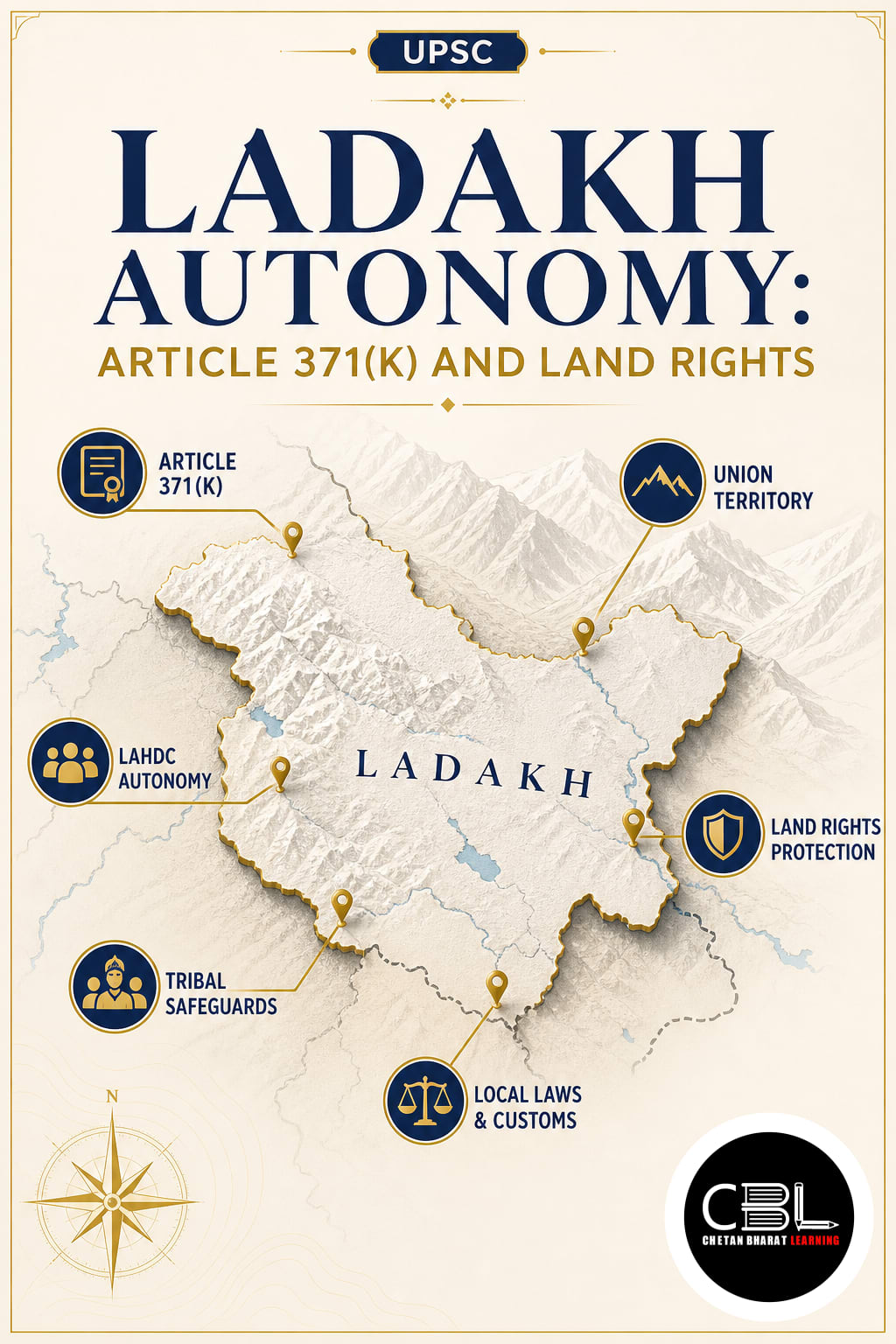
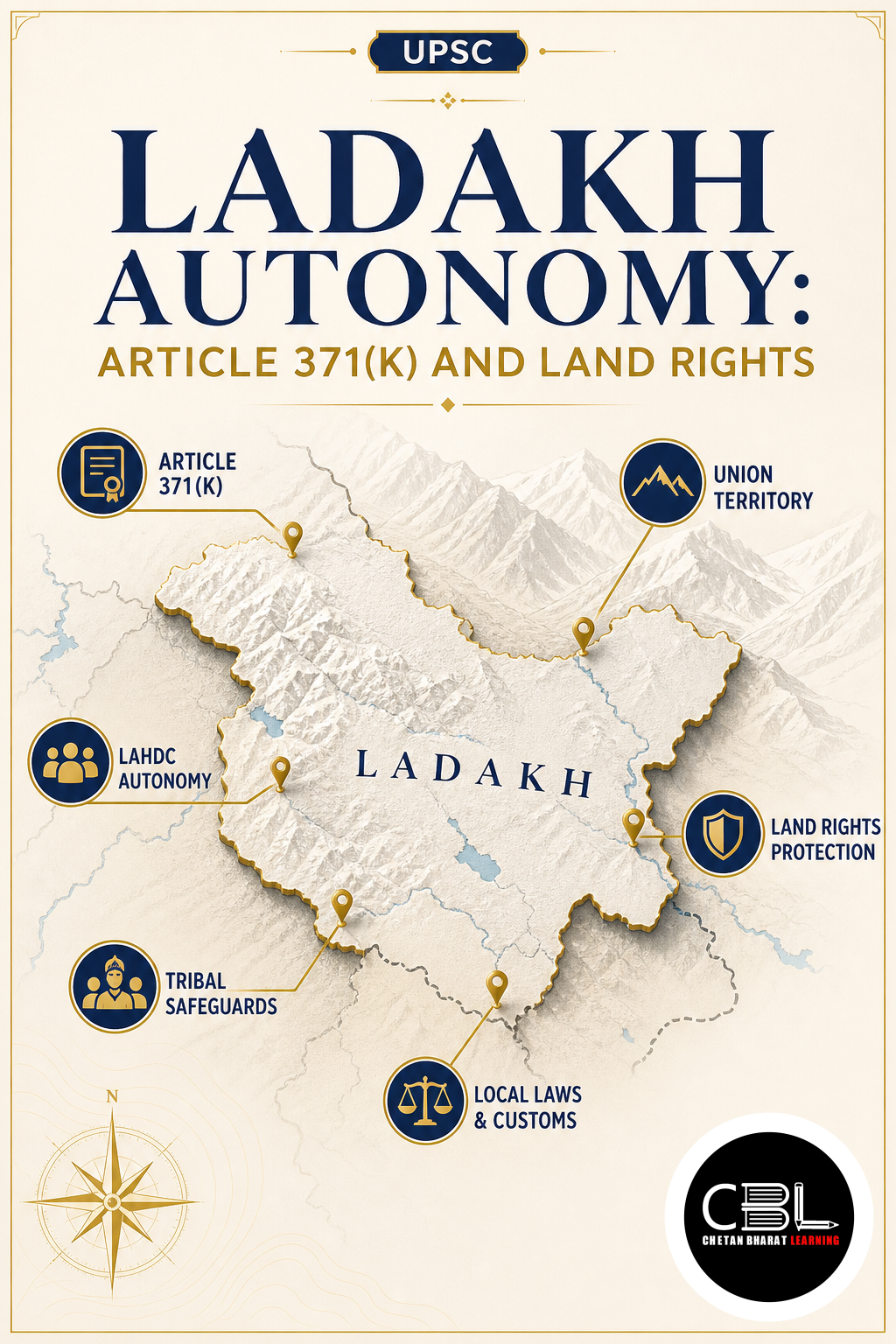
UPSC Mapping
Important for
- Prelims: Articles 239 and 371, Sixth Schedule and LAHDCs
- Mains: GS Papers II and III — Federalism, Environment and Security
Quick Facts
| UT Formation | 31 October 2019 |
|---|---|
| Present Status | Union Territory without legislature |
| Local Councils | LAHDC Leh and LAHDC Kargil |
| Existing Demands | Statehood and Sixth Schedule |
| Reported Proposal | Article 371(K) framework |
| Strategic Character | High-altitude border region |
What is Ladakh Autonomy?
Ladakh Autonomy refers to demands for stronger elected institutions and constitutional protection over land, employment, culture and development. Ladakh became a Union Territory without a legislature under the Jammu and Kashmir Reorganisation Act, 2019. The Lieutenant Governor and Union Territory administration consequently exercise substantial executive authority.
Ladakh already has Autonomous Hill Development Councils in Leh and Kargil, but their powers do not equal those of a legislative assembly. Local groups argue that existing arrangements provide insufficient control over major administrative and resource decisions. Their demands have included statehood, Sixth Schedule protection, employment safeguards and greater parliamentary representation.
Why is Ladakh Autonomy in News?
Ladakh Autonomy returned to the news after discussions between the Union government and regional representatives considered a distinctive governance model. Reports described a possible constitutional provision called Article 371(K) and a directly elected Union Territory–level body. The precise composition, powers and accountability arrangements remain under negotiation.
Article 371(K) has not been enacted and no complete constitutional text was publicly available during the reported discussions. Any new provision would require approval through the constitutionally prescribed parliamentary process. Talks led through the Ministry of Home Affairs must also address local demands concerning land protection, bureaucracy and elected accountability.
Key Features
- Special constitutional provision: The proposed clause would create safeguards designed specifically for Ladakh rather than automatically extending arrangements applicable to another state or tribal area.
- Elected territorial body: Reports indicate direct elections through defined constituencies, although the proposed body’s legislative, financial and executive powers remain unsettled.
- Land safeguards: Local representatives seek protection against unrestricted transfer, speculative acquisition and development that could damage traditional livelihoods or the fragile cold-desert ecosystem.
- Administrative accountability: Regional groups want senior officials to answer to an elected institution instead of functioning principally through the Union Territory bureaucracy.
- Cultural and employment protection: Demands include safeguards for local languages, customs, public employment and the demographic character of communities in Leh and Kargil.
Challenges
A durable settlement must balance local democracy, national security, ecological limits and equitable representation across Ladakh’s diverse communities.
- Unclear distribution of powers: An elected body may remain ineffective unless the constitutional arrangement clearly defines its authority over laws, finances, officials, land and development planning.
- Regional representation: The model must provide fair participation to both Leh and Kargil while respecting differences in population, geography, religion and political preferences.
- Sixth Schedule comparison: Local groups may reject a new arrangement if it offers weaker land and cultural protection than the autonomous governance mechanisms they originally demanded.
- Security considerations: Ladakh borders China and Pakistan, so the Union government must integrate elected governance with defence requirements and the administration of sensitive frontier areas.
- Ecological carrying capacity: Tourism, infrastructure and industrial expansion can increase pressure on scarce water, cultivable land and high-altitude ecosystems discussed in wider polity and environment coverage.
Way Forward
A credible Ladakh Autonomy framework requires a published draft, structured consultation and clearly enforceable powers. Parliament should examine whether the proposed model provides genuine control over land, local planning, employment and cultural protection. The arrangement must also specify financial resources, judicial review and the relationship between elected representatives and the Lieutenant Governor.
Major land or resource decisions should follow transparent environmental assessment and meaningful community participation. The government can strengthen the Hill Councils while negotiations continue and protect balanced representation between regions. Official rules, notifications and administrative decisions should remain accessible through the Union Territory of Ladakh portal to improve public accountability.
Prelims Practice Corner
-
Q1. Ladakh became a separate Union Territory under which legislation?
(a) States Reorganisation Act, 1956 (b) Jammu and Kashmir Reorganisation Act, 2019 (c) Government of Union Territories Act, 1963 (d) North-Eastern Areas Reorganisation Act, 1971Answer: (b) The 2019 Act reorganised the former state into the Union Territories of Jammu and Kashmir and Ladakh.
-
Q2. What is the present legislative status of the Union Territory of Ladakh?
(a) It has a bicameral legislature (b) It has a unicameral legislature (c) It has no legislative assembly (d) It shares a legislature with Himachal PradeshAnswer: (c) Ladakh is presently a Union Territory without a legislative assembly.
-
Q3. The Sixth Schedule of the Constitution provides for autonomous governance in tribal areas of:
(a) Four north-eastern states (b) Every Himalayan state (c) All Union Territories (d) Only Jammu and KashmirAnswer: (a) It currently applies to specified tribal areas in Assam, Meghalaya, Tripura and Mizoram.
-
Q4. Which institutions provide district-level autonomous governance in Leh and Kargil?
(a) Regional Development Boards (b) Autonomous Hill Development Councils (c) Metropolitan Planning Committees (d) Inter-State CouncilsAnswer: (b) Separate Autonomous Hill Development Councils operate in Leh and Kargil.
-
Q5. Consider the following statements regarding proposed Article 371(K): 1. It has already become part of the Constitution. 2. Reports associate it with special safeguards for Ladakh. Which statements are correct?
(a) 1 only (b) 2 only (c) Both 1 and 2 (d) Neither 1 nor 2Answer: (b) It remains a reported proposal under discussion and has not been enacted.
Mains Practice Questions
-
Q1. Examine whether a special provision under Article 371 can adequately address Ladakh’s demands for democratic representation and local safeguards. (15 marks)
Answer Structure:
- Intro: Explain Ladakh’s present status as a Union Territory without a legislature.
- Body: Discuss elected authority, land, employment, culture, bureaucratic accountability, Sixth Schedule comparison and regional representation.
- Conclusion: Recommend a transparent and enforceable framework developed through meaningful local consultation.
-
Q2. Governance in Ladakh must reconcile local democracy with ecological fragility and national-security requirements. Discuss. (15 marks)
Answer Structure:
- Intro: Present Ladakh as a strategically located and environmentally sensitive Himalayan region.
- Body: Cover border security, water scarcity, tourism, land use, climate change, representation and community-led development.
- Conclusion: Support decentralised governance within a coordinated national-security and ecological framework.
FAQs on Ladakh Autonomy
- What are the principal demands related to Ladakh Autonomy?
- Regional groups have demanded statehood, Sixth Schedule safeguards, stronger elected institutions, public-employment protection and additional parliamentary representation. Land and environmental protection remain central concerns.
- Has Article 371(K) already been added to the Constitution?
- No. It is a reported proposal discussed during negotiations, not an enacted constitutional provision. Its final text and institutional powers remain unsettled.
- Why are land safeguards important for Ladakh?
- Ladakh has limited cultivable land, scarce water and a fragile cold-desert ecosystem. Unregulated acquisition and construction could affect local livelihoods, cultural identity and ecological stability.
Related Current Affairs
Preparing for UPSC, PCS or HCS?
Talk to a mentor at Chetan Bharat Learning, Chandigarh. Free guidance on choosing the right exam and building a study plan.
Chat on WhatsAppCall 97793 53345UPSC / IAS / PCS coaching in Chandigarh · Trusted by aspirants across Punjab & Haryana
Leave a Reply
You must be logged in to post a comment.