
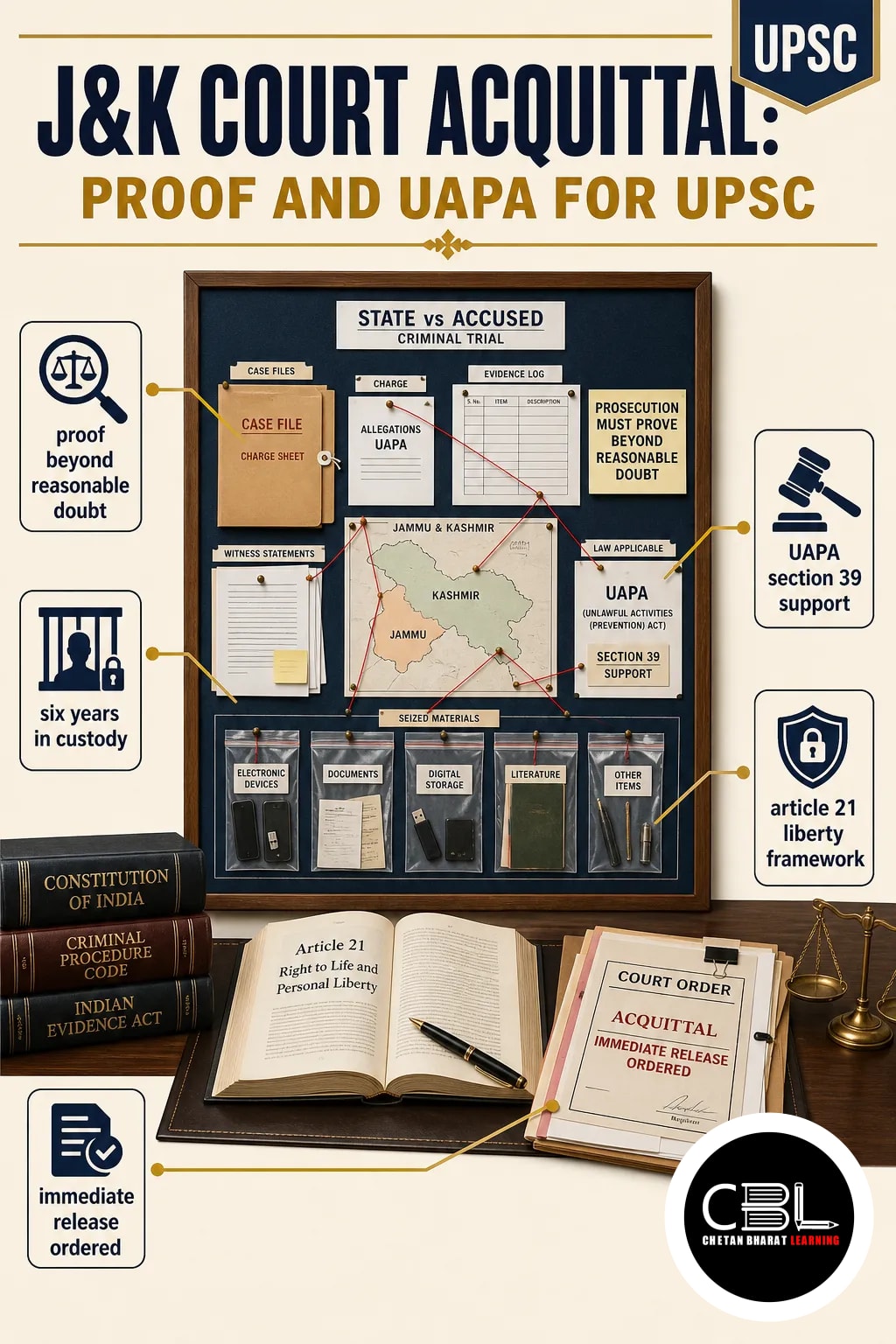
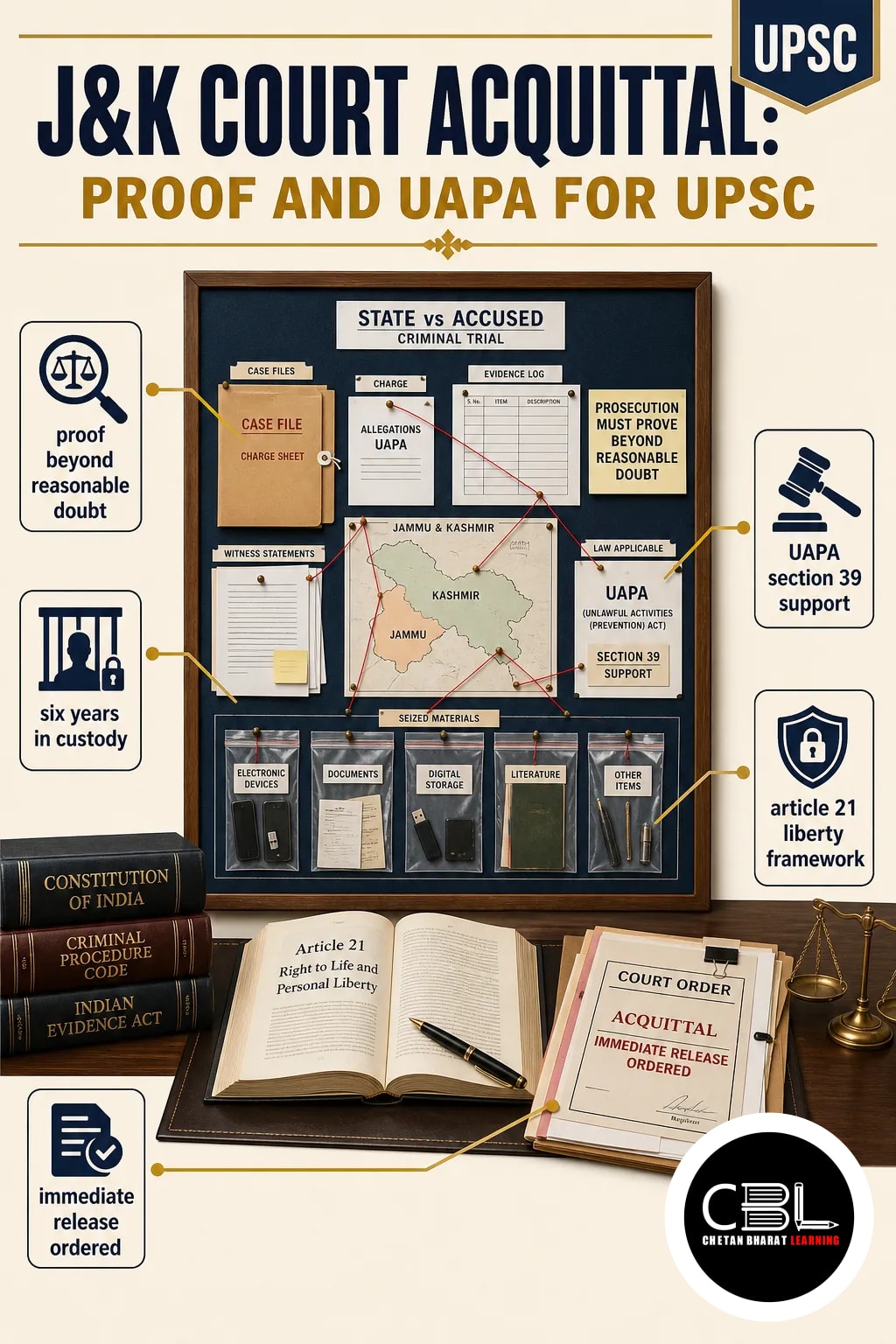
J&K court acquittal of two men after six years brings criminal proof and prolonged detention into focus. The case connects constitutional rights and criminal justice with the enforcement of anti-terror laws.
Quick answer: In the J&K court acquittal, a designated court at Sopore ordered the immediate release of Huzaif Firdous Bhat and Ajaz Ahmad Khan after six years. It found that the prosecution had not proved the charges beyond reasonable doubt. The case involved alleged ammunition recovery and charges under anti-terror and arms laws.
What did the court hold?
Special Judge Feroz Ahmad Khan held that suspicion could not replace proof beyond reasonable doubt. The prosecution had failed to establish the essential ingredients of the offences charged; therefore, the benefit of doubt went to both accused.
The judge also addressed Section 39 of the Unlawful Activities (Prevention) Act, 1967 (UAPA). An allegation of association, without dependable evidence of intentional support or assistance, could not by itself sustain a conviction. The court directed immediate release and said the seized property should be dealt with according to law after the appeal period expires.
This J&K court acquittal is a finding about the evidence in this case. It does not establish that every prosecution under the same law lacks merit, nor does it itself decide any appeal.
What was the background of the case?
The case concerned allegations that the two men transported ammunition for terrorist activities. Police claimed that the men were in a vehicle travelling from Singhpora towards Baramulla town.
According to police, two grenades and 100 live AK-47 rounds were packed in polythene beneath the driver’s seat. Police also claimed recovery of two photocopies of letterhead bearing the initials of Lashkar-e-Taiba (LeT). These were prosecution allegations; the court found the evidence insufficient to prove the offences.
Bhat came from Choora Sopore, while Khan came from Najibhat Kreeri. The source identifies charges from 2020 under Sections 23 and 39 of UAPA and Section 7/25 of the Arms Act. The court also discussed Section 18 of UAPA when assessing the foundation of the prosecution case.
Which legal and constitutional provisions matter?
UAPA and the Arms Act supplied the charges, while fundamental rights provide the broader constitutional framework.
| Provision | Relevance |
|---|---|
| UAPA, Section 39 | Concerns support given to a terrorist organisation; the court examined proof of intentional assistance. |
| UAPA, Sections 18 and 23 | Section 18 concerns conspiracy and related acts; Section 23 provides enhanced penalties for specified arms offences in notified areas. |
| Arms Act, Section 7/25 | The prosecution invoked these provisions concerning prohibited arms and ammunition and punishment for contraventions. |
| Constitution, Article 21 | Protects life and personal liberty except according to procedure established by law; it underpins fair criminal process. |
| Constitution, Article 22 | Provides safeguards concerning arrest and detention, subject to the distinctions and exceptions stated in the Article. |
Exam distinction: Police arrest, bail and conviction involve different legal questions. Consequently, an acquittal after trial should not be treated as an automatic finding that the initial arrest was unlawful.
Why does the acquittal matter for criminal justice?
The ruling illustrates why courts must test each offence against reliable evidence, even in serious security cases.
Proof and security
Investigators must connect alleged recovery to the accused and prove the relevant ingredients of each offence. Moreover, the seriousness of an allegation cannot fill an evidentiary gap. This protects the integrity of prosecution as well as the accused’s right to a fair trial.
Time in custody
The six-year period highlights the personal cost of detention when a trial ends in acquittal. However, the source does not establish why proceedings took that long or whether either accused sought bail. Those questions require separate examination rather than assumptions.
More broadly, court rulings on Kashmir security clearance and rights offer another context for studying state action and legal safeguards.
What concerns and reforms does the case raise?
The central challenge is to protect public security without allowing weak evidence or delay to undermine individual liberty.
- Evidence quality: Investigators should document recovery, custody and links to each accused carefully; courts can then assess the material against the charged offences.
- Timely proceedings: Regular monitoring of pending cases can identify delays. However, speed must not compromise defence rights or judicial scrutiny.
- Access to counsel: Effective legal assistance helps an accused challenge evidence and pursue available remedies. Therefore, access should remain meaningful throughout proceedings.
- Accountability: An acquittal warrants a review of investigative and procedural shortcomings where appropriate. Nevertheless, liability or compensation requires a separate legal basis and assessment.
- Institutional capacity: Better training, evidence handling and coordination can strengthen legitimate prosecutions. In addition, courts need adequate support to manage complex cases.
Mirwaiz Umar Farooq criticised the human cost of prolonged detention and called for accountability. His statement is a response to the outcome, not a judicial finding about other cases.
Source: The Hindu, 10 November 2026
- Hydel Water Tax Verdict: J&K High Court on UPSC (30 Oct 2026)
- J&K Water Charges Verdict: UPSC Analysis (30 Oct 2026)
Asked in UPSC: Previous Year Questions
- UPSC CSE Mains 2019 (GS Paper III): Analyse amendments to UAPA and the NIA Act in the security context, and discuss the scope and reasons for human rights organisations’ opposition to UAPA.
UPSC links anti-terror legislation with both security needs and rights concerns; therefore, revise both dimensions.
Punjab PCS and Haryana HCS may test UAPA provisions, fundamental rights and standards of criminal proof in General Studies. In addition, Mains answers can examine police investigation, legal aid and timely trials as governance issues.
Prelims Practice Corner
Mains Practice Questions
Frequently Asked Questions
Why did the Sopore court acquit the two men?
The court acquitted them because the prosecution failed to prove the charges beyond reasonable doubt. Therefore, it extended the benefit of doubt to both accused.
Which laws were involved in the case?
The case involved UAPA and the Arms Act. In addition to discussing Section 39 of UAPA, the court examined the evidentiary foundation for other provisions.
Does an acquittal automatically establish that an arrest was unlawful?
No, because arrest and conviction involve distinct legal questions. An acquittal on insufficient evidence does not by itself decide the legality of the initial arrest.
What did the court say about support to a terrorist organisation?
It said an allegation of association alone could not establish intentional support under Section 39. Moreover, it required dependable evidence to meet the standard for conviction.
Related Current Affairs
Preparing for UPSC, PCS or HCS?
Talk to a mentor at Chetan Bharat Learning, Chandigarh. Free guidance on choosing the right exam and building a study plan.
Chat on WhatsAppCall 97793 53345UPSC / IAS / PCS coaching in Chandigarh · Trusted by aspirants across Punjab & Haryana









Leave a Reply
You must be logged in to post a comment.