
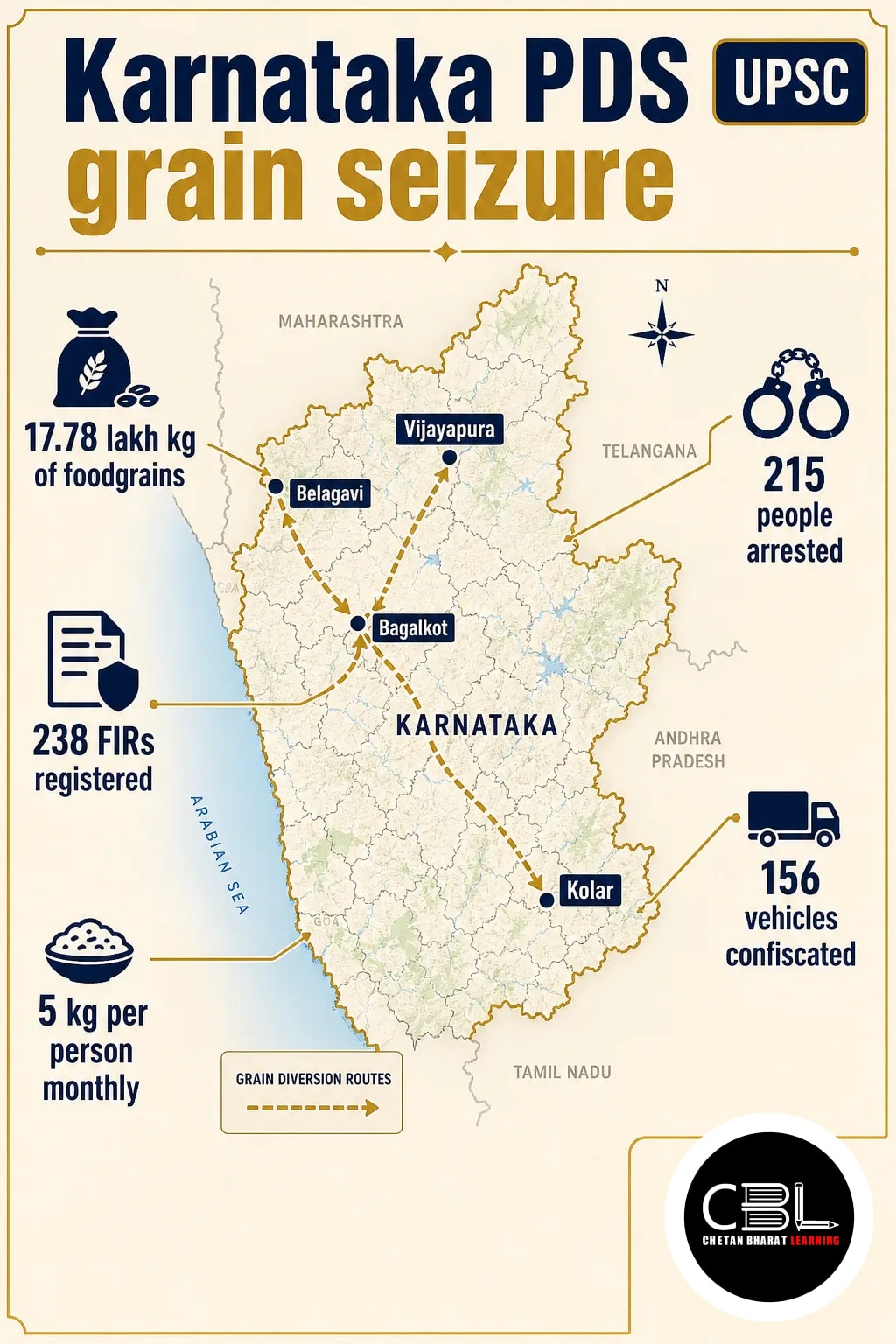

The Karnataka PDS grain seizure has brought ration diversion into focus during drought. The enforcement drive also raises questions about accountability across the public distribution system.
Quick answer: In the Karnataka PDS grain seizure, officials recovered 17.78 lakh kg of rice and other foodgrains over three months. They arrested 215 people and registered 238 First Information Reports. The drive targeted illegal diversion during drought; the minister also warned against hoarding and black-market sales amid rising prices.
What is the Public Distribution System?
The Public Distribution System (PDS) distributes subsidised foodgrains to eligible households through fair-price shops. It is a key instrument of food security, although its effectiveness depends on supplies reaching the intended recipients.
The National Food Security Act (NFSA), 2013 gives eligible households statutory entitlements to subsidised foodgrains. The Centre and states share responsibilities: the Centre arranges grain allocation and delivery to designated depots, while states handle identification and distribution within their jurisdictions.
Priority households are entitled to 5 kg of foodgrains per person per month. Antyodaya Anna Yojana households, however, receive 35 kg per household per month. The Act also provides for grievance redress and transparency in distribution.
Why is ration diversion in the news?
Karnataka officials seized PDS foodgrains during a three-month enforcement drive against illegal diversion. Since 1 August, they have inspected vehicles carrying ration commodities and raided private warehouses in several districts.
Food and Civil Supplies Minister Rizwan Arshad directed the action. Amid drought and a recent rise in rice prices, he warned against illegal hoarding and black-market sales. However, the reported seizures do not by themselves establish the final outcome of the cases.
| Location or measure | Reported figure |
|---|---|
| Belagavi district | More than 5 lakh kg of foodgrains seized |
| Kolar district | 3.5 lakh kg seized |
| Bagalkot and Vijayapura | More than 1 lakh kg seized in each district |
| Other commodities | 14,250 litres of petrol and 1,492 liquefied petroleum gas cylinders seized |
| Estimated value | ₹10 crore for foodgrains, fuel and cylinders combined |
The Food, Civil Supplies and Consumer Affairs Department registered 238 First Information Reports (FIRs) and arrested 215 people. It also confiscated 156 vehicles allegedly used for illegal transport. The estimated ₹10 crore value covers all three commodity categories, not foodgrains alone.
How does PDS diversion affect food security?
Diversion can prevent subsidised grain from reaching households that hold an entitlement. During drought, reliable access matters especially because households may face pressure on their food supplies and incomes.
- Household access: When grain leaves the authorised supply chain, eligible recipients may have to purchase food at market prices.
- Public resources: Diversion can undermine the public expenditure used to procure, transport and distribute subsidised grain.
- Market incentives: Rising prices can increase incentives for illicit resale; therefore, enforcement must examine transport and storage as well as shop-level distribution.
- Trust in delivery: Repeated supply failures can weaken confidence in welfare administration and make grievance redress more important.
The Karnataka PDS grain seizure demonstrates enforcement activity, not the total scale of diversion. Moreover, seizure quantities and arrests cannot establish how many households lost their rations or whether those arrested will be convicted.
What are the governance challenges?
Effective distribution requires scrutiny at every stage, from depot dispatch to the household transaction. A discrepancy at one stage, however, does not automatically identify where diversion occurred.
Tracking and enforcement
Authorities must reconcile allocations, vehicle movements, warehouse stocks and shop-level sales. They also need evidence that connects seized grain to a specific diversion route. Therefore, inspections should support investigation and prosecution rather than serve as the only measure of success.
Access and accountability
Digital records can make transactions easier to check, but technology alone cannot guarantee delivery. Authentication failures or record errors can prevent genuine recipients from obtaining rations. Consequently, safeguards and accessible grievance channels must accompany monitoring.
The earlier analysis of PDS rice diversion provides further context on food-security risks.
What should the way forward be?
A durable response should combine supply-chain checks with protection of household entitlements. The following measures address both objectives:
- Reconcile records: Compare depot releases, transport records and fair-price shop receipts; then investigate unexplained gaps.
- Strengthen local oversight: Publicly display allocations and stock information, while enabling community monitoring and social audits.
- Protect access: Provide workable alternatives when authentication fails, and resolve complaints promptly through the prescribed grievance system.
- Follow cases through: Coordinate food department and police investigations; also track prosecution outcomes and lawful disposal of seized stock.
- Monitor drought response: Check whether eligible households receive their full entitlements, especially where access to food is under stress.
Overall, the test of reform is not seizure volume alone. It is whether accountable enforcement improves actual delivery without excluding eligible households.
Source: The Hindu, 29 October 2026
- Food Security Act Amendments: Proposed NFSA Changes (11 Aug 2026)
- Public Distribution System Modernisation: UPSC Analysis (31 Jul 2026)
- PDS Rice Diversion: Food Security Under Scrutiny (21 Jul 2026)
Asked in UPSC: Previous Year Questions
- UPSC CSE Mains 2022 (GS Paper III): What are the major challenges of the Public Distribution System in India? How can it be made effective and transparent?
- UPSC CSE Mains 2021 (GS Paper III): What are the salient features of the National Food Security Act, 2013? How has the Food Security Bill helped eliminate hunger and malnutrition in India?
UPSC tests both food-security entitlements and the effectiveness of their delivery.
Punjab PCS and Haryana HCS candidates can use this case to examine state responsibilities in ration distribution and district-level enforcement. They should also connect fair-price shop oversight with grievance redress and food-security entitlements.
Prelims Practice Corner
Mains Practice Questions
Frequently Asked Questions
How much PDS grain did Karnataka seize?
Officials seized 17.78 lakh kg of rice and other foodgrains over three months. Belagavi alone accounted for more than 5 lakh kg.
How many people were arrested in the Karnataka drive?
Officials arrested 215 people in connection with the seizures. They also registered 238 FIRs across the state.
What is the foodgrain entitlement under the NFSA?
Priority households receive an entitlement of 5 kg per person per month. Antyodaya Anna Yojana households, however, are entitled to 35 kg per household per month.
Does the seizure figure measure all PDS diversion in Karnataka?
No, because it records grain seized during the reported enforcement drive, not all diversion. Moreover, arrests and seizures do not establish the final outcome of the cases.
Related Current Affairs
Preparing for UPSC, PCS or HCS?
Talk to a mentor at Chetan Bharat Learning, Chandigarh. Free guidance on choosing the right exam and building a study plan.
Chat on WhatsAppCall 97793 53345UPSC / IAS / PCS coaching in Chandigarh · Trusted by aspirants across Punjab & Haryana
Leave a Reply
You must be logged in to post a comment.