
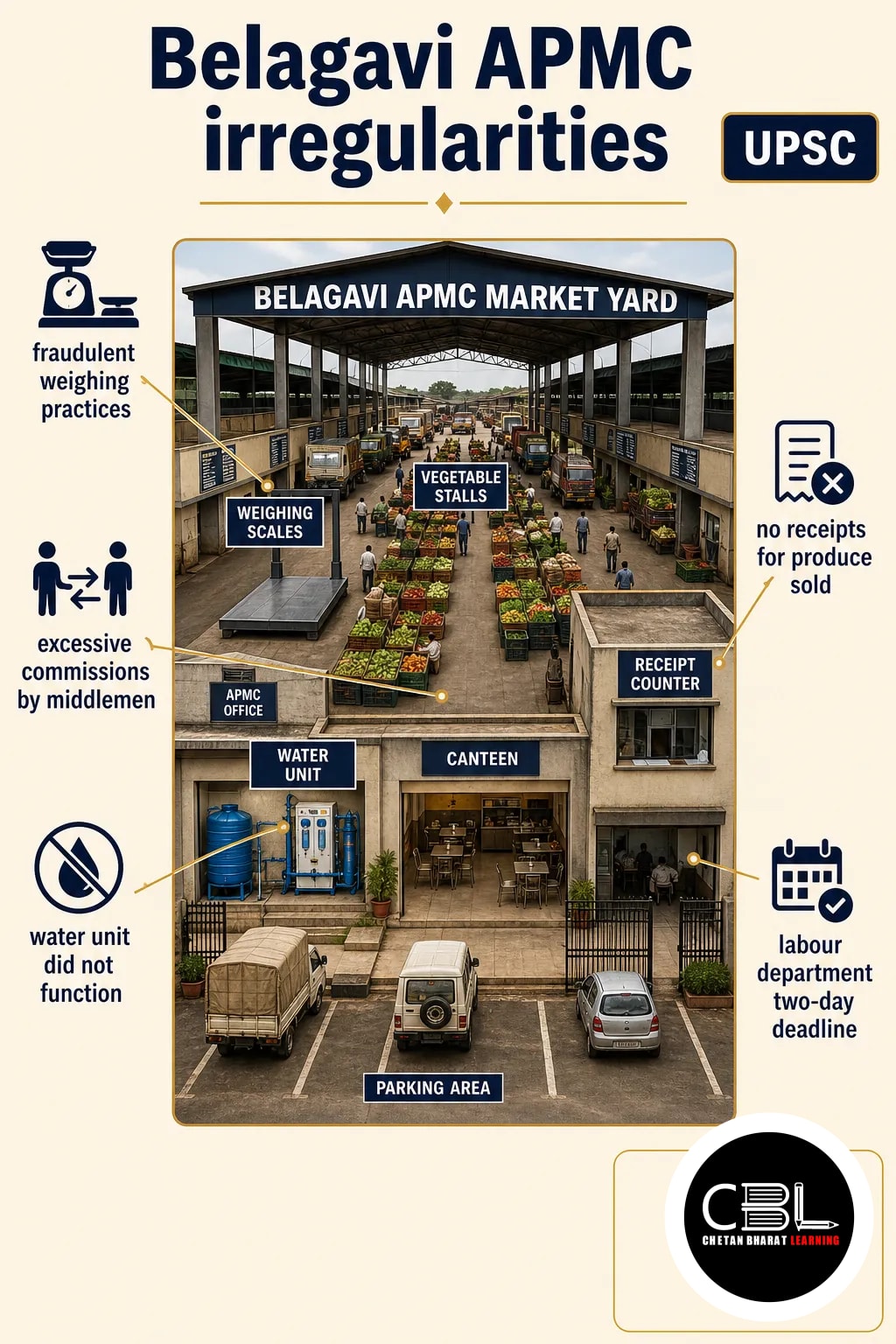

Belagavi APMC irregularities have brought agricultural market oversight into focus after an inspection of the Karnataka market yard. The case also complements the discussion on minimum support price by drawing attention to conditions in which farmers sell produce.
Quick answer: Belagavi APMC irregularities came to light during Upa Lokayukta Justice B. Veerappa’s inspection on 29 October 2026 in Karnataka. He found problems with weighing practices, missing wholesale vegetable sale receipts and excessive middlemen’s commissions. He also directed officials to improve farmer facilities and identify workers entitled to government benefits.
What is an APMC market yard?
An Agricultural Produce Market Committee (APMC) market yard is a place for trading agricultural produce under a state’s market regulation framework. Such yards bring sellers, traders and other market participants together. Their rules and administrative arrangements depend on state law.
For farmers, the sale price is only one part of the transaction. Accurate weighing, clear deductions and a record of sale also matter because they affect the payment received and the ability to question discrepancies.
Why are the Belagavi APMC irregularities in the news?
Upa Lokayukta Justice B. Veerappa found trading and facility-related problems during his inspection of the Belagavi yard on 29 October 2026. He examined weighing scales used by vegetable traders and observed fraudulent practices. He also spoke to farmers and porters to gather information.
The Upa Lokayukta said none of the wholesale vegetable traders issued receipts for produce sold, while middlemen charged excessive commissions. He instructed officials to prevent such practices. However, the source does not specify individual traders, commission rates or a quantified loss.
What did the inspection find?
The inspection identified gaps in transaction records, basic amenities and worker-related information. The table separates the observations from the directions reported.
| Area | Finding or direction |
|---|---|
| Weighing and commission | The Upa Lokayukta observed fraudulent weighing practices and excessive commissions charged by middlemen. |
| Sale receipts | None of the wholesale vegetable traders issued receipts for produce sold. |
| Drinking water and canteen | The clean drinking water unit did not function, and the canteen lacked hygiene. |
| Other facilities | The yard lacked farmer rest areas and vehicle parking; the toilet was unclean and lacked necessary facilities. |
| Workers | The Labour Department was directed to collect worker details across shops within two days and ensure eligible benefits. |
Justice Veerappa also reprimanded the yard secretary over the canteen’s condition. Moreover, Lokayukta, APMC, horticulture and labour welfare officers attended the inspection, making it a multi-departmental exercise.
What are the governance challenges?
The case illustrates how weak transaction oversight and neglected infrastructure can affect market users. Its implications extend beyond the quoted sale price.
- Weighing integrity: Incorrect weights can reduce a seller’s payment; therefore, credible checking is essential to fair transactions.
- Transaction records: Without receipts, farmers have less documentary evidence to examine sale proceeds or challenge deductions.
- Commission transparency: Excessive charges reduce net returns; clear disclosure can help sellers understand what they pay.
- Public amenities: Non-functional water facilities and unclean toilets undermine basic conditions for people using the yard.
- Worker welfare: Incomplete worker information can impede assessment of eligibility; therefore, the department must first identify workers across shops.
Constitutional context
Markets and fairs fall under Entry 28 of the State List in the Seventh Schedule. Agriculture also appears in the State List, subject to specified constitutional entries. Therefore, state legislation and administration are central to understanding how a particular APMC operates.
Lokayuktas are state-level institutions associated with public accountability, but their powers depend on the relevant state law. An inspection finding should not be treated as a final determination of individual liability without the applicable procedure.
What should the response prioritise?
The response should combine immediate repairs with verifiable action on transactions and worker welfare. Officials can use the inspection findings as a starting point rather than treating amenities and trading practices as separate concerns.
- Document sales: Ensure traders provide receipts showing the quantity, price and deductions, so sellers can check their proceeds.
- Check weighing: Inspect scales regularly and create a route for farmers to report discrepancies; then record the action taken.
- Disclose charges: Display applicable charges clearly and examine complaints about commissions against the relevant rules.
- Restore facilities: Repair the water unit and improve canteen and toilet hygiene; also assess rest and parking needs.
- Follow up on workers: Collect the directed details within two days and verify benefit eligibility with the concerned departments.
Finally, named responsibilities and follow-up inspections can make corrective action easier to monitor. Farmers and porters should also have accessible channels to raise unresolved problems.
Source: The Hindu, 29 October 2026
- Minimum Support Price (MSP) (25 Apr 2024)
Punjab PCS and Haryana HCS candidates can connect this case to state responsibility for markets and fairs. They should also examine how receipt issuance, weighing oversight and market amenities relate to state governance.
Prelims Practice Corner
Mains Practice Questions
Frequently Asked Questions
What did the Upa Lokayukta find at Belagavi APMC?
He found problems with weighing practices, sale receipts, commissions and basic facilities. In addition, he directed officials to address farmer amenities and worker benefits.
What deadline was given for collecting worker details?
The deadline was two days. The Labour Department must collect details across shops and, in addition, ensure workers receive benefits for which they are eligible.
Are markets and fairs a State List subject?
Yes, markets and fairs are in Entry 28 of the State List. Therefore, state legislation is important when examining a particular market committee.
Related Current Affairs
Preparing for UPSC, PCS or HCS?
Talk to a mentor at Chetan Bharat Learning, Chandigarh. Free guidance on choosing the right exam and building a study plan.
Chat on WhatsAppCall 97793 53345UPSC / IAS / PCS coaching in Chandigarh · Trusted by aspirants across Punjab & Haryana
Leave a Reply
You must be logged in to post a comment.