

UPSC Mapping
| Important for | |
|---|---|
| Prelims | Polity & Security |
| Mains | GS Paper 2 (Constitutional Rights & Polity) |
| Key Rights | Article 14, 19, 21 |
|---|---|
| Key Issue | Proportionality of force |
| FRT Concern | Privacy and bias |
Article
What is the Jantar Mantar Protest?
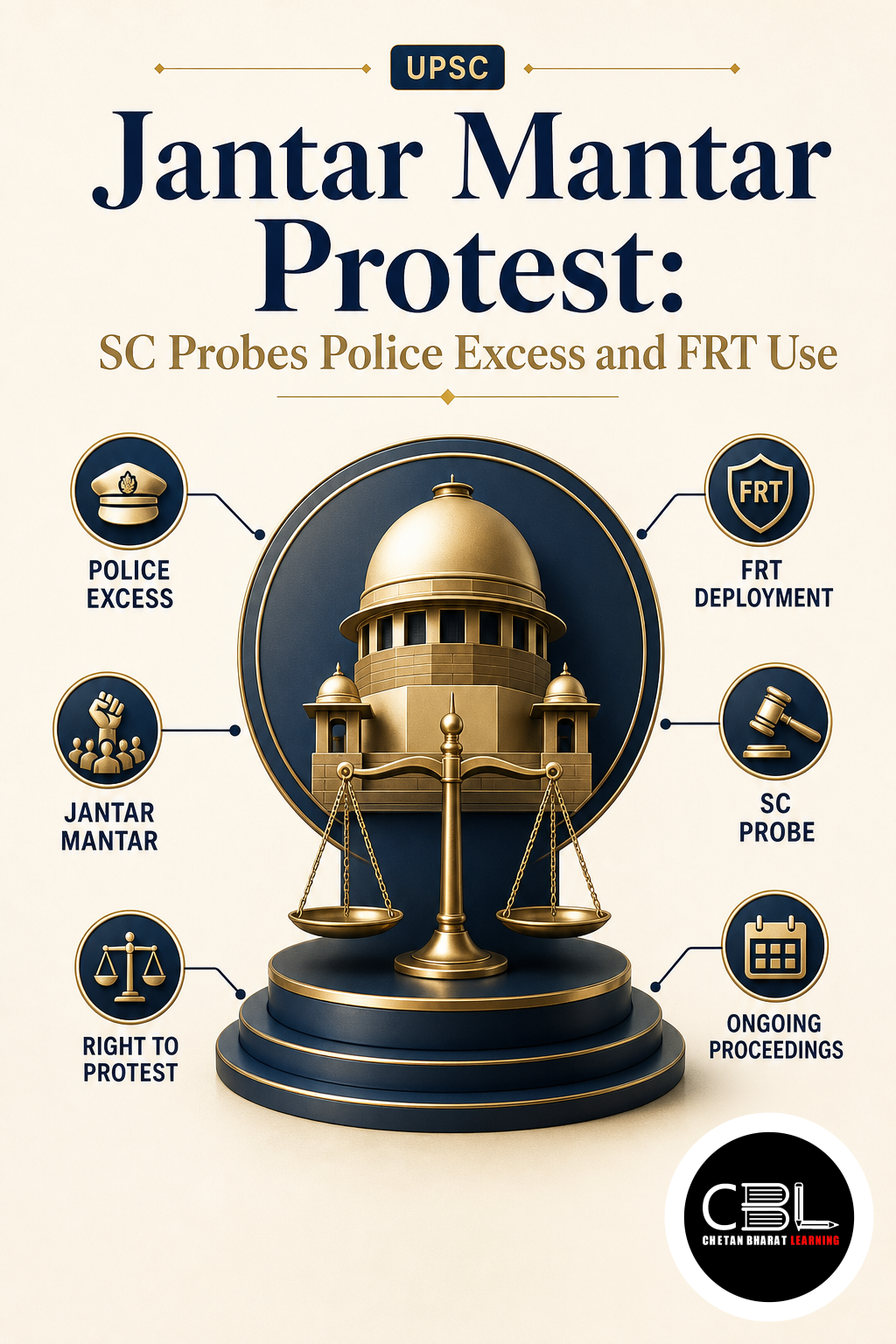
The Jantar Mantar Protest refers to the demonstrations held at Jantar Mantar in New Delhi, where protesters raised concerns over the NEET paper leak, unemployment, and other issues. The Supreme Court is examining allegations of excessive use of force, assault, online harassment, and the use of facial recognition technology (FRT) by police during the protests.
The court has proposed a high-powered committee comprising a former Supreme Court judge, a former High Court Chief Justice, and a retired police officer to investigate the issues. The case raises fundamental questions about the right to protest, reasonable restrictions, police powers, proportionality, and the right to privacy.
Why is Jantar Mantar Protest in News?
The Jantar Mantar Protest is in the news because the Supreme Court took suo motu cognisance of the allegations and proposed a high-powered committee. The court noted that the allegations, if true, raise serious constitutional concerns, including violations of Articles 14, 19, and 21.
The use of facial recognition technology to identify protesters has also come under scrutiny, with concerns over privacy, surveillance, accuracy, and bias. The committee will examine whether peaceful protesters were treated fairly, whether force was used proportionately, and whether procedures and safeguards were followed. For more details, refer to this PIB release.
Key Features of Jantar Mantar Protest
- Right to Protest: Citizens have a constitutional right to express dissent and participate in peaceful demonstrations under Article 19(1)(a) and (b).
- Reasonable Restrictions: Article 19 permits restrictions in the interests of sovereignty, public order, and morality.
- Proportionality: State action must be lawful, necessary, and proportionate—the minimum force required.
- Police Powers: Police have legitimate powers to maintain order, but these powers have constitutional limits.
- Facial Recognition Technology: Use of FRT raises concerns over privacy, surveillance, accuracy, and lack of regulation.
Challenges in Jantar Mantar Protest
- Balancing Dissent and Public Order: The central constitutional tension is between protecting dissent and maintaining public order.
- Proportionality of Force: Determining whether the force used was proportionate and lawful.
- FRT Regulation: India lacks a comprehensive law on facial recognition technology, leading to privacy and surveillance concerns.
- Accountability: Ensuring law enforcement agencies are accountable for their actions.
- Transparency: The use of surveillance technologies must be transparent and subject to oversight. For more on constitutional rights, visit the polity section.
Way Forward for Jantar Mantar Protest
To address the Jantar Mantar Protest issues, the high-powered committee must conduct a thorough and independent investigation into the allegations. The committee should examine the sequence of events, the nature and level of force used, the treatment of protesters, and compliance with law and procedures.
Clear guidelines for the use of facial recognition technology, including safeguards against misuse, are essential. Strengthening police accountability mechanisms and ensuring transparency can build public trust. Ultimately, a healthy democracy protects dissent while ensuring public order—State action must always be lawful, fair, and proportionate. For international best practices, refer to the UNHRC.
Prelims Practice Corner
Q1. Under which Article is the right to protest protected?
(a) Article 14 (b) Article 19 (c) Article 21 (d) Article 22
Show answer
Answer: (b) The right to protest emerges from Article 19(1)(a) and (b).
Q2. What is the principle of proportionality?
(a) Unlimited state power (b) State action must be lawful, necessary, and proportionate (c) Protesters cannot be arrested (d) Police can use any force
Show answer
Answer: (b) Proportionality requires state action to be lawful, necessary, and proportionate.
Q3. What is a key concern with the use of facial recognition technology?
(a) It is always accurate (b) Privacy and surveillance risks (c) It is free (d) It is transparent
Show answer
Answer: (b) FRT raises concerns over privacy, surveillance, accuracy, and bias.
Q4. Who will head the high-powered committee proposed by the SC?
(a) A serving SC judge (b) A former SC judge (c) A police officer (d) A government official
Show answer
Answer: (b) The committee will include a former SC judge, a former HC Chief Justice, and a retired police officer.
Q5. Why is the Jantar Mantar protest constitutionally significant?
(a) It is a political event (b) It raises questions about the balance between dissent and public order (c) It is about economic policy (d) It is a one-time issue
Show answer
Answer: (b) It highlights the constitutional tension between protecting dissent and maintaining public order.
Mains Practice Questions
Q1. Discuss the constitutional framework governing the right to protest in India, with reference to the Jantar Mantar protest and the Supreme Court’s intervention. (250 words, 15 marks)
Answer Structure:
- Intro: Introduce the Jantar Mantar protest and the SC’s intervention.
- Body: Discuss the constitutional basis of the right to protest (Article 19) and reasonable restrictions. Analyse the principles of proportionality and police powers. Examine the concerns raised by FRT use. Suggest safeguards and oversight mechanisms.
- Conclusion: Emphasise the need for a balanced approach that protects both dissent and public order.
Q2. What are the privacy and surveillance concerns associated with the use of facial recognition technology by law enforcement agencies? (150 words, 10 marks)
Answer Structure:
- Intro: Define FRT and its growing use.
- Body: Discuss concerns: lack of a comprehensive legal framework, privacy violations, potential for profiling, accuracy and bias issues, and lack of transparency and accountability.
- Conclusion: Conclude that strong legal safeguards and oversight are essential.
FAQs on Jantar Mantar Protest
What is the right to protest?
It is a constitutional right emerging from Article 19(1)(a) and (b), allowing citizens to express dissent and participate in peaceful demonstrations.
Is the right to protest absolute?
No, Article 19 permits reasonable restrictions in the interests of sovereignty, public order, and morality.
Why is facial recognition technology controversial?
Due to concerns over privacy, surveillance, accuracy, bias, and lack of a comprehensive legal framework.
Related Current Affairs
Preparing for UPSC, PCS or HCS?
Talk to a mentor at Chetan Bharat Learning, Chandigarh. Free guidance on choosing the right exam and building a study plan.
Chat on WhatsAppCall 97793 53345UPSC / IAS / PCS coaching in Chandigarh · Trusted by aspirants across Punjab & Haryana
Leave a Reply
You must be logged in to post a comment.