
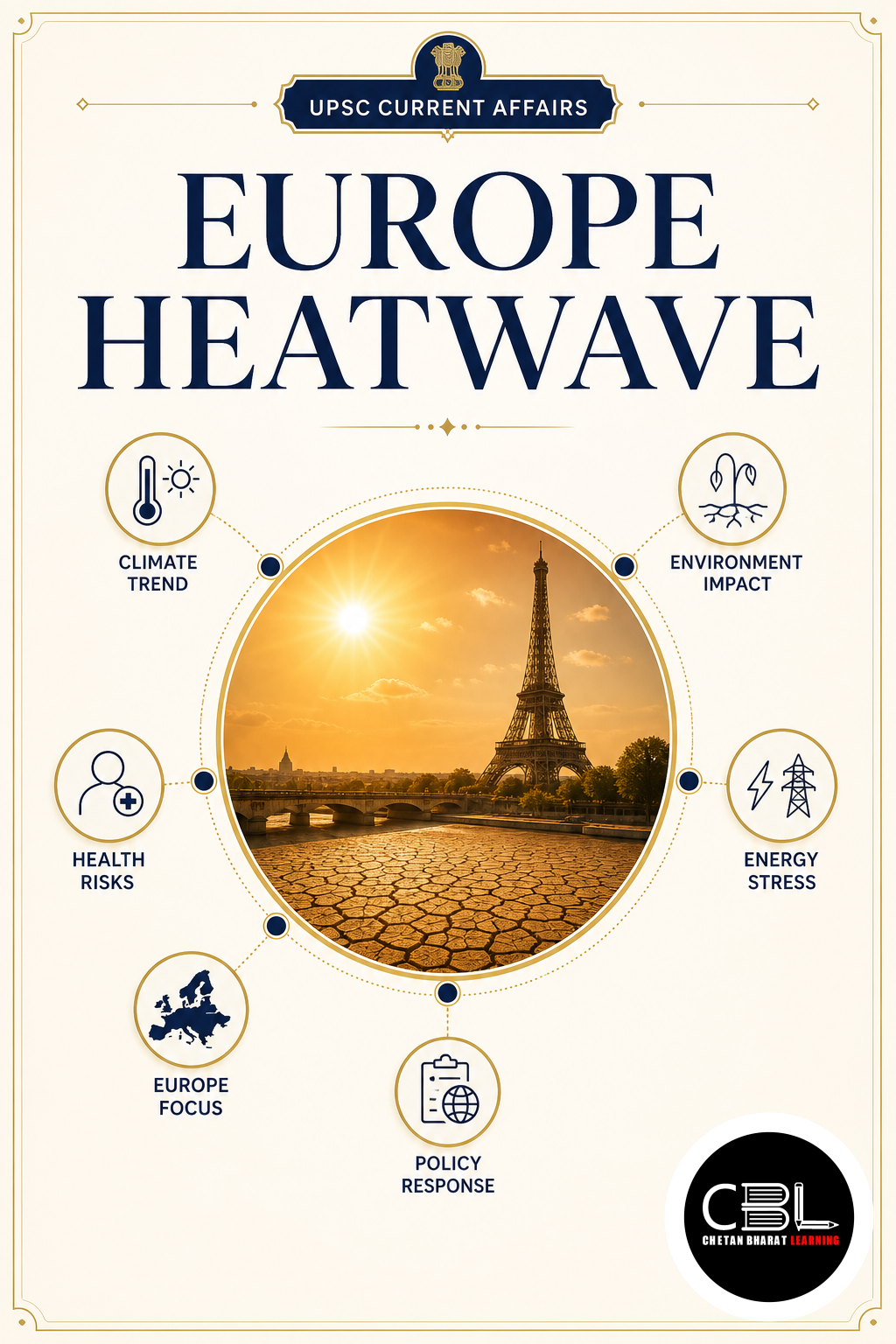

Europe Heatwave is among the most important international environment developments highlighted in the passage. Several European countries are experiencing prolonged high temperatures, leading to red alerts, drying rivers, energy stress and wider economic disruptions. It also highlights new scientific observations of the Sun that improve understanding of plasma, magnetic fields and space weather. This article is prepared as an exam-oriented UPSC current affairs summary based on the passage.
Why in News?
The passage highlights two major developments. First, several European countries are facing an intense heatwave, with Italy issuing red alerts while Hungary adopted electricity-saving measures by switching off decorative lighting. Rivers such as the Rhine and Danube are witnessing reduced water levels, affecting transport, cooling water availability and economic activity.
The second development is a scientific breakthrough where researchers released new images of the Sun showing previously unseen plasma structures and magnetic interactions. The passage explains how these observations may improve understanding of solar activity and space weather.
Topic 1: Europe Heatwave
What is a Heatwave?
The passage defines a heatwave as a prolonged period of unusually high temperatures compared with the normal climate of a region. It generally lasts between two and seven days, though some events may continue much longer.
Why is Europe warming faster?
- Arctic amplification increases warming in northern regions.
- Loss of snow and ice reduces reflection of sunlight.
- Climate change makes heatwaves more frequent and intense.
- Blocking high-pressure systems trap hot air and prevent cooling.
Red Alert
A red alert is the highest level of heat warning and indicates extreme conditions requiring emergency measures to protect public health.
Why did Hungary switch off lights?
According to the passage, high temperatures increased electricity demand due to heavy air-conditioner usage. Decorative lighting was switched off as an energy management measure to reduce electricity consumption.
Importance of Rhine River
- Major European trade route.
- Supports movement of coal, oil, chemicals, steel and grain.
- Low water levels reduce shipping capacity.
- Transport costs increase when river depth falls.
- Industrial supply chains face disruption.
Why are rivers drying?
- High evaporation.
- Reduced rainfall.
- Declining snow and glacier melt.
Broader impacts of heatwaves
- Health risks including dehydration and heat stroke.
- Water shortages.
- Agricultural losses.
- Higher energy demand.
- Economic disruption.
- Tourism impacts.
UPSC Linkage
GS Paper III: Environment, Climate Change and Disaster Management.
Prelims: Heatwave, Rhine River, Danube River, climate change.
Topic 2: New Images of the Sun
Why in News?
Scientists using the Daniel K. Inouye Solar Telescope (DKIST) released detailed images showing previously unseen plasma structures and magnetic interactions on the Sun.
Key observations
- Images reveal fine plasma structures.
- Magnetic fields interact with plasma flows.
- Ripple-like instabilities were observed.
- These findings improve understanding of solar dynamics.
Structure of the Sun
- Core
- Radiative Zone
- Convective Zone
- Photosphere
- Chromosphere
- Corona
What is Plasma?
The passage describes plasma as the fourth state of matter where gases become ionized at extremely high temperatures, producing free electrons and positive ions.
Space Weather
Space weather results from solar activity including solar flares, coronal mass ejections, solar wind and high-energy charged particles. These phenomena can influence satellites, GPS, radio communication, aviation and power grids.
DKIST
- Located in Maui, Hawaii.
- Largest solar telescope highlighted in the passage.
- Designed to study sunspots, plasma, solar magnetic fields and the solar corona.
India Connection
The passage also mentions India’s Aditya-L1 mission, positioned around the L1 point to study the Sun, solar wind, coronal activity and magnetic fields.
UPSC Linkage
GS Paper III: Science and Technology, Space Technology.
Prelims: Plasma, photosphere, corona, solar wind, Aditya-L1.
Prelims Practice
- Which European river mentioned in the passage is an important commercial waterway?
Answer: Rhine River. - What is the highest level of heat warning mentioned?
Answer: Red Alert. - Which state of matter is described as ionized gas?
Answer: Plasma. - Which telescope released the new solar images?
Answer: Daniel K. Inouye Solar Telescope (DKIST). - Which Indian mission studies the Sun from the L1 point?
Answer: Aditya-L1.
Mains Practice
Q1. Examine the environmental and economic consequences of prolonged heatwaves in Europe.
Q2. Discuss how improved understanding of solar activity contributes to modern space-weather forecasting and technological resilience.
Source Note
This summary is grounded in the content visible in the passage pages and is prepared in line with the CBL editorial, SEO, WordPress and UPSC article frameworks.
Related Current Affairs
Preparing for UPSC, PCS or HCS?
Talk to a mentor at Chetan Bharat Learning, Chandigarh. Free guidance on choosing the right exam and building a study plan.
Chat on WhatsAppCall 97793 53345UPSC / IAS / PCS coaching in Chandigarh · Trusted by aspirants across Punjab & Haryana
Leave a Reply
You must be logged in to post a comment.