
UPSC Mapping
| Exam | Focus Area |
|---|---|
| Prelims | Polity & Federalism |
| Mains | GS Paper 2 (Federalism & State Reorganisation) |
Quick Facts
| Reorganisation Year | 2019 |
|---|---|
| UT Jammu & Kashmir | With Legislature |
| UT Ladakh | Without Legislature |
Article
What is the Jammu Kashmir Statehood Debate?
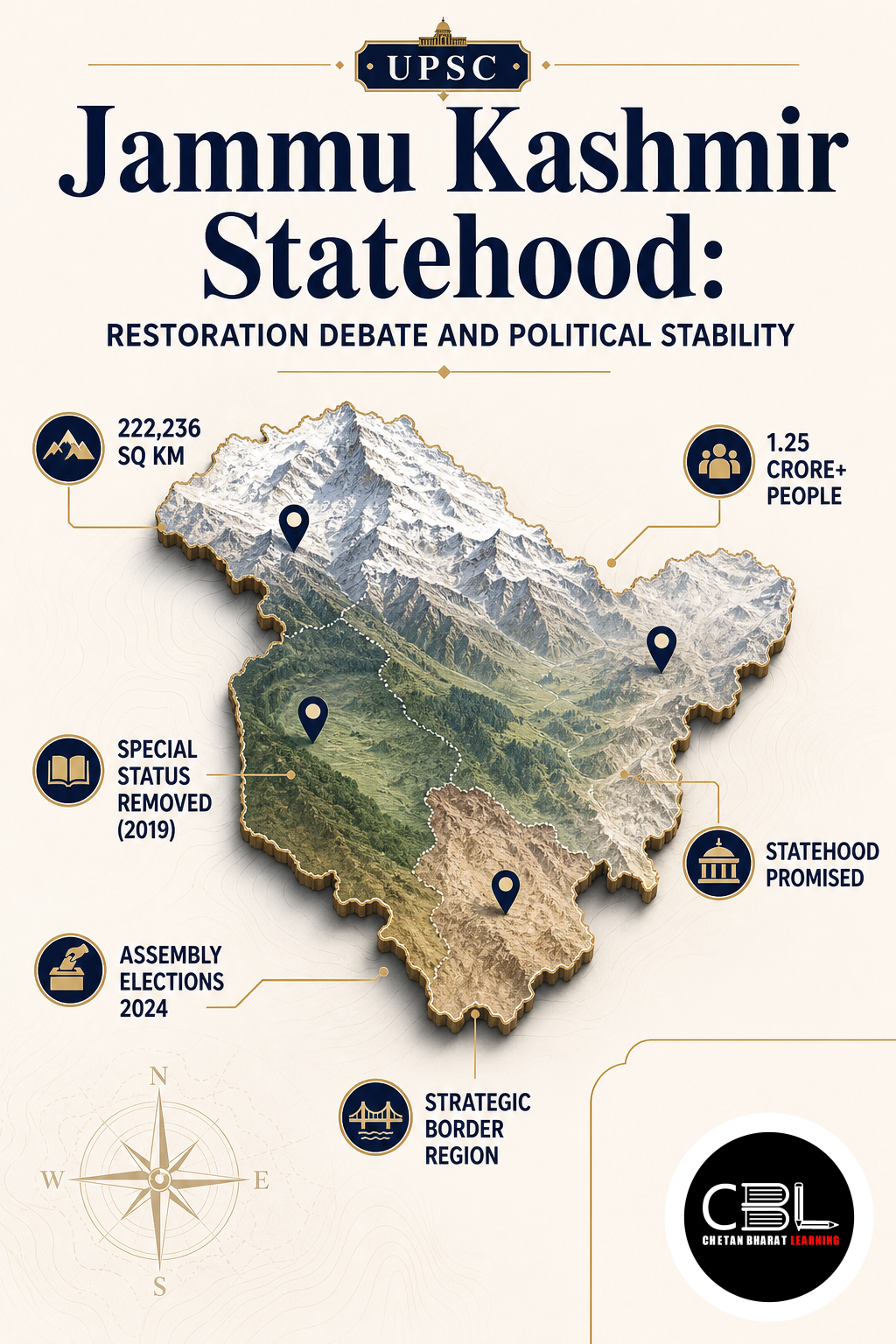
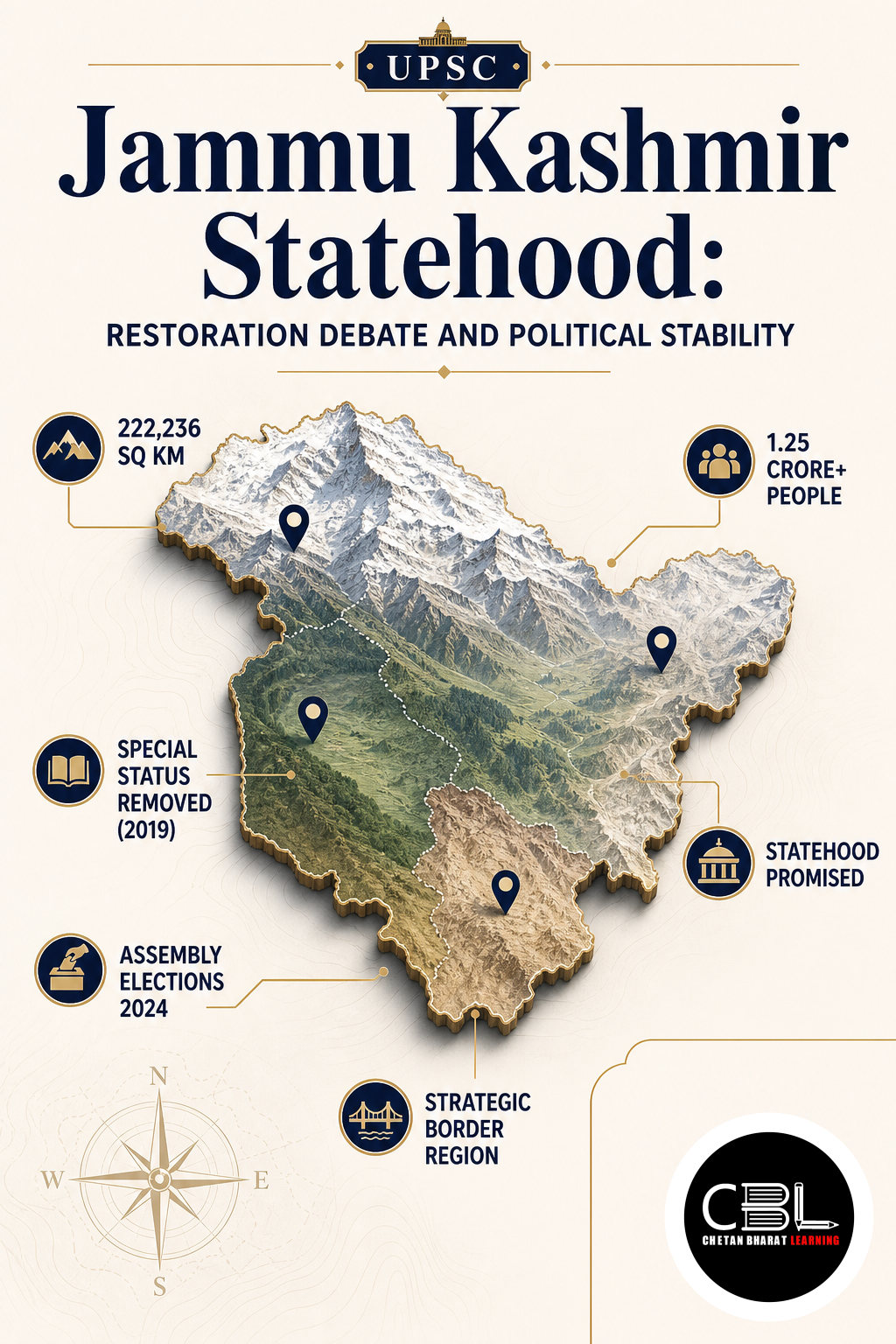
The Jammu Kashmir Statehood debate centres on whether the Union Territory status should be reversed and full statehood restored to the region. The 2019 reorganisation, which also revoked Article 370’s special provisions, has been a contentious issue in Indian politics, with various parties demanding restoration of statehood as a prerequisite for normalcy and political stability.
Proponents of statehood argue that the UT status limits the political autonomy and democratic representation of the region, while opponents point to security concerns and the need for administrative integration. The debate touches on core issues of federalism, democracy, and national integration.
Why is Jammu Kashmir Statehood in News?
The debate has resurfaced with the passage of the Kerala (Alteration of Name) Bill, rekindling discussions on statehood and reorganisation. Political parties in J&K have consistently demanded restoration of statehood, with some linking it to the conduct of fair elections and the return of democratic normalcy.
The Union Home Minister has indicated that statehood restoration is a matter of time, suggesting a possible timeline after the delimitation process and assembly elections.
Key Features of the Debate
- Reorganisation of 2019: Bifurcation into J&K with a legislature and Ladakh without one.
- Article 370 Revocation: Removal of special status, separate constitution, and flag.
- Delimitation Process: Redrawing of constituencies to pave the way for elections.
- Political Stability Argument: Statehood seen as key to democratic participation and development.
- Security vs Autonomy: Balancing national security concerns with regional federal autonomy.
Challenges in Restoration
- Security Concerns: UT status justified as a temporary measure for control.
- Ladakh’s Aspirations: Demand for its own legislature complicates the process.
- Timing and Process: No clear constitutional mechanism or timeline exists.
- Political Consensus: Requires support across political parties and Parliament.
- Economic Integration: Revisiting investment and development policies may be needed.
Way Forward
A phased approach is recommended: conduct assembly elections under the UT framework, build consensus with stakeholders, and commit to a time-bound restoration of full statehood. Safeguards for national security and recognition of Ladakh’s demands should accompany any decision.
Prelims Practice Corner
Q1. In which year was Jammu and Kashmir reorganised into Union Territories?
Answer: (b) 2019
Q2. Which UT was created without a legislative assembly?
Answer: (b) Ladakh
Q3. What was the status of Article 370 after the 2019 reorganisation?
Answer: (b) Revoked
Q4. What is the primary argument for restoring statehood to J&K?
Answer: (b) Political stability and democratic normalcy
Q5. Which neighbouring UT has also demanded statehood or greater autonomy?
Answer: (c) Ladakh
Mains Practice Questions
Q1. Discuss the constitutional and political implications of restoring full statehood to Jammu and Kashmir. (250 words, 15 marks)
- Intro: Frame the debate in the context of federalism and the 2019 reorganisation.
- Body: Explain constitutional provisions for state creation, debate pros and cons, and include the Ladakh dimension.
- Conclusion: Suggest a phased restoration with security and consensus safeguards.
Q2. What are the arguments for and against restoring statehood to Jammu and Kashmir? (150 words, 10 marks)
- Intro: Outline the two sides of the debate.
- Arguments For: Democratic normalcy, political stability, federal autonomy.
- Arguments Against: Security concerns, administrative control, potential unrest.
- Conclusion: A balanced, time-bound approach is essential.
FAQs on Jammu Kashmir Statehood
Why was J&K reorganised in 2019?
It was reorganised to enhance administrative efficiency, integrate security measures, and spur economic development; Article 370 was revoked to fully integrate J&K with India.
Does J&K have a legislative assembly now?
Yes, as a Union Territory it has a legislative assembly, but its powers are limited compared to full statehood.
What is the status of Ladakh?
Ladakh is a Union Territory without a legislature, directly governed by the Central government.
Related Current Affairs
Preparing for UPSC, PCS or HCS?
Talk to a mentor at Chetan Bharat Learning, Chandigarh. Free guidance on choosing the right exam and building a study plan.
Chat on WhatsAppCall 97793 53345UPSC / IAS / PCS coaching in Chandigarh · Trusted by aspirants across Punjab & Haryana
Leave a Reply
You must be logged in to post a comment.